Showing posts sorted by relevance for query nato. Sort by date Show all posts

Thursday, August 14, 2008

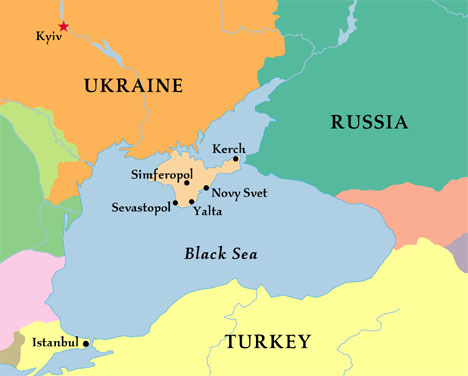
Crimea crisis looms

In the case of Ukraine, in particular, there was the thoughtless tossing into that country, upon the collapse of Russian communism, of the totally un-Ukrainian Crimean peninsula, together with one of the three greatest Russian naval bases. For that we, too, must accept a share of the blame. But even in this case, all the recent Russian aspirations have been limited to the alleviation of the effects of these blunders; they have not taken the form of any encroachments upon Ukrainian independence.

- George F. Kennan
The renowned US national security strategist spoke the above words in 1999, before Washington announced plans to admit former Soviet Republics such as Ukraine and Georgia into NATO. As Kennan observed, Russia's modest restraint was fortunate blessing, a circumstance which American leaders have taken for granted.

The first fallout of Western arrogance will be the integrity of Georgia. The second could be the status of the Crimean Peninsula in Ukraine.

In a bizarre twist of fate, Russia is presently forced to lease Sevastopol, the headquarters for its Black Sea Fleet, from Ukraine. But this lease is due to expire in 2017. Ukraine, which hopes to join NATO within the next decade, has declared it wants the Russian navy out of its country before the lease expires. Why is Russia in the position of having to lease Sevastopol from a former Soviet Republic? Der Spiegel reports:
In 1954, the USSR’s Nikita Khrushchev handed the Crimea -- long a favorite holiday spot for Communist party brass -- to the Ukrainian Soviet Socialist Republic to mark the 300th anniversary of Russo-Ukrainian unification. It was little more than a symbolic gesture until the Soviet Union collapsed in 1991, which left Crimea a part of a newly independent Ukraine.

During the course of a number of interviews in Crimea, many people said they often feel like persecuted minorities: The state doesn’t recognize Russian as an official language, and Ukrainian schools have been steadily squeezing out Russian ones across the peninsula. There is little feeling that Kiev is listening, while Russia offers €6 million for social programs in Crimean cities, according to local news reports.

The population of the Crimean is largely Russian-speaking, they feel persecuted, and the territory is a historic part of Russia since 1783. Talk about expanding NATO to include Ukraine and possibly even Georgia has -- not surprisingly -- deeply offended Russian sensibilities both in the Crimea and throughout Russia.

Despite the fact that Western diplomats profess otherwise, Ukrainians, just like Georgians (and Poles, Czechs, Hungarians, and citizens of the Baltic States), look upon NATO memerbship primarily as a defense bulwark against Moscow. Understandably. As its membership grows, NATO incrementally becomes more anti-Russian if only because that's how each new member tends to view it. Is it any surprise that Russia objects to the encroachment of NATO to its very borders?

Equally, we should not be astonished, if, in the not-so-distant future, Russia moves to reclaim the Crimean peninsula.

Not only have NATO expansion plans proved insulting to Russia. NATOs expansion strategy brings no additional security benefits the citizens of the original NATO countries. Rather, NATO enlargement is a gift to the Euro-American defense industry. That's because new NATO countries are required to upgrade their forces to NATO standards (abandoning old Russian-made weapons, buying French, British and American ones instead, hiring contractors like Haliburton to upgrade bases, etc.). Like the overtures toward Georgia, the plan to bring Ukraine into NATO reeks of foolish opportunism.

Russia is poised to put its foot down in the Crimea. When the seemingly inevitable happens, we should remember that the Crimea has been a Russian possession since 1783. We should also keep in mind what precipitated the crisis.

NATO expansion map legend: Current member (blue) Acceding members (light blue) Promised invitation (green) Intensified Dialogue (turquoise) Membership not goal (red) Undeclared intent (grey).
Maps: Archaeology.org, Wikipedia NATO

Monday, August 18, 2008

George F. Kennan on NATO expansion


What did the late George F. Kennan, former US ambassador to the Soviet Union, and architect of America's fifty-year-long "containment policy" have to say about NATO expansion to the borders of Russia? Kennan wrote:
(E)xpanding NATO would be the most fateful error of American policy in the entire post-cold war era. Such a decision may be expected to inflame the nationalistic, anti-Western and militaristic tendencies in Russian opinion; to have an adverse effect on the development of Russian democracy; to restore the atmosphere of the cold war to East-West relations, and to impel Russian foreign policy in directions decidedly not to our liking.

More recently, Henry Kissinger, proponent of NATO expansion to include the states of Soviet-dominated Eastern Europe, warned against further NATO expansion:

Confrontational rhetoric notwithstanding, Russia's leaders are conscious of their strategic limitations. Indeed, I would characterize Russian policy under Putin as driven in a quest for a reliable strategic partner, with America being the preferred choice ... But the movement of the Western security system from the Elbe River to the approaches to Moscow brings home Russia's decline in a way bound to generate a Russian emotion that will inhibit the solution of all other issues. It should be kept on the table without forcing the issue to determine the possibilities of making progress on other issues.
Earlier in 2008 the US Senate passed the NATO Freedom Consolidation Act of 2007. John McCain co-sponsor off the bill, which authorized the United States to invite Georgia and Ukraine -- former Soviet Republics -- into NATO. It passed unanimously in the United States Senate.

Stalin biographer Richard Lourie wrote a commentary on NATO expansion back in 2006 in which he concluded: "There’s still plenty of time for Kennan to be right." It looks as if that time is at hand.

Hat-tip: Belgravia dispatch

Friday, August 15, 2008

Why might Russia feel encircled?

"NATO leaders agreed that Georgia would become a member of the Alliance."
- April 2008, NATO

"NATO and Azerbaijan approved an updated version of their Individual Partnership Action Plan" - 7 March 2008, NATO

"Warsaw and Washington signed a preliminary deal Thursday on basing part of a US missile shield in Poland, in the face of Moscow's vehement opposition and mounting East-West tensions over Georgia."
- August 14, 2008, AFP
How might recent actions of the United States and NATO have been perceived by the Russians? How about we attempt to view Russia's security problem from a Russian perspective. We might consider the fact that Russia has borders not only with bitter former allies seeking NATO membership (and weapons modernization), but also China, Japan, and North Korea. Iran is located to its South, across the Caspian Sea. In stepping into Russian shoes, we might also consider the threats and challenges the Russians have faced in the not-so-distant past -- as George Kennan observed:
Since the Thirty Years' War, no people, I think, have been more profoundly injured and diminished than the Russian people have been by the successive waves of violence brought to them by this past brutal century. There were: the Russian Japanese War of 1904-1905; the fearful manpower losses brought about by Russia's participation in the First World War; the cruelties and the fighting that were a part of the consolidation of Communist power in the immediate aftermath of that First World War; then, the immense manpower losses of World War II; and finally, extending over some seven decades and penetrating and in part dominating all these other disasters, there were the immense damages, social, spiritual, even genetic, inflicted upon the Russian people by the Communist regime itself.
Add to all this, the fact that Russia's population is actually declining, the epidemic alcoholism, staggering economic inequalities. We might consider the challenges Russia faces from Islamic extremists and various secessionist movements. Indeed, consider the tenuousness of the Russian Federation's hold over its constituent republics. Finally, we should consider the relative size of the US defense budget compared to that of Russia ($600 billion Vs $40 billion); not to mention the relative size of Russia's population in the East compared to that of China.

If you all this up -- and consider the many areas in which Russia's cooperation is vital -- does the way the West approaches Russia make any sense? By what criteria did Western leaders decide that policies such as missile defense and the expansion of NATO were more important than building strong relations with Russia?
___-
Drawing: hat-tip AKM

Friday, September 12, 2008

She's nuts

Daily News reports on Palin's interview with ABC:
Palin's comments went further than GOP presidential nominee John McCain on the war option if Georgia or Ukraine is invaded by Russia, a nuclear power.
Here are her exact words:
GIBSON: Would you favor putting Georgia and Ukraine in NATO?

PALIN: Ukraine, definitely, yes. Yes, and Georgia.

GIBSON: Because Putin has said he would not tolerate NATO incursion into the Caucasus.

PALIN: Well, you know, the Rose Revolution, the Orange Revolution, those actions have showed us that those democratic nations, I believe, deserve to be in NATO.

Putin thinks otherwise. Obviously, he thinks otherwise, but...

GIBSON: And under the NATO treaty, wouldn't we then have to go to war if Russia went into Georgia?

PALIN: Perhaps so. I mean, that is the agreement when you are a NATO ally, is if another country is attacked, you're going to be expected to be called upon and help.

Here's the video.

Wednesday, June 10, 2009

What kind of bear is Russia?

Jotman's live-blogging of the International Press Institute (IPI) World Congress in Helsinki continues...

A changing situation means new chance. Let's take a chance to make a new detente as has been made in Helsinki many years ago.

- Anatoly Adamishin

I met CNN anchor Jim Clancy at the Helsinki International Airport. Jim would be moderating the upcoming panel discussion on Russia at the IPI World Congress.

"I like to break these things up," Jim said as he hailed a cab. "Grab a mike, walk around the room. Make the audience part of the discussion." Jim added, "I don't want the speakers to drone on, putting everyone to sleep -- bor-ing!"

Jim's panel would be
anything but boring.

The panelists included:
  • Anatoly Adamishin, former USSR ambassador to the UK; as ambassador to Italy he first worked for the USSR and finished up his term as Russian ambassador.
  • Edward Lucas, Eastern European correspondent for The Economist.
  • Brahma Chellaney, whom the IHT refers to as "one of India's top strategic thinkers."
As a Finnish taxi driver opened the back hatch and loaded our bags, arranging them neatly, Jim told me it had not been easy to get in touch with Anatoly Adamishin.

"I hope that the Russian ambassador doesn't think I chose the title because I didn't," Jim said.

I knew what Jim meant. This is how the panel had been described in the literature:

“The Bear on the Doorstep – Russia’s Resurgence and the Start of a New Cold War?”

A natural gas pricing dispute that left vast parts of Central and Eastern Europe in the cold; a five-day war with Georgia to defend the rights of Russian citizens living in separatist enclaves; and threats to do the same in other areas – is Russia trying to restore some of its former status, or is this a sign of a possible new Cold War?

As it happened, I had lunch with Anatoly Adamishin just prior to the panel discussion.

"I notice the topic refers to the 'resurgence' of the 'Russian bear,'" I said. "Should we all be afraid of the bear?"

"The bear is relaxing now" Adamishin replied.

We finished our lunch and made our way to the conference room of Finlandia Center -- site of the 1975 Conference on Security and Co-operation in Europe which gave rise to the Helsinki Accords. The setting of such an historic meeting -- one which would improve
relations between the Communist bloc and the West -- seemed a fitting venue for this panel discussion.

Jim Clancy
: The big question today -- if you're a journalist -- is: Who's in charge of Russia?

Edward Lucus: If there was an election today in Russia, Putin would win. Seventy percent believe Medvedev follows Putin, does whatever Putin wants.

A law going through the Duma will criminalize any challenges to a pro-Stalinist version of history.

Brahma Chellaney: The big picture is that Russia is the world's wealthiest country in terms of its natural resources. And we don't know its future direction at the moment.

Anatoly Adamishin: Don't keep a bear until he's filled up. If you want me to speak about Russia's internal situation, I may tell you Russia is without democracy. Why? Small demand for it. Why? Many reasons. First is historical. Second, ruin of the 90s connected to the democracy under Yeltsin.

Russians enjoy three freedoms. First is to make money; second is travel abroad; third is to pray to God. They are so busy enjoying these freedoms they don't think about political liberties. There has been an increase from 200 billion to 1.7 trillion in GDP under Putin -- eight times!

Jim Clancy: Here's a statistic: 80% have no responsibility for what goes on in their country.

Edward Lucas: Sure living standards have gone up, but investment in infrastructure has lagged. Media is under control of the Kremlin and media doesn't ask the embarrassing questions: when money getting skimmed off this doesn't make it into the press.

Jim Clancy: Roots of Animosity to the West?

Brahma Chellaney: The West has been turning a blind eye to the effects of NATO enlargement [Jotman: see here and here]; the West ignored Russian opposition to Kosovo independence, making it awkward to oppose similar right of self-determination in South Ossetia.

Jim Clancy: Is there freedom, today?

Anatoly Adamishin: There were 300,000 functionaries in USSR; but there are 3,000,000 in Russia today. I like to tell this story about first year after civil war during the 20's. Will life win over socialism or socialism win over life? That was the question then. Socialism won then, but life became a bit lousy. Now I fear that bureaucracy could corrupt the rising energy and entrepreneurship of young Russia, the Internet. Will the bureaucracy squeeze out the dynamism? (Will bureaucracy win over life, or life win over bureaucracy?)

Jim Clancy: What's happening to press freedoms?

Edward Lucas: Some of my (Russian) friends are dead because they pushed press freedoms too far. Billions came in from West, little of it reached people who needed it.

Although the 90s were corrupt, at least there was scrutiny of the government by the press. Each oligarch had its own television station. Even Putin could be ridiculed.

Putin didn't just take television stations away from oligarchs; he gave them to his friends.

Brahma Chellaney:
A comparison of Russia to Singapore and Malaysia is in order. The West doesn't criticize these one-party states to the same extent. Why not? Because they are close to the West. But you find many of the same restrictions as in Russia, it's not really any worse.

Anatoly Adamishin: We need Western cooperation. We don't have the money to modernize Russia on own own. We can't rely on China.

Edward Lucas: At Davos Putin was approached by Gates or Jobs. Putin replied to Gates or Jobs "go away." (Implication was that Putin thought Russia didn't need their help.)

We must not allow weak countries to pay the cost. Thank goodness we brought the Baltics into the country. I'm sorry Russia doesn't want to join NATO....

Question by Tina of Russia Today Television: Do you think just easier to have Russia as enemy simply because the West needs an enemy.

Anatoly Adamishin: I don't like NATO. Because it's a a military alliance. Because the US plays the main role. If you are outside Russia then you can be part of NATO. NATO is a military alliance that fought in 1999 over Serbia, and now makes war in Afghanistan.

Why is it that Russia disagrees with NATO? We disagree just because we don't want to be left out. When we are out and everyone else is in, then we don't like it. I would say the so-called "imperial dream" is -- from a practical point of view -- out of sight. We have to live within our means. Our neighbors shouldn't be afraid. The imperial project is too big; our people in the government too practical. Can't do business along with this (imperial) project.

Brahma Chellaney: Three pillars of the world: China, EU, and US.

Russia is the most important swing state in world. More so than India or China. Russia truly is the wildcard. A wrong policy choice on Russia by the West can push Russia inexorably in the wrong direction.

In early July Obama will be in Moscow. US going slow on missile defense in E Europe. Can US and Russia redefine relationship?

Anatoly Adamishin: The US must not treat Russia's neighbors as if Russia did not exist. Ethnic conflicts in Georgia have long history. The borders were drawn by Stalin -- a Georgian. Failure of the USSR caused turmoil. Georgians tried to settle ethnic conflict by military means. Four and a half wars. Mikheil Saakashvili (talked?). There were solutions. [Jotman: see my Georgia-Russia conflict timeline]

Georgians, armed by Americans, said 'we are not afraid of Russia.' I believe war was linked to two factors: First, (it was assumed that) Russia wouldn't have courage; second, (the intention to launch) a blitzkrieg war, aimed drive Russia out of South Ossetia. If Russia didn't respond, Russia would have lost its authority in all of the region. No country would tolerate it. Not the US, and certainly not Britain with respect to the Falklands.

Edward Lucas: (Didn't agree.) The time frame is the problem. Increased shelling by Russia of villages loyal to Tbilisi -- (that's what caused Tbilisi) to send troops north.

Jim Clancy: Russia's neighbors are afraid. Why?

Brahma Chellaney: Russia, with its enormous size and clout, is able to exploit political instability in the neighborhood.

Dutch journalist: You still think Russia should have veto power over its neighbors?

Anatoly Adamishin: Kosovo was a bad precedent. A very bad precedent for our Caucus. That was the provocation. Who was first to provoke, etc.

Now Caucuses people live well in Moscow. One million Georgians work in Russia. Big source of money for Georgia. Many Ukrainians work in Russia too.

Jim Clancy: How many journalists think Russia poses a danger to its smaller neighbors?

Nigerian journalist: (Alleges Gazprom is involved in espionage in Nigeria - that the company has exerted heavy pressure on the Nigerian gas industry.)

Anatoly Adamishin: I'm not here to defend my government. I am not on their pay list anymore.

Russia's decline is the story of volatile oil prices. Higher prices mean less pressure to diversify economy.

Edward Lucas: If "inside Russia" breakaway is bad, why "outside" breakaway good? Econo -- history lessons. Google for the Youtube video "Putin Estonia" Shocking!

Development, define broadly, includes press freedom, civil society

Anatoly Adamishin: Blame is on both sides, common enemy: first, after the cold war; second, after 9/11. We missed 2 chances. Now we have a third chance.

A changing situation means a new chance. Let's take a chance to make a new detente as has been made in Helsinki many years ago.

Brahma Chellaney: The world cannot afford a new cold war. Don't bait a bear. For example, China has come a long way since 89. The decision not institute trade sanctions has (proved successful). Had the Burma sanctions approach been applied to China in '89, a more poor, more destabilizing China would have likely have resulted.

Edward Lucas: That question from the Nigerian journalist was important. It concerns Europe sleepwalking to disaster on energy. Europe won't build the pipeline it needs and wants. Europe should treat Gazprom as it treats Microsoft. Its far worse than Microsoft. Russia has to play by the rules. Though lots don't.... Must clean up financial system -- it is used and abused by corrupt. This will hit the Kremlin ...

Anatoly Adamishin: My prediction? If Russia enters the WTO at the end of this year, then there will be no cold war.
____
Photos by Jotman (from top down): no sooner had the conference came to a close than Helsinki was invaded by Russian football fans; Clancy speaks with Adamishin after the conference; Clancy with Chellaney in the background; Clancy has handed the mike to a journalist in the audience; Adamishin and Lucas spar (2 photos); Chellaney, the dispassionate; a Russian football fan in Helsinki; a Nigerian points a finger a Gazprom; Chellaney speaks as Lucas looks on.

__
I asked Russian Jotman reader Sanjuro, who comes from Sibera, to share his reflections on to the discussion. These reactions are outlined in several posts:

Jotman live-blogged the following panel discussions at the IPI World Congress:

Saturday, August 23, 2008

Who is Randy Scheunemann?


There something about the behavior of some Americans in the lead-up to the recent crisis in the Caucasus that stinks. I have touched on it in a number of posts. Now someone has nailed it.

In this previous post, I quoted from a Washington Post article that discussed the business activities of one Randy Scheunemann. That article left readers with a big question that begged to be asked far more emphatically: Who the hell is this man? To his everlasting credit, Pat Buchanan returns to the question, and then gives the answer the emphasis it deserves. The answer is disturbing:

Who is Randy Scheunemann?

He is the principal foreign policy adviser to John McCain and potential successor to Henry Kissinger and Zbigniew Brzezinski as national security adviser to the president of the United States.

But Randy Scheunemann has another identity, another role.

He is a dual loyalist, a foreign agent whose assignment is to get America committed to spilling the blood of her sons for client regimes who have made this moral mercenary a rich man.

From January 2007 to March 2008, the McCain campaign paid Scheunemann $70,000 -- pocket change compared to the $290,000 his Orion Strategies banked in those same 15 months from the Georgian regime of Mikheil Saakashvili.

What were Mikheil's marching orders to Tbilisi's man in Washington? Get Georgia a NATO war guarantee. Get America committed to fight Russia, if necessary, on behalf of Georgia.

Scheunemann came close to succeeding.

Had he done so, U.S. soldiers and Marines from Idaho and West Virginia would be killing Russians in the Caucasus, and dying to protect Scheunemann's client, who launched this idiotic war the night of Aug. 7.
By putting Scheunemann in in charge of his foreign policy team, surely McCain has proven -- among other things -- that he is simply not smart enough to be President.

Later in the piece, Buchanan asks:
. . . .what are McCain, Barack Obama, Bush, and German Chancellor Angela Merkel doing committing the United States and Germany to bringing Georgia into NATO? For that would commit us to war for a cause we have already conceded, by our paralysis, does not justify a war.
That's also a good question. This is the second outstanding article by Pat Buchanan I have read in relation to the Russia-Georgia conflict (a Jotman reader refers Buchanan's earlier article in Comments).
__
Hat-tip Sullivan, photo shows Randy Scheunemann at the NATO summit in Latvia in 2006. I the above-quoted article, Buchanan also discusses how Scheunemann was instrumental in bringing the former Baltic Republics into NATO.

Saturday, August 16, 2008

Scheunemann: McCain foreign policy advisor

The Washington Post reported that McCain's top foreign policy advisor, Scheunemann, was acting as a paid consultant to Georgian President until quite recently.
On April 17, 2008, McCain spoke on the phone with Georgia President Mikheil Saakashvili about Russian efforts to gain leverage over two of Georgia's troubled provinces. That same day, McCain issued a public statement condemning Russia and expressing strong support for the Georgian position. Also on that same day, Georgia signed a new, $200,000 lobbying contract with Scheunemann's firm, Orion Strategies. [...]

The contacts often focused on Georgia's aspirations to join NATO and on legislative proposals, including a measure co-sponsored by McCain that supported Georgia's position on South Ossetia, one of the Georgian regions taken over by Russia this weekend.

Another measure lobbied by Orion and co-sponsored by McCain, the NATO Freedom Consolidation Act of 2006, would have authorized a $10 million grant for Georgia.

The NATO Freedom Consolidation Act of 2006 was co-sponsored by McCain, and it opens the doors to the admission of the former Soviet Republics Ukraine and Georgia into NATO.

Monday, November 17, 2008

Ukraine bans Russia-Georgia war documentary

InfoRus reports, "The Ukrainian Security Service (USS) banned Russian documentary film “War 08.08.08 The Art of Betrayal” claiming that it may provoke riots."

Yes, Ukraine which is supposed to be on track to eventually become a NATO member, is banning documentary films. In the US leaders have taken a different approach to the obscuring the truth about the conflict known as the Georgia-Russia war.

I just finished watching the banned Russian documentary, which is available in English on Youtube. It's not particularly controversial. Recent reports in the BBC and the New York Times suggest that Russian aggression was not the cause of the conflict.

Although Barack Obama's initial response to the hostilities had been measured and balanced, during each of the three presidential debates the Change Candidate embraced McCain's point of view that the war was entirely Russia's fault. Let's hope the shift was mere campaign tactics. In Washington D.C. last week, French President Sarkozy repeated the myth of Russian "aggression." It's the fear that a recent cover of Foreign Affairs propogates: that Russian aggression desperately needs to be "checked." So what are the Russians going to do next, invade France?

One thing is certain, the image of a Russian bear on the move in Europe is a marketing bonanza for defense contractors. To keep NATO growing you need to build a lot more big equipment: big ships, big bases, big planes. It sure helps if the Russians look like trouble.

Not only was it the Georgians who started the war, but the Russian intervention appears to have served a legitimate humanitarian purpose. It seems Georgian forces perpetrated war crimes against the people of South Ossetia.

Some points raised in the video:
  • Evacuation of women and children from South Ossetia villages three days prior to Georgian attack.
  • Role of Ukraine in arming the Georgians. A conduit for US and NATO supplies?
  • Firing at homes, cars and civilians, which has been documented by the BBC and Human Rights Watch, among others.
  • A network of deep trenches built above the city in weeks prior to the attack. Apparently
  • people knew about the trenches and fortifications, but there was no reaction from the European observers in the OSCE
  • 127 advisors from US defense department working in Georgia at the time.
  • August 27: 1,000 American soldiers took part in Geogian-US military exercises.
  • Attacks by Saakashvili's government killed 66 Russian peacekeepers, 1692 Russian citizens. Russians call it a "crime against Russia."
The film was made by Russians, and is obviously pro-Russia. But I do not like it when a film like this gets banned. And especially I do no like it when the US political class and media choose to disseminate an outright distortion of events-- turning myth into public opinion -- as has so obviously happened in this case. Make no mistake, the official US posture concerning the Georgia-Russia conflict is at once a fraud, a sham, and a breathtaking act of hypocrisy.

You can watch the Russian documentary here.

Saturday, September 6, 2008

Russia calls it aggression, Wall Street calls it growth

Thursday night John McCain informed Americans that Russia appeared to be "reassembling the Russian Empire." Resolved to poke the old bear in the eye, CNN reports that today the US
has backed Ukraine's bid for NATO membership a day after similarly supporting Georgia, in a move which may further stoke tensions with Russia.
Anyone who knows anything about Russian history knows that the expansion of NATO into onto the territory of the former Soviet Union is likely to be perceived as "aggression" by the Russians.

What Russia calls NATO aggression, Wall Street calls growth. I noticed that the stock of the world's number three defense contractor, Northrop Grumman, climbed in trading Friday after Dick Cheney gave the Ukrainians some bold new assurances.* Northrop Grumman, for example, does not only merely make the weapons of war, it actually tries to define US national security requirements (see this post).

Back in early August, at least one Wall Street analysts had seen what was coming:
"No less than the Soviet invasion of Afghanistan in 1978, [the] events of the past several days are a bell-ringer for defense stocks," said Paul Nisbet, an analyst with JSA Research, an aerospace equity research firm. "We strongly urge purchase of aerospace/defense issues, a sector which has declined with the broad market since the start of the year."
__
* Cause and effect? We have no way of knowing what actually caused NOC to rise in early trading Friday (see chart). Some defense industry stocks went down. Rather more clear to me is the observation that the long-term prospects for the US defense industry improve with the worsening of US-Russia relations. Companies like Northrop Grumman build a lot of Cold War-era weaponry; without an escalation in tensions between the US and Russia -- or China -- the future of their industry would not look so bright.

Tuesday, August 19, 2008

Europe's lame leaders

A lot has been written about the inability of the US Democratic party go against the will of George W. Bush, despite the fact that the Democrats control Congress.

As it turns out, America's European allies have also, by and large, continued to follow the hapless American president. The New York Times reports:

On April 3, the night before the NATO summit meeting in Bucharest, Romania, Mr. Bush attended a dinner with European leaders and annoyed the Germans and French by lobbying long and hard for Ukraine and Georgia to be welcomed into a Membership Action Plan that prepares nations for NATO membership.

Mr. Bush lost that battle, but won two others the next day that would anger Russia: NATO leaders agreed to endorse a United States missile defense system based in Eastern Europe, and the Europeans said invitations to the membership plan for Georgia and Ukraine might come in a year, at the next summit.

Why, despite serious misgivings, did European leaders give Bush most of what he wanted?

Nevertheless, on the basis of remarks made to Der Spiegel, at least the former German Chancellor Gerhard Schröder gets it.*

h/t: Tharoor

Wednesday, June 24, 2009

Does Russia sincerely hate the West?

At Davos Putin was approached by Gates or Jobs. Putin replied "go away."

- Edward Lucas

The West has been turning a blind eye to the effects of NATO enlargement [Jotman: see here and here]; the West ignored Russian opposition to Kosovo independence, making it awkward to oppose similar right of self-determination in South Ossetia.

-Brahma Chellaney
What kind of bear is Russia? JOTMAN.COM recently traveled to Helsinki to answer that question. Jotman live-blogged an encounter between former Russian ambassador Anatoly Adamishin, The Economist's European correspondent Edward Lucas, and Indian foreign affairs expert Brahma Chellaney, moderated by CNN's Jim Clancy.

The other day, we asked Russian Jotman contributor Sanjuro, who comes from the Russian Far East, to share his reflections on the discussion (this is part 1).
As I see it now, in hindsight, Russians had no problem with the West - whatsoever. Even the NATO bombings of Serbia did little to change the attitude. The energy policy wasn't never in the agenda. The rise of racism and xenophobia also had little to do with the external relations - it was largely a reaction to the increased migration from the former Soviet republics.

I am totally subjective in this very rough interpretation, but I believe that in 1999-2000 Putin and Co. saw some very tentative conditions to propel their candidate to power, and to keep him there. Anti-Americanism, anti-Westernism were not a commonplace attribute at the end of the Yeltsin's term, they were simply wiped up to create favorable conditions for Putin's two terms.

This was done skillfully, and/but in complete awareness of the Russian people inherent apoliticism. Because, quite frankly, most of the Russians will "believe" whatever they are told to believe, but in reality they will not give a damn about it. I am pretty sure, if Medvedev - or whoever - goes on TV tomorrow and says "Americans are our best friends and have always been", they will start waving US flags, not without a vague expectation of some benefit, but also without much mental involvement in the process.
This is the second part of a series featuring reactions to "What kind of bear is Russia" -- our live-blog of the 2009 IPI World Congress panel. Don't miss Part 2 "Could Putin's new goal for Russia be liberal democracy" and Part 3 "Should Europe get tough with Russia?"

Saturday, September 27, 2008

Why Obama lost the debate with McCain

I jotted out the following during the last ten minutes of the debate:

McCain has far exceeded my own expectations for his performance in this debate. He sounded remarkably convincing and knowledgeable. Except for when the topic was the economy, my mind more often wandered while Obama spoke. It was as if I did not feel I would miss anything by not paying too close attention to Obama's thoughts about foreign policy. Obama seemed to agree with McCain about a lot of things.

Surprisingly, I actually thought McCain's statements about Pakistan and Afghanistan were reassuring. I disagree with McCain about staying in Iraq. I disagree with McCain's stance concerning Iran. But I'm not convinced we need an escalation in Afghanistan -- something Obama seems to want. I thought McCain's retort that Obama has not spent enough time in Northwest Pakistan and Afghanistan was strong.

Obama may have made a major mistake by (retroactively) adopting -- verbatim --- McCain's position on Russia. Obama has made it clear to everyone tonight that he supports McCain's belligerent stance vis a vis Russia. Obama backs the provocative Western plan to invite Georgia and Ukraine into NATO. Although arguably it is an important position he would want to maintain as a bargaining chip. Maybe Obama is just realistic; he assumes he does not have the credibility to shift the neocon-directed foreign policy concensus during a campaign. (Note: I blogged about NATO expansion here and here).

Having said that, I'm more convinced than ever that McCain is scary; that the McCain-Palin ticket must not be elected to the presidency. Towards the end of the debate McCain raised the specter of Russian aggression in the Crimea (I recently blogged about this prospect here). McCain's defiant stance regarding the Crimea is more frightening to me than his policy on Iran. Why? Because Russia has a very strong claim to the Crimea. I think if McCain wins -- a prospect which increased tonight -- relations among major global powers could well turn as erratic -- therefore tense and nerve-racking -- as this crazy election campaign.

Obama came across better in the earlier part of the debate which concerned the financial crisis, yet stopped short of delivering a knockout blow on that front. It looks like Obama will have to win this election on the economy.

In search of Sarah Palin's leadership qualities

The American blogosphere is buzzing about the horror that is Sarah Palin as revealed in the Couric interview. James Fallows presents one of the best analysis I have read of that dismal performance. And Fallows is frank and sweeping about what he thinks it tells us about the candidate. In his long career as a journalist, he claims to have met only three other politicians so empty-headed. Fallows highlights a passage that is scary partly because it echoes other spooky things she has said:
COURIC: If this [Wall Street bailout plan] doesn't pass, do you think there's a risk of another Great Depression?

PALIN: Unfortunately, that is the road that America may find itself on. Not necessarily this as it's been proposed has to pass or we're going to find ourselves in another Great Depression.
James Fallows blogs:
There is no sign, listening to Palin, that she has any idea of what another world depression might mean, how loaded a term "another Great Depression" is, how this relates to what John McCain or her Republican party is saying and doing, or anything else involving public finance.

I submit: no one could have read a novel (Grapes of Wrath), seen a movie (Cinderella Man, to choose an easy one; or Annie, or Of Mice and Men or Bonnie and Clyde or All the Kings Men or They Shoot Horses Don't They), or read any history book about the Great Depression and have said these things. Implication: Sarah Palin has never seen or read, or never absorbed, any such material.
Fallows goes on to note that Palin is most certainly not the intellectual equal of President Bush. "George W. Bush is in a completely different and superior league to what we've seen from Palin."

Fallows' comments reminded me of what had struck me most about Palin's response to the "Great Depression" question. That is, I was shocked by how similar in expression her answer was to a question asked of her by Charlie Gibson of ABC:
GIBSON: And under the NATO treaty, wouldn't we then have to go to war if Russia went into Georgia?

PALIN: Perhaps so. I mean, that is the agreement when you are a NATO ally, is if another country is attacked, you're going to be expected to be called upon and help.
It is almost as if Sarah Palin might have no more knowledge of the era known as the "Cold War" -- during which time Russia acquired its nuclear arsenal -- than she evidently has about the complexities of the "Great Depression" period. From what we have seen, it is fair to say that Sarah Palin most likely lacks the ability to put major contemporary world historical events into any kind of larger context -- except perhaps, a pseudo-Biblical one.

Needless to say, such a person lacks a leadership quality indispensable to any American vice-president.

Thursday, August 13, 2009

The real reason Thailand will not extradite Victor Bout to the US

Jotman readers J-P and RM, noting my apparent indifference to the outcome of the trial of the notorious arms dealer Victor Bout in Thailand, have commented on the need for Victor Bout to be brought to justice, expressing dismay at the outcome of the trial (described in the previous post).

The statement that "Bout should face justice" is something that I completely agree with in principle.

Saddam Hussein was another person many of us thought should face justice.

Behind both cases a deeper question loomed: Whose justice? Are we talking about American justice or international justice? The basic question is the same, whether it is Saddam Hussein or Victor Bout we are talking about.

And the matter before the Thai court, of course, was whether or not to extradite Bout to the US -- where he would face American justice.

Should Bout have been extradited to the US, this might have seriously set back US-Russian relations at a time when Obama seems to want to set the relationship on a new course. At the very least, it would have put the new US administration in an awkward position. Therefore, whatever the US government might have being saying out loud (the tough talk), I wouldn't be surprised if, privately, the Obama Administration had not given the nod to the Thais that they need not extradite Bout.

Let's look at it another way: if, as Obama claims, the US government has too many important things on its plate to bother investigating Bush Administration war crimes, then surely the last thing the White House needs is a high-profile trial of a semi-retired Russian merchant: a trial sure to create diplomatic trouble with Moscow, complicating Obama's "fresh start" foreign policy agenda.

Recall that by 2008, the Bush Administration seemed hell-bent on roughing up Russia's feathers: NATO expansion, military advisers in Georgia, independence for Kosovo, missile defense for Eastern Europe, etc. The DEA's capture (the Russians claim "entrapment") of Victor Bout in Bangkok can viewed as part and parcel of a high-handed approach to dealing with Russia. By contrast, the Obama Administration has shown clear signs of wanting to turn over a new leaf. We saw that in early July with the Obama-Medvedev nuclear agreement.

So international justice for Bout, yes. I'm all for that. In fact, according to Oxfam, the UN is negotiating an "Arms Trade Treaty" that would "help regulate arms dealers and make it harder for them to break embargoes." Hopefully in the future, the likes of Victor Bout could be brought before an international court. I agree with the UK-based NGO that the urgent need for a treaty regulating the arms trade should be the enduring lesson of this week's acquittal of Victor Bout in Bangkok.

As they say "justice must not only be done, it must be seen to be done." As the case before the Thai court concerned whether Bout should receive American justice, the question too few Americans asked back in 2003 needed to be asked again: justice toward what ends?

If the cost was going to be a setback in Russian-US relations, then I would say "getting Bout" was not worth it. Moreover, I think Obama's new approach deserves a fair go and warrants a clean slate.

Saturday, May 17, 2008

France sends FSS Mistral to Burma

Updated 2:00am Sunday 18 May

On Saturday France moved one very impressive piece of rescue equipment offshore the Irrawaddy Delta. CNN reports:
French defense and foreign ministry officials said the FSS Mistral, carrying 1,500 tons of food and medication, was expected reach Myanmar "sometime Saturday." They said the French government was "still in negotiations," even though the junta has so far refused to give authorization for it to dock, either in the delta or in Myanmar's largest city, Yangon.

. . . the Myanmar government asked the French to airlift the material through Yangon, "which of course is a nonsense," (France's U.N. ambassador) said. . .

"We have small boats which could allow us to go through the delta to most of the regions where no one has accessed yet," he said. "We have small helicopters to drop food, and we have doctors."

In Yangon, news of the approach of the French ship created an excited buzz among residents who were phoning each other to ask how far the ship was and when it would arrive.
The above CNN report, which has just been updated, provides more details about the mission:

The ship was conducting joint exercises with the Indian navy when it was diverted to deliver aid under so-called Operation Orcaella -- named after the Latin name of a dolphin that lives in the fresh waters of the Irrawaddy delta, he said.

Le Mistral, with some 360 crew on board -- including five doctors -- is carrying the equivalent of 30 planeloads of material, he said.

Ideally, Le Mistral would ferry the aid up the waterways of the flooded Irrawaddy delta using two smaller boats aboard the ship and hand it to humanitarian workers from international aid organizations, Hinden said.

As I have been blogging for the past week, the relief operation should be mounted from naval vessels. Yangoon airport has been found to have limited capacity anyway.

I found more information about the Mistral. She is an impressive ship, one that appears ideally suited to deliver aid to the region. The Mistral is an amphibious assault helicopter carrier and the lead ship of her class.
She is capable of deploying (between 16 and 35) helicopters (depending on type), four landing barges or two LCAC, and 70 vehicles . . . with up to 450 soldiers (900 for a short period). She also features important hospital capabilities, and is able to accommodate a general staff.*
The photo (left and right) show the LCAC. It is a heavy-duty hovercraft for to bringing supplies from ship to shore (apparently France does not actually have any LCACs, but presumably they have other landing craft).

The mistral is described in one article as "the swiss army knife" of the French fleet:

The ship's NATO level 3 hospital . . . has 69 beds (50 for intensive care), two operating theatres which can function simultaneously, a dental unit (doctor plays dentist on this ship) and can send X-rays, electro-cardiogrammes, etc. to land-based hospitals by internet.

But medicine is not its main mission. “This ship doesn't have one,” explains Humeau. “It's a juxtaposition of different platforms: the Swiss army knife of French naval forces,” he laughs. . . .

He takes us down to a vast 900m² empty space of which 850m² can be transformed with panels which slot into the floor to make whatever configuration of rooms the multinational joint force command and control centre needs. “There are 180 plug and play stations down here and we can communicate at a data rate of 10 Megabits/second, compared to 2 Mbps on the Charles de Gaulle aircraft carrier.”

Massive quantities of aid relief must be delivered to cyclone victims in the Irrawaddy Delta. France has equipped and positioned the ideal platform from which to seriously begin to accomplish this herculean task. Operation Orcaella needs to happen -- whether or not Myanmar grants approval. It's time to start saving lives.
___
* Photo 1: Wikipedia.

Saturday, October 13, 2007

US Congress playing Turkey while Burma burns


This is unbelievable. We have a series of reports out of Burma of a sinister hidden crackdown by the junta against its people. It's happening now. There are many reports of beatings -- the injured being denied medical treatment, secret cremations, and monks being massacred. It is widely acknowledged that thousands of monks and protestors have simply "gone missing." And we hear that protestors are still being round-up; police and soldiers go door-to-door searching homes for suspected protestors. Privately, an editor at CNN even brought up the "G word" in relation to the situation in Burma: Genocide.

So what is the US Congress doing? They are busy debating a statement about a genocide that is believed to have taken place in Turkey almost 100 years ago. What's more, the debate is stirring up anti-American feelings in Turkey, one of America's closest allies. Obviously, the US needs all the friends it's got in the Middle East because Americans troops are dying in neighbouring Iraq.

There you have it: a real genocide -- one that the US Congress could actually do something about -- may well be happening in Burma at this moment. And what does the US Congress do? It decides to debate one that occurred 100 years ago, angering the Turks.

Congress is voting on the "Armenian genocide resolution" to score points with Armenian voters. The great weakness of US foreign policy has long been that it gets warped by elected representatives' eagerness to cater to the narrow interests of various ethnic constituencies. Sometimes this produces policies that run counter to the national interest of the United States.*

Photos: I took the photo at the top of the page in Northern Burma in 2006. The second photo, which I took in 2002, shows Turkish women in Bursa, an historic town not far from Istanbul. Visiting Turkey even prior to the Iraq war -- which is very unpopular among Turks -- I noted considerable Anti-Americanism. The Turkish people don't want any US Congress telling them about right and wrong. The US has no moral authority in their eyes. It won't make them more open to the question of genocide; in fact, it's almost certain to have to opposite effect. Turks are fed up with the US. They are also angry with racist Europeans who say corruption-ravaged (but Christian) Romania qualifies for EU membership, but not their own country. They see where the Greek part of Cyprus gets to join the EU, but not the Muslim side. Why do politicians in the West -- European and American alike-- act as if they are determined to alienate the people of Turkey? It's just plain stupid.

* The election cycle takes precedence over national interest in the minds of little politicians like House Leader Nancy Pelosi, who stands firmly behind the nonsensical -- and possibly dangerous -- Armenian declaration. At times this unfortunate aspect of the US political system has led to some questionable foreign policy decisions; most commonly cited is US policy towards Israel and Cuba. Catering to Polish voters in Chicago, in the late 90's the US drew the whole of the old Eastern Block into NATO -- an arrogant and assertive move which the awakening Russia bear has certainly not forgotten. Less egregiously, Senator Ted Kennedy, catering to his Boston constituents, was able to change US immigration law to favor the Irish.

Friday, November 28, 2008

US defense strategy vis a vis great powers

James Fallows blogs about a CDI publication entitled, "America's Defense Meltdown." Fallows writes:
. . . from probably the most right-wing of all the authors in the book -- a man whose cubicle wall, in the Senate office building where he worked, was adorned with a poster of Mussolini when I met him in the early 1980s. He is discussing the overall balance between the US Navy and the Russian and Chinese fleets -- especially the looming Chinese "menace" that drives the need for new US ships:
Overwhelming any comparison of fleets is the fact that war with either Russia or China would represent a catastrophic failure of American strategy. Such wars would be disastrous for all parties, regardless of their outcomes. In a world where the most important strategic reality is a non-Marxist "withering away of the state," the United States needs both Russia and China to be strong, successful states. They need the United States to be the same. Defeat of any of the three global powers by another would likely yield a new, vast, stateless region, which is to say a great victory for the forces of the Fourth Generation. No American armed service should be designed for wars our most vital interest dictates we not fight.
This is easier said than done. This vital point brings to mind my theory about the bombastic official US reaction to the Russia-Georgia conflict. I elaborated on it in this post where I blogged:
What was the true meaning of the Russia-Georgia conflict? It concerned the fate of multi-billion dollar US Cold-War era defense procurements: cargo planes, fighter jets, ICBMs, warships, tanks, etc. Such defense contracts will be up for grabs soon after the new US administration takes office. For example, the question as to whether the US should undertake massive upgrades to the nuclear forces will top the defense policy planning. As the Northrop Grumman website explains, "the Air Force is already looking ahead to consider future enhancements to ensure that Minuteman is viable to 2030 and beyond." . . .

. . . the policy to expand NATO and the belligerence of US leaders towards Russia can easily be viewed as part and parcel of an overall defense industry marketing strategy. These initiatives will help to create the impression that the US will have continued need for Cold War era defense industry products and services. The US military-industrial complex had been at a loss for a genuine a long-term raison d'être.

But it may have found one in Russia. . . .
The US armaments industry must never be allowed to dictate US defense policy. The national interest and the interests of those who manage the US defense industry are different.

Thursday, October 16, 2008

Best question and answer of the final presidential debate

I thought this was the best question, followed by the best answers -- all provided by Obama -- of the presidential debate.
Q: O said M is angry, out of touch lying. M said .. lying, P said terrorist. Are each of you willing to say to each others face the things your campaigns have said about each other? (This was a really good question)

M: If only Obama had sat down with me in town hall debates like I proposed then we would not be experiencing so much negativity in the campaign. (M isn't looking at O).
The way Barry Goldwater did before tragedy at Dallas (What? Very strange). Deaths of children at church bombings. John Lewis comments, very unfair totally inappropriate. O has spent more money on negative ads.

O: 2/3 of US people think M running a negative campaign. 100 percent negative John. Americans less interested in our hurt feelings than addressing the issues. Health, to suggest the notion we aren't doing town halls somehow justifies the negative ads going up! (McCain's point was not logical, and O rightly pointed out this out). I don't mean being attacked for the next 3 weeks. What the Americans deserve over next three weeks is discussion of economic crisis. M campaign said don't want to talk about that. I would love to talk about issues. Politics as as usual is not solving main problems. (O hit it out of the ballpark).

M: lists specific ads that were wrong. (O should say he won't go listing ads O doesn't agree with.)

O: If we want to talk about Congressman Lewis said -- unprompted by my campaign . . . Lewis was troubled that people were shouting things like terrorist and kill him. I think Cong. Lewis saying.... I put out a statement saying Lewis went over the line comparing it to Civil rights movement unrest. (O is totally in command of this thing. O is absolutely DESTROYING McCain!)

M: I'm proud of the people who go to our rally. To say those veterans are not patriots, I'm not going to stand here to someone saying that someone yelled at rally that I'm not happy. Some T-shirts. (M is attacking Obama for what? McCain is angry at Obama, and it's not clear why. McCain is pretending that Obama -- by mentioning the fact some McCain supporters have shouted "kill him" and "terrorist" -- has somehow insulted all McCain supporters?! Weird.)

Q: Do you take issue? (This debate is incredible)

O: If we are going to lift wages we are going to have to work together, disagree without being disagreeable.

M: You asked me... We need to know extent of O's relation to Acorn which is destroying fabric of democracy.

O: I will respond to Ayers. It is the centerpiece of the McCain campaign. Ayers is a Prof of education in Chicago. Despicable acts in 60s. 10 years ago I served on S Reform board, Annenberg, with Pres. of Chic Tribune, Pres of Ill Uni. Acorn apparently paying people to go out and register folks, some just filled out a bunch of names. My only involvement was when worked with Dept of Justice. Let me tell you who I associate with: economic policy: Buffet, foreign policy: Lugar Jim Jones, NATO, Biden. I think that this is such an important part of your campaign says more about you than about me. (Obama is demolishing M)

M: You started career in Ayer's living room.

O: Not true.

Source: Jotman's unofficial transcript.

Saturday, August 16, 2008

But do they really need us to save them?

It seems to me that the Georgians-as-victims narrative is, at some level, rather demeaning to actual inhabitants of places like Georgia. It leads people in the West to make grandiose pronouncements such as this one by Canadian columnist Andrew Coyne:

We can abandon any expansion of NATO beyond its present membership, as Russia demands. Or we can press on, understanding that we have a stake in the survival and success of democracy in the East, and that if we cannot democratize Russia we can at least contain its influence.*
We, we, we, we, we . . . Do you suppose people who actually live in some of these places might be capable of looking after — negotiating — what’s in their own best interest? Consider my timeline history** of Georgia and the Ossetians. Russian interventions in the region have been going on for hundreds of years. Sometimes the Russians have intervened at the request of the locals. The long history of the region leads me to suspect the inhabitants of places like Georgia know more -- certainly more than "we" ever will -- about how to meet their needs.

___
* H/tip Sullivan
** I have recently improved the timeline history.

Monday, August 11, 2008

Georgia, it's time for a reality check

NY Times reports on an epidemic of delusional thinking in Georgia:
It was the question of the day. As Russian forces massed Sunday on two fronts, Georgians were heading south with whatever they could carry. When they met Western journalists, they all said the same thing: Where is the United States? When is NATO coming?