Showing posts with label Sweden. Show all posts

Thursday, January 7, 2010

Japanese whaling ship rips Sea Shepherd boat


Updated (videos!)

ABC has a report on a rare collision in the Southern Ocean.   The Japanese whaling security ship Shonan Maru No. 2 has rammed and damaged the Ady Gil, a $2 million high-speed trimaran belonging to Paul Watson's anti-whaling Sea Shepherd Society.    The Andy Gil is believed to be sinking but the crew were rescued by the Sea Shepherd ship Bob Barker.   The Sea Shepherd Society has asked Australia to send a naval vessel to "restore peace" and protect the 21 Australian citizens on board the Sea Shepherd and the whales from the Japanese.   According to ABC, the incident happened "outside Australia's economic zone but within Australia's search and rescue zone."

The Sea Shepherd website gives some background about the unprecedented resources the organization has sent into the cold waters off Antarctica this whaling season.
The objective of Sea Shepherd’s three-ship campaign is to bankrupt the illegal Japanese whaling fleet and to sink them economically.

“This year, I have three ships, four small boats, a jet ski, a helicopter, 77 crew, and a bagful of aggravation for the Japanese whale poachers,” said Captain Paul Watson. “We intend to make life miserable for the whale killers over the next month and a half.”

Included in the crew is the Animal Planet crew filming the third season of the hit television series “Whale Wars.”

The Sea Shepherd crew number 77 from 16 nationalities including Australia, Brazil, Canada, Ecuador, Estonia, France, Germany, Ghana, Hungary, Ireland, Japan, Netherlands, New Zealand, South Africa, Sweden, United Kingdom, and the United States.
Jotman wishes Sea Shepherd every success against the whalers.

But it's important to recognize that whaling is just the tip of the iceberg -- the best known and most publicized -- of the various ways people are harming marine life.  The most important battles have yet to be won.
___
Pictured in my photo is a minke whale -- one variety that Japanese commercial whalers claim the right to hunt.   

UPDATE: Here's a video (h/t Omar Todd) -- taken by a person on the Japanese whaling ship -- showing the high-tech trimaran getting sliced by the bow of the whaler's "security ship."   


UPDATE 2: And here's a video of the incident shot from the Sea Shepherd's Bob Barker:

Tuesday, June 9, 2009

Is the Nordic model worth emulating?

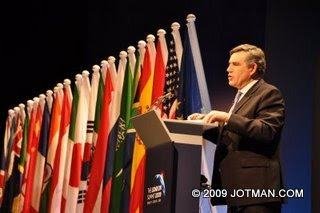
At the G20 summit in London I watched Gordon Brown announce that “the Washington Consensus is over.” Indeed, the financial crisis had left the so-called Anglo-Saxon model of economic growth completely discredited -- a fact that even a British Prime Minister could no longer deny.

So the old model was out. But what might serve as an alternative? Going into the summit France and Germany hardly inspired confidence. Neither did the safety-net deprived, export-driven model of growth adopted by Asian countries such as China, represented at the meeting seem to hold the answer.

Largely absent from the G20 summit of April 2 were a group of countries that have been wildly successful by almost any measure -- countries that may well offer a model worth emulating. Now, as never before, the example of Sweden, Finland, Norway, Denmark (and to this list might be added the Netherlands) deserve a careful look.

But is it possible for other countries to emulate the example of the Nordic democracies?

At the IPI Congress in Helsinki, Monday, a panel of experts on Scandinavia addressed the question.

I live-blogged their answers.

At the IPI Congress in Helsinki, Monday, a panel of experts on Scandinavia addressed the question.

The first panelist to speak, Andrew Brown, the author of Fishing in Utopia, was skeptical.

“Democracy not one thing, not a set of constitutional arrangements, but almost religious faith in the people, and social attitudes” Brown said. “If you take these away, you are merely left with the constitutional arrangements.”

Andrew saw much of what had made Nordic democracy viable absent in his native England. “Swedes will complain to radio call in shows about how the country is not doing enough to nurture badgers” Andrew observed. For Andrew, the essence of Nordic democracy is something cultural -- you simply can’t export an attitude of caring for badgers!

Andrew’s critique stood in marked contrast to the optimism of the two panel economists concerning the transferability of Nordic model. Here’s a list of the panel members as presented in the agenda:


“Nordic Democracy – A Lesson for the World?”


The so-called Nordic Model, with its emphasis on consensual political institutions, social welfare, and the universal provision of basic human rights, has long been admired by other countries. But critics point at the increased state interference in all areas of public life. Has the right balance been achieved? Is the Nordic model of democracy exportable? What challenges does globalisation present to the model?

  • Andrew Brown, Writer and Journalist, The Guardian, London
  • Sixten Korkman, Managing Director of ETLA (The Research Institute of the Finnish Economy) and EVA (Finnish Business and Policy Forum)
  • Pär Nuder, former Minister of Finance, Stockholm
  • Egill Helgason, Moderator, Presenter, "Silfur Egils", Icelandic National Broadcasting Service (RUV), Reykjavik

Drawing on a US political analogy, Sixten Korkman, Managing Director of ETLA, explained that that in the Nordic countries social welfare had not come at the expense of their ability to compete in the global marketplace. In other words, these countries showed that what’s good for society can be good for companies.

Taking the current US debate over health care reform, Korkman said, “You can have collective solutions that are also good for business -- argument for publicly funded health care (as opposed to employer financed as in the US).”

I thought this was a good example. One explanation for the bankruptcy of GM is that the company had been weighed down by having to foot the bill for employee healthcare -- money that could have been invested in making the cars of the future.

Korkman listed three points that seem to characterize Nordic Democracy.

  • Spending more on education
  • Social security
  • Keeping people working

He added, “You can typically find a Nordic ‘cluster’ (in statistical analysis). This suggests it’s real. You can talk about these countries as a distinct group.”

The main point? “The Nordic countries,” Korkman said, “represent a more liberal economic systems than everyone in Europe except Anglo-Saxon countries.”

“But is the model successful?” Korkman asked. “Yes, generally speaking, it is. Take one key variable: Social mobility. Inter-generational mobility higher than in France, UK, and the USA.”

Pär Nuder, former Minister of Finance, Stockholm, supported much of what Korkman had said.

“(Relative to most OECD countries) we have higher employment, lower inflation, stronger public finances.” And he asked “Why?”

Answering his own question, Nuder said, "is it that Nordic countries have lowest taxes? No, they don't. A small public sector? No, they have a large public sector." So what explains it?

Nuder told us he would explain it in several points:

  • Open economies. Free traders in his genes. Free trade key since “back when”. No other countries -- except perhaps Netherlands -- have so many well-known international brands. Part of Nordic culture to be free traders.
  • Social democratic system. I believe in strong public finances. Much fight deficits and high inflation.
  • Human capital investment. Invest in people through education and R&D. We know we have to compete with more R&D.
  • Inclusive workforce. Natural conclusion. If you want a sustainable society, must mobilize whole work force, including women. Highest female participation in the labor force. World’s most generous parental leave. One percent of GDP (spent on childcare) delivers highest female participation in labor.
  • Green ethic. Back in the early 90s we introduced a CO2 tax. We lowered tax on labor, raised it on emissions.
  • Cooperation. Eternal conflict between work and capital. We are too small, we concluded to have labor conflicts. Our countries are very vulnerable to lack of peace on labor market, so we need organized, responsible, labor unions. We have social bridges for people to walk on. These social bridges mean that more people willing to accept the often painful adjustments of global market capitalism. You can have world's highest taxes if they promote not only equality and safety, but high growth. These could be adopted by other countries.


I had not known about point number five. To think these guys had a CO2 tax back in the early 90s! Brilliant.

“Our model is to ‘Protect people not jobs.’ This way we can pursue free trade. The way of providing subsidies to companies is decidedly not part of the Nordic solution.”

The panel took questions from the audience.

Question: How Nordics got out of the financial crisis of the early 90s?

Egill Helgason replied: “The early 90s were bad for the world, but not as bad as now. You could export your way out. We all expected the market economy and welfare state. Even though we cut down everything, we didn’t cut education or R&D. We increased human capital investment.”

Question: Why did peasant societies transform? An ideology?
Andrew Brown said “It seems to me Scandinavia is small community surrounded by hostile wilderness. So you have to have cooperation and doing the best for yourself (culture hostile to freeloaders).”

Other speakers agree with Andrew, raising these additional points: Finland part of Swedish Kingdom. Lutheranism. Long roots of national democracy. But Finland took longer to realize that reforming capitalism, not overthrowing it, is the way to go.


Question: If it’s so great living up there, why the high suicide rate? Or is that a myth?


Panelists agreed that overall, it’s a myth that suicide rates are higher in Scandinavia. One noted that “in Finland, suicide rate high, but not linked to labor welfare.”

There was a back and forth about immigration. One panelist noted that it “isn’t fair to compare Canada’s success with Scandinavia’s failure. Canada’s immigrants are economic migrants -- highly educated, etc. But Scandinavia has mainly accepted refugees.”

Jotman live-blogged the following panel discussions at the IPI World Congress:

Thursday, May 7, 2009

Geithner behind banking fraud cover-up?

Sweden did it in the early 90s with respect to its entire banking industry. It is standard procedure for the US government to take over a failing bank. So why has the Obama Administration refused to temporarily nationalize America's woefully mismanaged major banks?

It seems Treasury Secretary Timothy Geithner -- who served as one of the top US regulators throughout the rise of the sub-prime debacle -- did not think nationalization a good idea.
Why not?

William K. Black, a professor of economics and law with the University of Missouri who led investigations into the S&L crisis of the 1980s, has an interesting theory. He told PBS’ Bill Moyers Journal:

Black: [They] don't want to change the bankers, because if we do, if we put honest people in, who didn't cause the problem, their first job would be to find the scope of the problem. And that would destroy the cover up....


Geithner is ... covering up. Just like Paulson did before him....


These are all people who have failed. Paulson failed, Geithner failed. They were all promoted because they failed....


Until you get the facts, it's harder to blow all this up. And, of course, the entire strategy is to keep people from getting the facts....


Moyers: Are you saying that Timothy Geithner, the Secretary of the Treasury, and others in the administration, with the banks, are engaged in a cover up to keep us from knowing what went wrong?


Black: Absolutely....


They're deliberately leaving in place the people that caused the problem, because they don't want the facts. And this is not new. The Reagan Administration's central priority, at all times, during the Savings and Loan crisis, was covering up the losses.

In other words, the foxes are (still) guarding the hens.

Here's the video of the interview:

Hat-tip: Mercola

Tuesday, January 27, 2009

Evidence of Thai Navy human rights abuses against refugees

Urban Svensson, a Swedish witness to what appears to have been a pattern of savage human rights against abuses perpetrated by the Thai Navy against refugees from Burma writes in an email:
... we where also at Similand Island 23 dec 2008 when Thai navy force these refugees into the beach. It was horrible to see the treatment disparity between tourists and these Burma men. We think it was the last time we visit Thailand, if the human rights in lovely Thailand not gonna change. It has been one full page in a newspaper(Aftonbladet) here in Sweden about this. . .
Urban has passed along to Jotman some of the photos he took. They show officers of the Thai Navy rounding up the refugees while tourists frolic on the beach.


Meanwhile, CNN correspondent Dan Rivers traveled to the remote Thai island where the refugees had been detained (story). He also obtained photos from the Thai Navy showing the refugees being set adrift in the high seas (h/tBangkok Pundit).

New Mandala blog notes that acording to a human rights group report, one of the military officers involved in the the abuse and deaths of numerous Rohingya refugees was implicated in a previous atrocity.

Check out the the attached CNN video, it includes some extaordinary new evidence.


This is my third post this month about the plight of the Rohingyans.

Thursday, October 9, 2008

From George Soros to Paul Krugman: Gordon Brown's bailout plan

Concerning the present financial crisis, the only financial minds I have any confidence in are those who had the wherewithal to anticipate it. Both financier George Soros and the economist Paul Krugman fit my criteria.

Soros was one of the first big investors to stress the gravity of the global financial situation in early 2008. Of course, Soros had been warning about the dangers of securitized mortgages for five years.* Similarly, economist Paul Krugman has been warning about the dangers presented by a bubble in the housing market since the dot-com bubble burst.

At this time, both advocate the nationalization of insolvent banking institutions. That's the essence of a bailout plan proposed by the British government on Wednesday. It was Sweden's strategy when that country faced a similar crisis in the early 1990s.

On October 1, George Soros, writing in the Finanacial Times, outlined a means by which the US treasury could save the country from disaster:

Instead of just purchasing troubled assets the bulk of the funds ought to be used to recapitalise the banking system. Funds injected at the equity level are more high-powered than funds used at the balance sheet level by a minimal factor of twelve - effectively giving the government $8,400bn to re-ignite the flow of credit. In practice, the effect would be even greater because the injection of government funds would also attract private capital. The result would be more economic recovery and the chance for taxpayers to profit from the recovery.

Soros outlines the details as to how it would work, and concludes:

Private investors, including me, are likely to jump at the opportunity. The recapitalised banks would be allowed to increase their leverage, so they would resume lending. Limits on bank leverage could be imposed later, after the economy has recovered. If the funds were used in this way, the recapitalisation of the banking system could be achieved with less than $500bn of public funds.

A revised emergency legislation could also provide more help to homeowners. It could require the Treasury to provide cheap financing for mortgage securities whose terms have been renegotiated, based on the Treasury’s cost of borrowing. Mortgage service companies could be prohibited from charging fees on foreclosures, but they could expect the owners of the securities to provide incentives for renegotiation as Fannie Mae and Freddie Mac are already doing.

Banks deemed to be insolvent would not be eligible for recapitalization by the capital infusion programme, but would be taken over by the Federal Deposit Insurance Corporation. The FDIC would be recapitalised by $200bn as a temporary measure. FDIC, in turn could remove the $100,000 limit on insured deposits. A revision of the emergency legislation along these lines would be more equitable, have a better chance of success, and cost taxpayers less in the long run.

Paul Krugman wrote on his blog today:

Readers ask what I think should be done about the financial crisis. The answer is, what Gordon Brown in doing in Britain: a bailout, yes, but one that gives the government an ownership stake in the bailed-out institutions. That plus a serious fiscal stimulus plan that includes emergency aid to state and local government.

The Brown plan, by the way, is 50 billion pounds; scaled by GDP, that would be the equivalent of a $500 billion plan here. The headline number would be smaller than the Paulson plan, but the probable effectiveness much, much greater. Not so incidentally, my reading of the TARP as passed is that thanks to the equity participation provisions, it could be converted into a version of the Brown plan at the Treasury secretary’s discretion; let’s hope that he does so discrete, or something like that, as soon as possible.
During the debate Tuesday night, John McCain announced his own proposal for bailing out homeowners. Krugman commented, ". . . John McCain’s bailout plan manages to take everything that’s wrong with the Paulson plan and make it worse. I’ll outsource the explanation to Brad."

It is encouraging to note Krugman's observation that the $700 billion TARP bailout program could be "converted into a version of the Brown plan."**
___
* At least since the publication of The Bubble Of American Supremacy.
** Bloomberg surveys some reactions to the Gordon Brown bailout plan.

Saturday, February 9, 2008

What Barack Obama could learn from Ronald Reagan

A magnificent orator, Barack Obama evokes memories of Ronald Reagan. But a comparison of Obama to Reagan points to a difference between their campaigns. As a candidate in 1980, Ronald Reagan was not only understood to be a "great communicator" promising "Morning in America."

Reagan also displayed strong convictions; revolutionary ideas. In 1980, Ronald Reagan declared: Down with big government! And concerning foreign policy he said: America ought to negotiate with the Soviets from a position of strength. Reagan had unambiguous policy objectives. Moreover, his straightforward ideas were highly contentious. Saying controversial things with a sense of conviction made Reagan appear brave.

By contrast, Barack Obama's message is all "Morning in America." The Obama campaign reflects the sunny side of Reagan, not the underdog fighter side. With respect to Obama, it is hard to detect anything concrete about a message that amounts to little more than the hopeful promise of change. I happen to believe Obama is a man of principle. But I am left wondering what his principles stand for in terms of substantive policies. In 1980 Ronald Reagan spelled this out for Americans and the world.

Obama -- assuming he wins his party's nomination -- will be pitted against a man with a clear message: McCain -- McCain who is winning the Republican Party nomination because his main opponent, Romney, was perceived not to stand for anything. At least when you see McCain's strange website, you know McCain has convictions. McCain's campaign shouts: America is at war with terrorists and so must elect a warrior to lead the country in battle -- and do some good societal things on the side.

And if Barack Obama becomes the Democratic nominee, in November there remains a strong likelihood that Americans will pick McCain as their leader. Because John McCain clearly stands for something.

On the other hand, if Hillary Clinton becomes the Democratic nominee, in a match-up with McCain at least Hillary Clinton will be able to say: "I'm every bit as competent as McCain. And I am better than McCain because I have a plan to end the war in Iraq and the knowledge to keep American safe." Hillary is not vulnerable on the basic question of competence or whether she and Bill can protect the American people.

To date, Obama's inspiring speeches have attracted many educated Democrats with high-level aspirations. Obama's present approach might win him a general election in Sweden or Canada. But in the US, a presidential candidate must address the safety issue before he or she can successfully appeal to people's dreams and higher aspirations. Despite the "land of the free" rhetoric, America is a country where many people subsist near the bottom of Maslow's hierarchy of needs pyramid. Many Americans are not at the "self-actualization stage." The demographics of the US do not mirror the profile of the enthusiastic early Obama supporter.

Unless Obama learns from Ronald Reagan's successful bid for the White House, McCain's campaign is liable turn the rhetoric of the Obama candidacy against Obama. McCain's people will bombard US voters with variations of these lines:

Hope won't keep America safe. Vote McCain.
Hope won't save your job. Vote McCain.

However, McCain cannot use these devastating slogans against Hillary Clinton. She is not vulnerable to the charge that she offers hope of change without substance.

Barack Obama might yet be the Democrats' ticket to the presidency in 2008. But first Obama needs to show he is brave enough to present his priorities clearly with conviction. I long to hear some bold ideas worthy of the rhetoric.

I want to hear Obama say he will make America safe. Safe from corporate predators. Safe from inept bankers, media conglomerates, drug and insurance companies, big oil, and the shady dealings of military contractors. What if Obama redefined national security?

Because Barack Obama's present approach won't cut it. He is unlikely to win if he is perceived both lacking in conviction and short on competence. Obama can't do much about the second, but now is the time for him to shore up the first. Twenty-eight years ago a former actor made up by way of sheer audacity what he lacked in terms of knowledge and experience. It's a lesson for Barack Obama.

Sunday, October 21, 2007

Swedish toys for Thailand's generals - the Burma angle

Reuters (via Fonzi's blog) reports that Thailand's air force has agreed to buy six Swedish-made JAS-39 Gripen fighter jets from Sweden's Saab for about half a billion US dollars. A second-phase purchase of roughly equivalent size is planned within the next ten years.

As it happens, there's a Burma-angle to this report. And it highlights the fundametal problem here.

Just the other day, Thailand's prime minister Surayud Chulanont said that Thailand's unelected interim government was in no "moral" position to approve punitive measures against the Burmese junta following the crackdown. By the Thai prime minister's own logic, surely a military-junta appointed interim government has no business authorizing major long-term defense expenditures. Now there's a conflict of interest!

The Thai media have shown little interest in covering this story, but Fonzi at Thailand Jumped the Shark writes, "do the math, it comes out roughly to $90 million plus change a plane. Ninety million is a lot of money for one fighter craft " Fonzi has done some serious digging (his comments page is also informative), and Bangkok Pundit provides further context.

"What's good for the Thai military is good for Thailand" has been the unspoken motto of Thailand since last years coup. Alarmingly, the Thai media seems to have swallowed this line. This jet fighter procurement is but the latest -- though possibly the most egregious -- example in recent months of the Thai military taking care of its own priorities first.

Does Thailand need these fighter jets? One justification by the military for the purchase of new jets could be the insurgency in Southern Thailand. One might well ask whether Thailand's generals now need the Southern insurgency in so far as they need excuses to justify initiatives that could increase their power and line their pockets. One historical analogy to the present juncture is the Thai military's role in stoking and exaggerating the communist insurgency of the 1970s. A misguided policy served to expand the Thai military and empower and enrich Thai generals at the expense of civil society. Another -- contemporary -- analogy might be present-day Burma. Some speculate that Burma's junta chooses not to completely defeat Burma's own ethnic insurgencies in order that the junta might justify its expansive budgets and repressive policies.