Showing posts with label Netherlands. Show all posts

Thursday, January 7, 2010

Japanese whaling ship rips Sea Shepherd boat


Updated (videos!)

ABC has a report on a rare collision in the Southern Ocean.   The Japanese whaling security ship Shonan Maru No. 2 has rammed and damaged the Ady Gil, a $2 million high-speed trimaran belonging to Paul Watson's anti-whaling Sea Shepherd Society.    The Andy Gil is believed to be sinking but the crew were rescued by the Sea Shepherd ship Bob Barker.   The Sea Shepherd Society has asked Australia to send a naval vessel to "restore peace" and protect the 21 Australian citizens on board the Sea Shepherd and the whales from the Japanese.   According to ABC, the incident happened "outside Australia's economic zone but within Australia's search and rescue zone."

The Sea Shepherd website gives some background about the unprecedented resources the organization has sent into the cold waters off Antarctica this whaling season.
The objective of Sea Shepherd’s three-ship campaign is to bankrupt the illegal Japanese whaling fleet and to sink them economically.

“This year, I have three ships, four small boats, a jet ski, a helicopter, 77 crew, and a bagful of aggravation for the Japanese whale poachers,” said Captain Paul Watson. “We intend to make life miserable for the whale killers over the next month and a half.”

Included in the crew is the Animal Planet crew filming the third season of the hit television series “Whale Wars.”

The Sea Shepherd crew number 77 from 16 nationalities including Australia, Brazil, Canada, Ecuador, Estonia, France, Germany, Ghana, Hungary, Ireland, Japan, Netherlands, New Zealand, South Africa, Sweden, United Kingdom, and the United States.
Jotman wishes Sea Shepherd every success against the whalers.

But it's important to recognize that whaling is just the tip of the iceberg -- the best known and most publicized -- of the various ways people are harming marine life.  The most important battles have yet to be won.
___
Pictured in my photo is a minke whale -- one variety that Japanese commercial whalers claim the right to hunt.   

UPDATE: Here's a video (h/t Omar Todd) -- taken by a person on the Japanese whaling ship -- showing the high-tech trimaran getting sliced by the bow of the whaler's "security ship."   


UPDATE 2: And here's a video of the incident shot from the Sea Shepherd's Bob Barker:

Saturday, November 21, 2009

What countries appeared most/least corrupt in 2009?


 Scanning the list from best to worst, here's what strikes me about the rankings of countries in Transparency International's corruption perceptions index for 2009:*
  • The top ten least corrupt are the Nordic countries, plus New Zealand (#1), Canada, and Australia.  (Netherlands isn't exactly Nordic, but it comes in at #6.  Singapore (#3) is perceived as the least corrupt country in all of Asia.
  • The US (home to Delaware) and UK (protector of Jersey) just barely make the top twenty.
  • Three Gulf states are perceived as less corrupt than Israel (#32)
  • The big countries of Eastern Europe  -- Hungary, Czech, Poland (#46-52) -- are believed to be more corrupt than any country in East Asia outside of China.
  • Turkey (#61) and Italy (#63)are perceived as being almost equally corrupt, but Turkey (still considered unfit to join the EU) ranks higher than both Italy and dismally-ranking Greece which is tied with Romania at #71.
  • China (#79) and India (#84) rank similarly on corruption.    India is tied with Thailand.
  • In South America, Chile is #25 (ahead of Spain) but neighboring Argentina is #105.  (As we saw with the English speaking world, the "colonials" seem to be outranking the "mother countries" on this survey).
  • Egypt has the same perceived level of corruption as Indonesia (#111), but the "land of baksheesh" is perceived as being less corrupt than Lebanon (#130) and Syria (#126) and even Vietnam (#120).
  • Pakistan and Philippines are tied at #139.
  • Zimbabwe is tied with Russia at #146.
  • Laos and Cambodia are tied at #158.
  • America is trying to win wars in two of the five most corrupt countries in the world.  (Iraq and Afghanistan's rank prior to America's invasions could not have been any lower.)
___
* ASEAN countries names are in bold. At Jot ASEAN I posted a short list that includes only Southeast Asian countries.

    Monday, June 15, 2009

    Asia's future: Capitalism sans freedom?

    Jotman's live-blogging the International Press Institute (IPI) World Congress in Helsinki continues...

    This panel and its agenda:

    Can Economies Survive without Free Media?
    Critics of the "Asian Values" propounded in the 1990s argued that they were a mere a justification by authoritarian regimes to suppress universal human rights. Yet the economies of such countries as Singapore and, in particular, China have continued to thrive without democratic reform. Will they now need a free media to help overcome the drag of the global financial crisis, corruption, and such problems as China's unsafe products?
    • Yuen-Ying Chan, Director, Journalism and Media Studies Centre, University of Hong Kong
    • Anthony Milner, professor of history, ANU
    • Xiao Qiang, Founder, China Digital Times; Director, China Internet Project, Graduate School of Journalism, UC Berkeley
    • Matt Steinglass (Moderator), Correspondent, DPA (German News Agency), Hanoi

    Matt Steinglass, the moderator, questioned the media's ability to cover corruption, given the strict government restrictions on covering politics in Vietnam.

    Yuen-Ying Chan, Director, Journalism and Media Studies Centre, the University of Hong Kong says media in China is neither free nor unfree. Fortunately, due to the Internet, there is space for dialogue.

    The Internet is growing fast, with almost 300 million Internet users in China. Ninety percent on broadband. One third on mobile platforms.

    Mobile phones are used to post photos. In Feb. there was a fire in the TVCC tower in Beijing. Within 30 minutes the picture of this 30 story building burning had been posted on the Internet. Although state broadcaster CCTV had an office close to the fire, the Internet led coverage of the fire. A story went in an online magazine, but got reposted elsewhere.

    There are many examples of officials being forced on the defensive, to defend themselves against stories published on the Internet.

    Xiao Qiang of UC Berekely showed a slide (next image). Shows that bloggers and online bulletin boards have the power to reconfigure the media and political landscape. These people are the frontline facing the state apparatus. This is where the most interesting things are happening. Issues of importance to the people first get raised on the blogs.


    Showed us a confidential document from the propaganda department. Explaining what can be reported. What they say is conformed to by the official media.

    Projected a graph (next image) showing how more and more frequently things raised on blogs reach up to become part of the national discourse and national consensus.

    One blogger posted a list of names of children killed in a school collapse. Before long this information becomes part of the policy debate at the highest levels of state.


    Look how search terms "free speech" "censorship" grow quickly (right image). Citizen, democracy, system reform search terms also growing – use of these words – increasing faster than growth of users on the Internet. Even taking new users into account, growth in frequency of these search terms is fast.


    Also, the number of Chinese websites mentioning "democracy" has grown. Again this growth exceeds the pace of growth of the Internet (left image).


    So what? What does this mean?


    It means that momentum towards press freedom is facilitated by the Internet.


    But society is still totalitarian: the vested interest of Party is not aligned with public as in a democracy.

    Consider history. Consider that twenty years ago, in 1989 when the Tienanmen massacre happened, and the collapse of USSR followed, all these China watchers were saying that the Chinese regime's days were numbered. Now we all know China has had a successful totalitarian regime -- for which -- due to financial crisis, the West now turns to as a partner (in maintaining the global system).


    I leave you with this question: How do we know, what makes us so sure that this time around -- with everyone assuming the regime will continue -- that the experts have China right?

    Anthony Milner, professor of history at the Australian National University suggested that "the current global crisis is unlikely to demonstrate the particular economic strength of democracies." Looking to the future, he sounded some cautionary notes based on the track record of some Asian countries:

    • Philippines and Indonesia are more democratic, but not prosperous. Singapore ranks high as non-corrupt country, near Finland. Malaysia, China have more corruption. Thailand too. Indonesia, despite relaxation of media controls, has a lot of corruption.
    • Need to look to 97-98. Geopolitical consequence of the earlier crisis. Singapore and Malaysia -- nations with little freedom -- handled crisis relatively well.
    • Today's financial crisis looks like a "democratic" recession. Asia looks to be coming out of the crisis today.
    • Militarily, in terms of power balance, crisis seems destined to have an adverse impact on West. What of values struggle?
    • China may face values contest within Asia.
    • Bottom line: the old liberal agenda -- including freedom of the press -- is likely to face serious resistance in the future.

    Yuen-Ying Chan says private ownership of the media has been undermined. It is not working. It has collapsed.

    "The blogs are where people speak there mind in China. It's not what people say to a camera on the street."

    Matt Steinglass: (In Vietnam) I don't see big corruption stories picked up by bloggers on the Internet, I see them picked up by professional reporters.

    Nationalism may be playing an increasing role (in stirring up interest in corruption stories). For example, there was the story of Thaksin's sale of his telecom firm to Singapore. Seemed to be a case where nationalism is a new factor in media narratives. A trend perhaps.

    Xiao Qiang: There is the need to legitimize party. One way is through performance; another is through a new nationalist narrative. So they are trying to construct a narrative of Chinese nationalism. There seems to be no intellectually coherent value behind Chinese nationalism. Are we witnessing a nationalism "bubble" in China? Perhaps. Maybe we are overestimating the importance of nationalism.

    Yuen-Ying Chan: Young Chinese are not so brainwashed....

    Question from Dave Underhill of Global Post: What gets through from West? What do you see as the role or potential of new media in the West impacting what happens in China?

    Xiao Qiang: In China, if you have the incentive, then you can get around the censorship. There is more and more censorship more all the time. The people who know how to circumvent the censors are those with enough curiosity and incentive to do so. These people tend to be the opinion leaders in China, who then, in turn, put this information into circulation in the Chinese domestic discourse.

    The important point is that the intended audience of the Western media is different. It's not the Chinese. That's one reason the Tibetan issue generated controversy. The background knowledge on the issue is different. The underlying perspective is different. If you want the Western media to have an impact on China, you have to know how the audience in China. You would need to take the Chinese audience into consideration in the reporting of the story. I don't think that's on the agenda of the Western media today.

    Yuen-Ying Chan: I would caution: don't write off the Chinese state media either, or the official media. I would like to see some representatives from the Chinese media in future (media freedom related) conferences (such as this one). I think they could contribute and learn from future gatherings.

    Xiao Qiang: We should not over-estimate the power of the Western media when it comes to China. The official Chinese media have real advantages. They have 1) access Westerners won't get, 2) real understanding, and 3) experience. The best scenario is everyone working in context, together, using each other's strengths to get China right.

    Anthony Milner: As for Southeast Asia – nationalism is making a (critical) space. You have to deal with Islamic ideas in careful terms; but this can open up space too.

    Matt Steinglass: True these (critical) spaces -- i.e. Islam in Indonesia -- (theoretically at least) seem to allow people to make claims that may be critical of their governments.

    Often in Vietnam, there will be a designated spokesperson liaison for media, but that person can never be found. Maybe there is a generation gap... It often seems to me as if old people in Vietnam need approval to speak, whereas the young will say what they think.

    Xiao Qiang: Because there is control, therefore online discourse tends not to be explicit...

    Question (Netherlands): One lesson i pick up from here is that we need to converge the frame of mind of a countryman, and of the international press. In terms of Africa, it seems to me the Internet could play a role. To what extent could converging the news rooms of the West and Asia come to contribute to the media in Africa?

    Yuen-Ying Chan: The bottom line is that people want to express themselves and don't want to be lied to. I would point to this basic commonality of values. In spite of the tight control of the party, the country has a robust IT infrastructure, allowing citizen journalism to develop. These citizen journals will push the ideas of openness. It means that building the enabling structure of IT infrastructure has to be on the development agenda.

    Anthony Milner: The convergence question. I think there are problems with that. There is the style question; the recognition of local styles question. A grabbing back into past to seek dignity. A bad century or two (of colonialism) leads to this looking back. How one couches arguments about the media seems to me very important indeed. "Digging back" is important in this region.

    Question (World Press Freedom representative): We tried inviting Chinese official representatives to our conference. But they (basically sent people to spy) on the attendees of our conference. And we later had incidents of hacking against the sites of people who were at the conference. So dialogue is one thing, but it is not so easy as it sounds.

    Yuen-Ying Chan: There are different types of groups that you can reach out to. I appreciate the difficulties. They will have to make decisions. They need to work, they need to adapt international standards.

    Xiao Qiang: Southern Media Group is the one of the most progressive news media organizations in China. Under the relatively autonomous government of the southern province that has politicians who support it (and so it is not subject to direct central government oversight).


    Jotman live-blogged the following panel discussions at the IPI World Congress:

    Tuesday, June 9, 2009

    Is the Nordic model worth emulating?

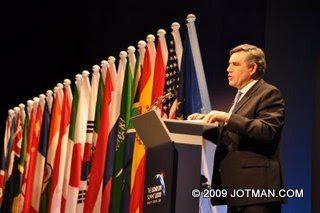
    At the G20 summit in London I watched Gordon Brown announce that “the Washington Consensus is over.” Indeed, the financial crisis had left the so-called Anglo-Saxon model of economic growth completely discredited -- a fact that even a British Prime Minister could no longer deny.

    So the old model was out. But what might serve as an alternative? Going into the summit France and Germany hardly inspired confidence. Neither did the safety-net deprived, export-driven model of growth adopted by Asian countries such as China, represented at the meeting seem to hold the answer.

    Largely absent from the G20 summit of April 2 were a group of countries that have been wildly successful by almost any measure -- countries that may well offer a model worth emulating. Now, as never before, the example of Sweden, Finland, Norway, Denmark (and to this list might be added the Netherlands) deserve a careful look.

    But is it possible for other countries to emulate the example of the Nordic democracies?

    At the IPI Congress in Helsinki, Monday, a panel of experts on Scandinavia addressed the question.

    I live-blogged their answers.

    At the IPI Congress in Helsinki, Monday, a panel of experts on Scandinavia addressed the question.

    The first panelist to speak, Andrew Brown, the author of Fishing in Utopia, was skeptical.

    “Democracy not one thing, not a set of constitutional arrangements, but almost religious faith in the people, and social attitudes” Brown said. “If you take these away, you are merely left with the constitutional arrangements.”

    Andrew saw much of what had made Nordic democracy viable absent in his native England. “Swedes will complain to radio call in shows about how the country is not doing enough to nurture badgers” Andrew observed. For Andrew, the essence of Nordic democracy is something cultural -- you simply can’t export an attitude of caring for badgers!

    Andrew’s critique stood in marked contrast to the optimism of the two panel economists concerning the transferability of Nordic model. Here’s a list of the panel members as presented in the agenda:


    “Nordic Democracy – A Lesson for the World?”


    The so-called Nordic Model, with its emphasis on consensual political institutions, social welfare, and the universal provision of basic human rights, has long been admired by other countries. But critics point at the increased state interference in all areas of public life. Has the right balance been achieved? Is the Nordic model of democracy exportable? What challenges does globalisation present to the model?

    • Andrew Brown, Writer and Journalist, The Guardian, London
    • Sixten Korkman, Managing Director of ETLA (The Research Institute of the Finnish Economy) and EVA (Finnish Business and Policy Forum)
    • Pär Nuder, former Minister of Finance, Stockholm
    • Egill Helgason, Moderator, Presenter, "Silfur Egils", Icelandic National Broadcasting Service (RUV), Reykjavik

    Drawing on a US political analogy, Sixten Korkman, Managing Director of ETLA, explained that that in the Nordic countries social welfare had not come at the expense of their ability to compete in the global marketplace. In other words, these countries showed that what’s good for society can be good for companies.

    Taking the current US debate over health care reform, Korkman said, “You can have collective solutions that are also good for business -- argument for publicly funded health care (as opposed to employer financed as in the US).”

    I thought this was a good example. One explanation for the bankruptcy of GM is that the company had been weighed down by having to foot the bill for employee healthcare -- money that could have been invested in making the cars of the future.

    Korkman listed three points that seem to characterize Nordic Democracy.

    • Spending more on education
    • Social security
    • Keeping people working

    He added, “You can typically find a Nordic ‘cluster’ (in statistical analysis). This suggests it’s real. You can talk about these countries as a distinct group.”

    The main point? “The Nordic countries,” Korkman said, “represent a more liberal economic systems than everyone in Europe except Anglo-Saxon countries.”

    “But is the model successful?” Korkman asked. “Yes, generally speaking, it is. Take one key variable: Social mobility. Inter-generational mobility higher than in France, UK, and the USA.”

    Pär Nuder, former Minister of Finance, Stockholm, supported much of what Korkman had said.

    “(Relative to most OECD countries) we have higher employment, lower inflation, stronger public finances.” And he asked “Why?”

    Answering his own question, Nuder said, "is it that Nordic countries have lowest taxes? No, they don't. A small public sector? No, they have a large public sector." So what explains it?

    Nuder told us he would explain it in several points:

    • Open economies. Free traders in his genes. Free trade key since “back when”. No other countries -- except perhaps Netherlands -- have so many well-known international brands. Part of Nordic culture to be free traders.
    • Social democratic system. I believe in strong public finances. Much fight deficits and high inflation.
    • Human capital investment. Invest in people through education and R&D. We know we have to compete with more R&D.
    • Inclusive workforce. Natural conclusion. If you want a sustainable society, must mobilize whole work force, including women. Highest female participation in the labor force. World’s most generous parental leave. One percent of GDP (spent on childcare) delivers highest female participation in labor.
    • Green ethic. Back in the early 90s we introduced a CO2 tax. We lowered tax on labor, raised it on emissions.
    • Cooperation. Eternal conflict between work and capital. We are too small, we concluded to have labor conflicts. Our countries are very vulnerable to lack of peace on labor market, so we need organized, responsible, labor unions. We have social bridges for people to walk on. These social bridges mean that more people willing to accept the often painful adjustments of global market capitalism. You can have world's highest taxes if they promote not only equality and safety, but high growth. These could be adopted by other countries.


    I had not known about point number five. To think these guys had a CO2 tax back in the early 90s! Brilliant.

    “Our model is to ‘Protect people not jobs.’ This way we can pursue free trade. The way of providing subsidies to companies is decidedly not part of the Nordic solution.”

    The panel took questions from the audience.

    Question: How Nordics got out of the financial crisis of the early 90s?

    Egill Helgason replied: “The early 90s were bad for the world, but not as bad as now. You could export your way out. We all expected the market economy and welfare state. Even though we cut down everything, we didn’t cut education or R&D. We increased human capital investment.”

    Question: Why did peasant societies transform? An ideology?
    Andrew Brown said “It seems to me Scandinavia is small community surrounded by hostile wilderness. So you have to have cooperation and doing the best for yourself (culture hostile to freeloaders).”

    Other speakers agree with Andrew, raising these additional points: Finland part of Swedish Kingdom. Lutheranism. Long roots of national democracy. But Finland took longer to realize that reforming capitalism, not overthrowing it, is the way to go.


    Question: If it’s so great living up there, why the high suicide rate? Or is that a myth?


    Panelists agreed that overall, it’s a myth that suicide rates are higher in Scandinavia. One noted that “in Finland, suicide rate high, but not linked to labor welfare.”

    There was a back and forth about immigration. One panelist noted that it “isn’t fair to compare Canada’s success with Scandinavia’s failure. Canada’s immigrants are economic migrants -- highly educated, etc. But Scandinavia has mainly accepted refugees.”

    Jotman live-blogged the following panel discussions at the IPI World Congress:

    Friday, September 5, 2008

    Angola holds elections

    Long torn by war, Angola is sub-Saharan Africa's number two oil producer. Brian Posthumus at Radio Netherlands reports:
    . . . all eyes will be on two players, the MPLA and UNITA. The first, Movimento Popular de Libertação de Angola (the Popular Movement for the Liberation of Angola), has been in power since 1975, the year that Angola broke free of Portugal's colonial grip. The second is the União Nacional para a Independendência total de Angola (National Union for the Total Independence of Angola). Once a movement of armed rebels, which only gave up its armed struggle in 2002, when its leader Jonas Savimbi was killed in a gun battle. The two sides still dominate Angolan politics.
    .

    Ushahidi - a way to collect and visualize crisis reports

    Out of an African nightmare emerges a potentially valuable innovation that could one day save lives.

    During the Kenya violence -- which I blogged in January -- reports about the extent of the violence emerged from people equipped with mobile phones. The founders of a website called Ushahidi are beta-testing a platform that will allow groups to aggregate such crisis reports in the future, displaying the information visually. Ushahidi means ''testimony'' in Swahili. I found this description on the Ushahidi website:
    The core engine is built on the premise that gathering crisis information from the general public provides new insights into events happening in near real-time. It is being developed by a group of volunteer developers and designers, hailing primarily from Africa. So far there are representatives from Kenya, South Africa, Malawi, Ghana, Netherlands and the US.

    The private alpha of the redesigned Ushahidi Engine is set to begin testing in late September of 2008.

    Ushahidi plans to make the Ushahidi mapping tool available globally for free. . .

    The intended benefits of Ushahidi are twofold. First, to provide the "general public" with "new insights into events happening in near real-time." Second, "to help organizations marshal efforts to assist areas that are not well covered in the mainstream media."

    There were some reports at the time of the Kenya crisis that mobile phones were implicated in the spread of ethnic violence (reminiscent of the role played by radio in the Rwanda genocide).* Can safeguards ensure today's promising new communications technologies do not get into the wrong hands?
    __
    Hat-tip Kenya Pundit.
    * Even running has been blamed for Kenya's ethnic violence -- a reminder that there's no activity that cannot be misused.

    Sunday, November 19, 2006

    Jotman Reader from Siberia: Flood of Chinese into Eastern Russia

    A Jotman reader offers rare insights into one of the most interesting geopolitical developments in Asia -- one most Westerners are in the dark about: the migration of Chinese into Eastern Russia. Could this pose a threat to Russian sovereignty? Could it eventually lead to conflict between Russia and China? The flow of Chinese peasants and merchants into Siberia gains momentum amidst the rush to exploit Siberia's rich natural resources. The three superpowers of Asia -- China, Japan, and Russia -- each have a keen interest in what happens to the region.

    In a recent posting I mentioned an Asian WSJ cover story which examined the issue. The Jotman reader from Siberia acknowledges that this is "the growing trend" and provides some historical context:
    Private Chinese trade started as early as the borders opened after perestroika, in the late 80s – early 90s. Ordinary people started shuttling across the border virtually on a daily basis. A typical "kommersant" (entrepreneur) of the mid 90s would be a Russian or Chinese woman of middle age, with a couple of huge duffle bags, called "shuttle bags", stuffed with cheap clothes etc. These small person's efforts would supply everything from tape-recorders to fur coats across the entire country. That's how Chinese people learned there was a giant country, with lots of land and very little population. Soon they would start settling their open markets, farms and light industry factories in the deepest parts of Russia. As for the Russian Far East, in the mid 90s they already made a visible portion of the population.
    The WSJ article showed that Russia’s trade with Europe far outweighs its trade with China. Russia’s total trade with China was less, overall, even than its trade with the Netherlands. The disparity is attributable to Russia’s oil and gas sales to Europe. The Jotman reader writes that by contrast:
    Asian oil and gas transport infrastructure is still in its infancy. The great confrontation of the early 2000s – whether the pipeline would go to China or Japan, has apparently been solved for the China's benefit (not 100% sure, though). Russian-Japanese relations are still very poor. After a very enthusiastic period in the 90s, when Japanese corporations would spend huge $$$ on their cultural programs, we end up in a situation where Mitsui and other foreign companies might lose their stakes in the Sakhalin-2 oil project.
    The Jotman reader says that although Japan and China both seek Russia’s natural resources, the Chinese appear to have the upper hand.
    Generally, Chinese companies feel a lot more comfortable operating in Russia, than Japanese or Korean competitors. They may lack experience and resources, but Russian business and official circles usually find Chinese a lot easier to deal with. Unlike their Japanese competitors, Chinese entrepreneurs are usually very eager to learn Russian and usually take Russian names, like Vanya, Petya, Kolya etc. This is especially common in Siberia and the Far East and has a long history too. Russian belletrists Nikolay Zadornov describes peaceful coexistence of Russian and Chinese settlers and Siberian natives in the late XIX c. in his monumental novel "The Amur Saga".
    Chinese have historic ties to this part of Russia, and in the past they assimilated into Soviet society:
    From the sociocultural point of view, Chinese, especially the older generation, are very close to any Soviet-background group. Same Communist stuff and beliefs. Cheap Chinese labor was widely used in road construction and gold mines of Yakutia in the late XIX c. until early 1920c. In many parts of Siberia there were so many Chinese that the Red Army recruited whole Chinese regiments to fight against the White Guard in the Civil War, – a fact recognized even by the Soviet history and literature (a short story by Mikhail Bulgakov describes the life of a Chinese soldier in the Red Army). Chinese regiments were extremely fierce and violent in battle even by the measures of the Civil War. In many cases, on important missions, such as assault or bodyguard assignments) when Bolshevik leaders like Leon Trotsky could not entirely trust their Russian forces, they would deploy Chinese mercenaries.

    In Yakutia (as it may be case in other Far Eastern regions), Chinese and Korean immigrants have long history. Second and third generations of Chinese immigrants became completely "yakutized" to the extent they speak Yakutian better than Russian. Yakuts and other northern indigenous people usually are quite positive towards Chinese and Korean, perhaps opposing them to Russians. Not sure if it can last if the Chinese population starts to dominate.
    Recent months have seen the rise of an ugly and fervent tide of animosty on the part of Russians toward non-ethnic Russians. Some observers, such as the author of a RAND study look at whether Russian mistreatment of Chinese migrants could lead to armed conflict between the two regional powers. Does recent explosions of ethnic hostility have a bearing on the fate of Chinese migrants streaming into Russia?
    The violent cities against non-Russian ethnics are Moscow, St Petersburg, and Voronezh. Less statistics is available on smaller towns in central Russia. Siberia and the Far East region are somewhat more tolerant to non-Russians, attributable to the history of relatively peaceful coexistence of the Russian settlers and the local indigenous population. These regions might also find comfort in being not like the rest of Russia, as people often like to feel being different, and more independent in their attitudes. However, tensions exist even in the safest of neighborhoods.
    The author of the WSJ article quoted someone fervently opposed to Chinese immigration, but the Jotman reader indicates that he was misleadingly identified in the article:
    The "Movement Against Illegal Immigration" (DPNI, or "Dvizheniye Protiv Nelegalnoy Immigratsiyi"), the WSJ refers to, has nothing to do with illegal immigration, - it is basically a radical nationalist party. Its leader Andrey Belov and other activists are largely accountable for the race provocation in Kondopoga.... DPNI has emerged as one of the most influential political movements in the last few years, fueled mostly by ordinary Russian's dislike of Caucasians (Armenians, Azerbaijanis, Chechens and Georgians) and Central Asians (Tajiks, Turkmens). Its anti-Chinese line is less significant. DPNI is not present in the Duma (Russian Parliament), but is closely affiliated with other nationalist MPs.
    For analysis of how the migration of Chinese into Russia is likely to impact Russia's security interests, check out this Carnegie Moscow Centre report by Galina Vitkovskaya.

    Recent developments in Russia have, for the most part, been off the Radar of the Western media. Jotman thanks this reader from Siberia for sharing his unique perspective on these developments.