Showing posts with label Burma - live reports 2006. Show all posts

Tuesday, October 24, 2006

“She fires machine guns”

© Copyright 2006 by Blogger Jotman (story and photos). All Rights Reserved.

Last night Dave, Emma, and I were having a drink (names have been changed) on the patio of bar by a quiet street of a town in northern Thailand. A few bugs hovered above our heads near a lamp.

I had met Dave the previous day at my guesthouse. Dave wore his hair long and had a Southern California manner about him. Spotting us from the street, Emma, whom Dave had only met that afternoon, sat down on the bench beside him. Emma wore a silver stud above her chin and large moon shaped earrings. As the evening light faded, her tanned face became more radiant.

We had just been chatting with the restaurant security guard. Smartly dressed in a blue cap and crisp white shirt, anyone would mistake the fifty year old guard for a police officer -- one of half his age. He told us he had been born to a Chinese mother and hill tribe father in Keng Tong, a town deep inside Myanmar’s Shan State which I had recently visited. Just as the guard left to check on something, I heard Emma say something to Dave about a “machine gun.” I glanced at the pair seated across the table from me.

Dave pointed at Emma. “She fires machine guns.”

“What?” I asked incredulously.

What Emma would say next, Dave had not heard before either. Indeed, we were about to hear this petite female tell us something about herself that was almost impossible to believe.

“I spent a year fighting for the Karen resistance army in Myanmar,” Emma said.

Dead silence. Needless to say Dave and I were almost speechless. “I think she’s joking” Dave muttered.

As for the background on her decision to join the army, here is what I was able to piece together from our conversation. Emma told us that at first she had worked with Karen refugees near a town on the Thai border -- a group who taught the Karen how to practice medicine in the jungle. But through a friend in the camp she had been introduced to a general in the Karen resistance army. Emma had the idea that by enlisting with the Karen resistance forces she could make a big difference to this suffering minority people. She told me that Myanmar's army had encroached on Karen villages, and the Karen had been fighting a defensive war to protect their home territory. After two months of boot camp, Emma was off fighting in the Burmese jungle.

“Did you shoot anybody?” I asked

“People always ask me that. And I don’t know,” Emma said. “In the confusion of a battle, you simply don’t know.”

It seems Emma had seen fighting quite frequently -- the longest stretch during which she saw no combat having lasted only a month and a half. In combat, she spoke of how the enemy line and her own side’s line would be mingled together. But she said she could always tell the two sides apart.

In the Burmese jungle the army subsisted mostly on a diet of rice and salt.

“Sometimes other soldiers caught rats, bugs, and whatever else they could catch in the jungle” she said. A vegan, Emma just ate the rice.

I asked her what kind of wild animals she had come across in the jungle.

“There were snakes -- really big snakes.”

“What about casualties?” I asked.

Emma said that although there were a couple fatalities, most of the casualties her platoon suffered had been leg injuries, related to land mines. She said the Myanmar army had planted mines that were of Chinese and Myanmar origin, and some others were hand made devices.

"The Myanmar army placed mines and left them. The Karen use mines too, but we always picked them up afterwards. Like when we camped in a village, we would put mines around the perimeter to protect the village. Then when we left, we picked up the mines we had placed,” she said.
In a previous posting I related my own observations of a Myanmar army battalion on the move and referred to a recent report describing the state of the army. I asked her if the Myanmar troops were indeed badly equipped.

“Yes, compared to a Western army they certainly are. But not compared to the resistance fighters, who are worse equipped. The Myanmar army has tanks, but they can’t use them up in the that region -- there are no roads.” She said the resistance used mostly old American weapons.

When Emma smiled, rows of straight white teeth gleamed in the darkness.

Emma said that during one battle, “There was actually a guy on our side who was talking on the radio to his brother who fought for the other side.”

“Brother against brother,” Dave said. Dave’s ancestors had fought in the US Civil War.

That guy’s brother, she explained, wasn’t exactly a part of the Myanmar army. Rather, he was fighting for a different mountain tribe. The Myanmar troops were allied with an enemy of the Karen. And the soldiers from this other ethnic group had been promised a share of any land taken from the Karen. But Emma said that the price these people paid for cooperating with the Myanmar army was that they had to fight at the front of the Myanmar army line.

"What really moved me," Emma said, "was one day when we were preparing to launch an attack on an enemy camp I got up so close to the enemy. I saw the Myanmar troops sitting around talking. I could hear what they were saying: they were talking about girls. They were only boys. I realized something at that moment; how they were not so different from my side -- that it was not their choice to be fighting this war."

We decided to take a walk. Emma had not eaten dinner and she hoped to find some street food. We passed some stalls. “Only meats” Emma scowled. Finally, spotting a cart loaded with a steaming pile of corn-on-the-cob, Emma said, “I’m going to buy some corn.”

We walked further: Emma now wanted to buy some durian -- a large fruit resembling a bloated pineapple that has the taste, smell, and texture of brie cheese. The smell is considered so offensive that it’s forbidden even to carry the fruit on the subway in Singapore.

“Durian’s also banned on the Bangkok skytrain” said Dave.
“Were there other women in the Karen army?” I asked.

“There were some nurses. But I was the only woman fighting.” She added, “The general who allowed me to enlist had the idea that by letting me join, I could be an example for Karen women. It might encourage them to sign up.”

But first some deep seated cultural issues would have to be resolved.

“The Burmese have these… well these cultural… oddities. In Burmese society, it is forbidden for a woman to be above a man, or for a woman to step over a man. Can you imagine? I’m not supposed to step over a man’s leg! So being in combat situations, obviously, this would not work. I told them I wouldn’t accept such restrictions. I said, ‘See that plane flying above you? There are women in that plane. You are already standing below some women.’ But my arguments did not convince them.

“So what happened?”

“Finally one of the army leaders came up with a solution to the problem,” she said. “It was decided that I was a man, and should be treated as a man.”

Dave and I looked at Emma. She was very much a woman.

“That must have got in the way of sex,” said Dave.

“Not at all,” she said with a wink.

Thursday, October 12, 2006

Giant Rodent

A giant rodent looked down at our bus -- it must have been twelve-feet tall. As we approached the figure, female dancers fanned out in front of our vehicle. The bus came to a stop as the performance commenced. When our bus was allowed to move forward again, I looked out my open side-window (this was an Air Con Bus after all). That was when some villagers caught sight of the foreigner on board. I smiled and waved. The revelers responded with a tremendous cheer. If only for an instant, it felt great to be the guest of honor at such a happy celebration.

Encounter with an Infantry Battalion

I have already described the first leg of my return bus trip from Keng Tong to Tachileik where we passed the wrecked Air Con bus. But this journey had other notable encounters in store for us – apart from the rendezvous with the ghost.

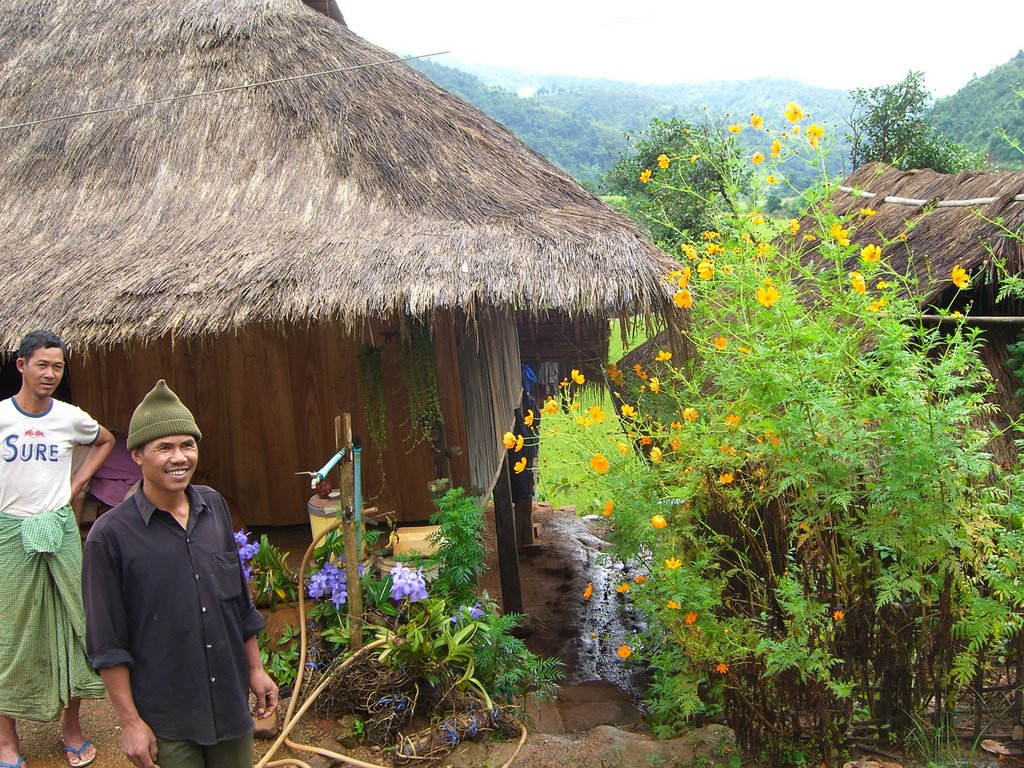
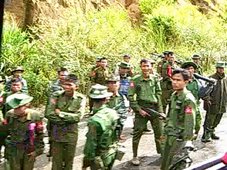
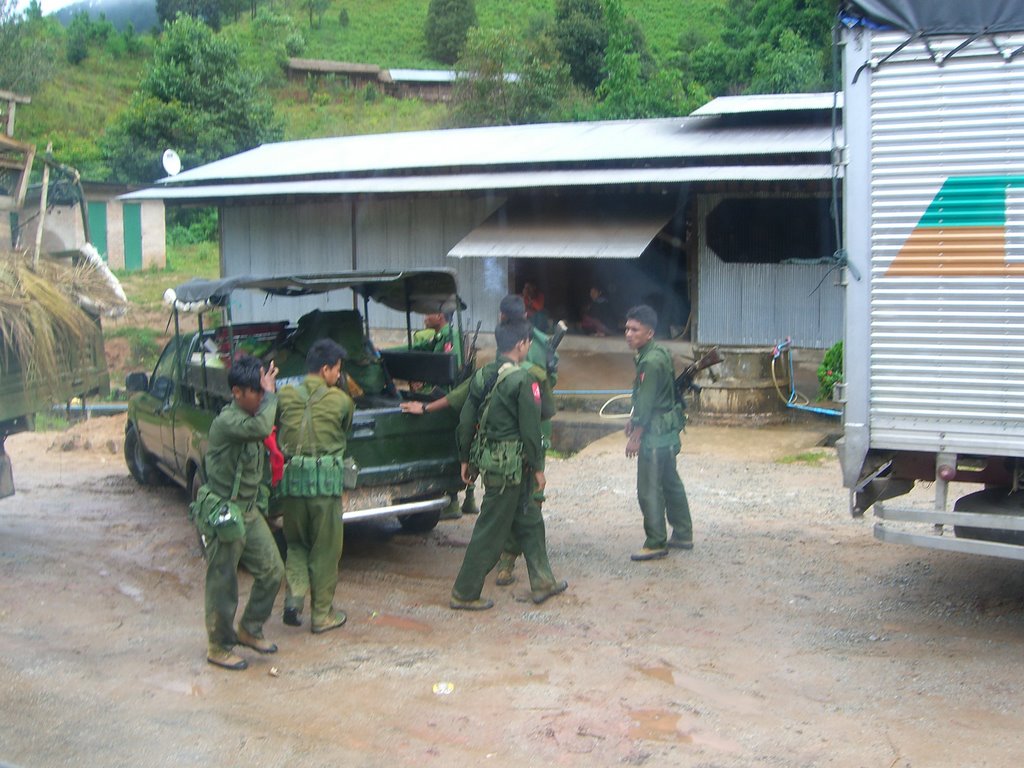
Our bus crossed a terrain of valleys, streams, ravines, jungle-covered hills, banana groves; we passed straw huts, small black pigs, and terraced rice fields. Rounding one corner, I looked up the road ahead of our bus and far in the distance I made out a group of people walking down the road towards us. I suspected they might be soldiers – something about the way they walked; also that they carried long objects. Indeed, we were about to pass an infantry battalion of the Myanmar army – presumably it was on the move against the insurgency which is known to be active in Shan State. Our bus passed several hundred soldiers in all: many carried heavy machine guns, others mortars or grenade launchers on their shoulders. On foot, apart from the big machine guns or mortars they slogged, the soldiers traveled light -- no heavy packs, just ammo belts around the waist.


Then our bus came to a stop for a few minutes. Military trucks blocked the road opposite some roadside stores – presumably the commanders were loading up on supplies (see top photo). Later we passed more trucks carrying soldiers, tents, poles, other camping equipment, but little else. No tanks, helicopters, jeeps, or other modern vehicles of war -- just old trucks.


What I saw on the road that day corresponded with a recent assessment of the state of preparedness of the Burmese army, in terms of its ongoing war against the insurgency. The analysis happened to have been published that same day in the the Asia Times. The writer, Clifford McCoy, noted that although the Burmese Army (the Tatmadaw) had purchased some newer tanks and guns, there was no evidence that any this modern equipment had been put to use in the field. Moreover, although much of it was useless for insurgent warfare, some of this new hardware seemed better suited for battling democracy protestors in urban settings. His main point was that today the Burmese government wages war against the insurgents almost exactly the same way it has for the last forty years: same tools, same ineffectual tactics. And with egregious human rights violations:

Strategy and tactics likewise remain relatively unchanged from decades ago. The guiding strategy is still the so-called "four cuts", which seeks to deprive armed resistance of food, funds, intelligence and recruits by separating them from civilian support. The army implements this strategy by targeting villagers, razing their jungle communities and forcing them out of the hills and mountains. The SPDC has notably shown very little inclination to dedicate resources toward winning the "hearts and minds" of ethnic civilians.

Recent reports from the Free Burma Rangers and the Karen Human Rights Group indicate that army columns have been conducting sweeps of KNU-controlled territory, shooting villagers on sight and destroying their food supplies and crops. True to form, the great majority of casualties inflicted by the army's current year-long operations have been Karen civilians, providing yet further fuel to the fire of Myanmar's long war.

Keng Tong: A Warning and a Celebration

Finally, I arrived in the northern Burmese town of Keng Tong. Khin had warned me about this place:
When you go there, be sure not to eat the chicken. They had bird flu recently -- three months ago ten people died there. A tour-guide friend in Keng Tong told me about it. He says a doctor lost his job for trying to report it.
My final night in Keng Tong, I attended the night festival for Buddhist Lent. I have never heard so many firecrackers. And kids liked to throw them at people – especially at me -- so getting around the town meant playing dodge-the-fire-cracker. That night, I shot this video clip depicting what struck me as an unusual procession: it consisted of perhaps fifty men in total...

Wednesday, October 11, 2006

Speaking Out Against Myanmar's Regime

TACHILEIK, MYANMAR: Khin told me his prized possession was a book by Aung San Suu Kyi, the imprisoned leader of the National League for Democracy who won the Nobel Peace Prize in 1991. His admiration of her was unshakable and his loyalty fervent. I asked him what had sustained the military dictatorship. Khin replied:
My country has many poor people with no education. Many of them think they are poor because they are lazy. They don’t see what the army has done to their country.
Another woman who Khin held in high esteem was US Secretary of State Condi Rice. He was well aware of her efforts to entice the Thailand and other ASEAN member states to get tough with the Burmese regime.

I mentioned to Khin that the UN Security Council was presently meeting to discuss the situation in Burma – also a US initiative. He was excited to hear such news. (International news was not quick to reach those living in this town. There was no Internet access. My Thai mobile phone still worked; but beyond this border town overseas calls were prohibitively expensive at $5 a minute). I advised Khin not to get his hopes up -- China would likely veto any sanctions against the regime -- and would sanctions do any good?

Perhaps such pessimism was not warranted. The UN Security Council talks seems to have galvanized the government to reconvene its never-ending constitutional conference -- a measure which prompted a boycott of those talks by opposition groups. Following from this, judging by some recent news reports (here and here) there seems to be increased resolve on the part of protestors in the capital city of Rangoon (Yangon) -- which won't remain the capital for much longer as last year the government inexplicably decided to move it. Other reports (here and here) are more gloomy.

The Ghost on the Bus

MYANMAR (BURMA): Consumer complacency appalls me. Because it is commonplace in Southeast Asia, I was surprised and thankful to discover on my bus journey to Keng Tong that among my fellow passengers was a most assertive – not to mention outspoken -- Burmese woman.

Our driver served as mechanic for the forward bus in our little two-bus convoy. My bus didn’t break down, but the one ahead of ours did – over and over again. The first time he got off the bus to make repairs, our driver abandoned us to the thickening heat (because docile passengers occupied seats situated in the isle, nobody could not get off). Had we not sat there sweating for an hour? Suddenly, a woman seated in the back row started hollering something; next other passengers giggled and began to cheer her on. Before too long the driver -- in apparent compliance with the lady’s request – was telling us to get off the bus.

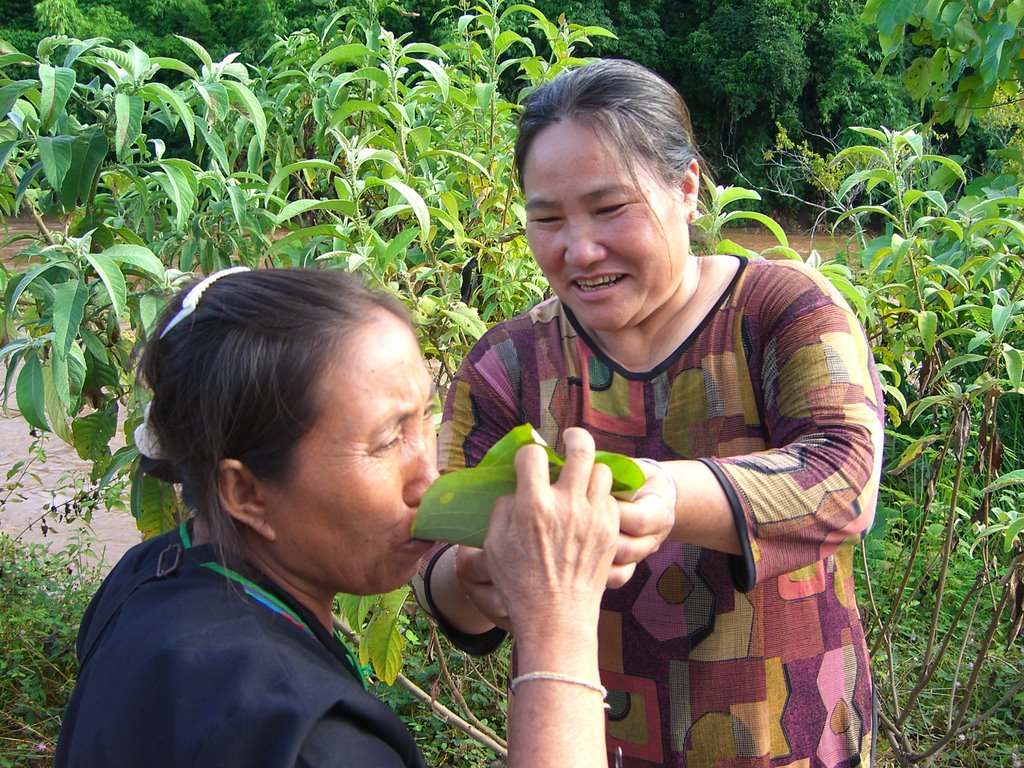
A few minutes later, near to where I stood, the assertive woman walked off the road and picked a giant round leaf. Folding the leaf into a cup-shape, she pointed at my water bottle, which I gave to her. She poured some water into the leaf-cup and gave this to her friend, who, sipping from the leaf-cup, popped some pills.

Now I should point out that -- officially -- I was on the “Air Con Bus.” The name was deceptive. Previously, the ticket agent had explained: “Actually there isn’t any air con on the air con bus because the passengers keep the windows open.” I had to restrain myself from laughing: Actually there isn’t any air con on the air con bus… I mention this because our driver exhibited an annoying tendency which was to tailgate the first bus, exposing his passengers to its smelly black diesel exhaust. Just as the air was getting unbearably noxious, familiar shouting came from the back of our bus; cries of support from other passengers followed. At this, the driver put some distance between the buses. Thanks to the outspoken woman we could breathe.

Before we had boarded the bus, local passengers had submitted state-issued identity cards; station clerks then hand-printed passenger information onto a roster that got faxed somewhere. (In my case, before boarding, a messenger actually had to be dispatched to immigration to get travel documents copied and my passbook stamped). Before arriving in Keng Tong, the bus attendant handed the ID cards back to passengers. As he called out names, he made up jokes – taking care to mock especially funny-sounding names. Most passengers thought his routine hilarious, though a few victims did not look amused.

Nine hours after our departure (the journey that was supposed to take 3 hours) we arrived at Keng Tong, but not before passing the wreck of a bus that had crashed the day before. Passengers leaned out the window and gasped at the sight of an Air Con Bus sticking out of a ditch.

A couple days later, on my return journey, when my bus again passed this wreck -- in daylight this time – like many other passengers I leaned to my window to take another look. I should mention that it felt like we were in the middle of nowhere; we were transiting through jungle; perhaps thirty kilometers out of town. Examining the bus-wreck, I spotted a man seated by an open window towards the elevated back-end of the bus. At first glace I thought I might be looking at a corpse – for he did not turn his head. But upon closer inspection, the man appeared very much alive; he had thick black hair; he was seated upright. Might he be the driver who had returned to meditate on his recklessness? Perhaps he was a friend or relative of a victim? In any case, I would hardly have faulted anyone on my bus for claiming to have just seen a ghost.

Monday, October 9, 2006

“Our religion is democratic; our country, authoritarian”

TACHILEIK, MYANMAR: Night had fallen. Under the glow of the pagoda, dozens of children played on the vast tiled piazza -- a no-shoes zone. The spectacle of many children sliding on a shiny tile expanse brought to mind the courtyard of Umayyad Mosque in Damascus. After we walked around the floodlit gleaming gold pagoda, we sat cross-legged on the piazza. Khin pulled a magazine out of his bag.

“The Christians --” he began, his finger pressed against the well-worn cover of Watch Tower (a publication of the Jehovah’s Witnesses), “The Christians do not impress me.”

“Where did you get that?” I asked.

“My friend at the church gives me these magazines – I find them a good way to study English. But I don’t agree with what the Christians say here…” (There seemed to be an acute shortage of reading material suitable for English study. Later, when we passed the town library he shook his head and sadly remarked: “That’s the town library: I tried to use it, but they won’t let me because I don’t have the right papers. I am not from this town, so it is not permitted.”)

Khin tapped the cover of Watch Tower. “According to the Christians, there is only one way. Christians say, ‘believe in Jesus and you go to heaven’ – they say that is the way, the only way.” An attractive woman holding a child had approached and lingered nearby, observing. Khin continued, “But Buddha says there are two ways.” He held up two fingers and explained it this way:
The first way is to be good; not to lie, etc. and so reap the benefits… The second way is to do whatever we like and then face the consequences of our actions.

The religion of Buddha is democratic. Burmese live in an authoritarian country but practice a democratic religion. Western people have an authoritarian religion but live in democratic countries. In Buddhism we are allowed to do whatever we want to do, and so we can learn – it’s a religion based on feedback. Because it encourages feedback, I say our religion is democratic.
The woman with the baby had left us, and a group of boys in their early teens had taken her place. They sat down nearby, observing. Khin suggested I ask the kids a question. They were extremely polite and had an innocent earnestness about them.

“What kid of jobs do you want to go into after graduation?”

My question elicited a predictable chorus of groans. “A sailor in the merchant marine” volunteered one boy. Two said they wanted to be pilots. The youngest of the students said he wanted to be an airplane steward. At this one boy jeered, “He wants to be a girl!” to great laughter. And finally one kid said he wanted to join the army.

I thought the responses interesting for the occupations that weren't mentioned.

Myanmar

In the past four hours, Jotman had been urged to buy cheap Viagra a dozen times, and London brand cigarettes as many more. No, Jotman has not been reading his email. He has been walking the streets of Tachileik, a border-town in Myanmar.

There is not a Westerner in sight. Scarcely a word of English spoken. Neither restaurant nor coffee shop to be seen -- despite a second circuit of the city by way of tuk-tuk. Same China-made stuff for sale here as across the border in Thailand, but these stores ramshackle, their interiors dark from lack of lighting.

A few hours earlier I had reserved a room in a guest-house. Now back at the border bridge, I looked at my watch and I saw that I might still escape this forbidding place: the border would remain open another ten minutes. While I contemplated the relative comfort of the opposite riverbank, a fellow in his twenties approached speaking almost fluent English. Khin (not his real name) had terrible-looking black teeth from eating too much betel-nut. I led down my guard a little as I came to the realization that Khin was not your typical tout or scam artist; for one thing, he struck me as both highly intelligent and sincerely hungry for something to eat. Perhaps here was someone who could tell me something about this place. I told Khin that dinner was on me if he could find us a place that served vegetarian.

We walked through backstreets crowded with pedestrians, bicycles, and the occasional motorcycle. A group of little monks scurried along in maroon robes; “many of them are orphans” Khin said. “Except for such children, if you ever see a monk outside a temple after 12 noon, you can be sure he is not a real monk.” I pondered the implication of what Khin had said: Burma has fake monks?


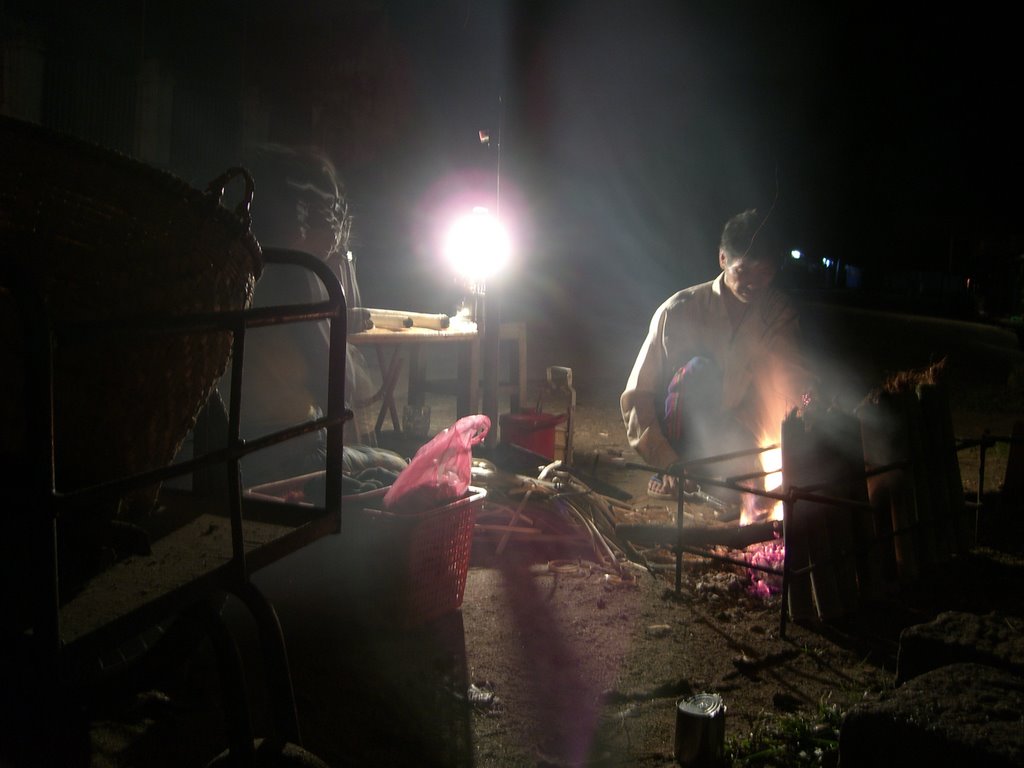
We passed a classroom by the side of the street where students were learning by light of candle. “They are studying Thai -- knowing Thai helps Burmese get good jobs.” Enchanted by this roadside classroom, I took this photo.

Sunday, October 8, 2006

On the Thai-Myanmar Border

Thailand has been under the thumb of the junta for almost two weeks. On this blog I discussed some of the immediate changes brought about by the regime change. But what is it like for a country to sustain sixteen years of military rule? With that question in mind, I arrived at Mei Sae, a town on the Thai-Burma border.

The river is lined by guest houses and shops; central is the bridge -- a neutral territory occupied by begging children -- which spans two official checkpoints. The town on the Burmese side is Tachileik, undistinguished except for a pagoda and a casino built on its river bank.

I stopped at riverfront guesthouse for dinner. The manager told me sometimes Myanmar soldiers shoot people trying to swim across the river to Thailand. (I have tried to confirm this, but others residents dispute that swimmers get shot).

Going further up the river, I almost walked right past a small Thai army checkpoint. I spoke at some length with a Thai army sergeant, while a procession of Burmese on bicycles streamed past us. Some of the young men took a steep path to the river where they quickly stripped down to their underwear. Their clothes contained in clear plastic bags, they waded and then swam across the river. Past where we stood, the Burmese border extended over to our side of the river.

"Where's the border line?" I asked the sergeant.

"See that white dog?" Through the bushes I could see the animal sleeping. "That dog belongs to the Myanmar army."

The sergeant told me the Burmese were permitted stay on the Thai side for one day.

Suddenly, the sergeant looked at me quizzically. "Why are you interested in this?" Scowling, he pointed in the direction of the myriad border-crossers, "All this, it is so very low-so." Using Thai lingo, the sergeant wanted to know why a Westerner would have interest in the activities of low-society people.

Such direct expressions of contempt for the underprivileged may be rare, but the attitude behind such statements is a familiar one. The prevelance of this outlook is one reason I view the prospects of Thailand's coup d'etat with skepticism. Deposed, but democratically elected, Prime Minister Thaksin was no altruist. But he owed his popular mandate to successful initiatives like $1 per-visit-health care. Such policies won him the support of the rural poor. Thaksin's constituency was, from the vantage point of Bangkok's "high-so," decidedly "low-so."