Showing posts with label Canada. Show all posts

Friday, March 19, 2010

Japan convinces world not to protect bluefin tuna

Not only Japanese, but also Canadians and the citizens of all but twenty nations -- should be ashamed of their governments.   Today, they failed to protect the once abundant, magnificent and endangered bluefin.

New York Times:
Delegates at a United Nations conference on endangered species in Doha, Qatar, soundly defeated American-supported proposals on Thursday to ban international trade in bluefin tuna and to protect polar bears ...
Delegates voted down the proposal to protect bluefin by 68 to 20, with 30 abstentions. The polar bear measure failed by 62 to 48, with 11 abstentions.

The rejection of the bluefin proposal was a clear victory for the Japanese government, which had vowed to go all out to stop the measure or else exempt itself from complying with it. Japan, which consumes nearly 80 percent of the bluefin catch, argued that the International Commission for the Conservation of Atlantic Tunas, or Iccat, should be responsible for regulating the fishery, not the United Nations. . . .
 AP reports:
Thursday's decision occurred after Japan, Canada and scores of poor nations opposed the measure on the grounds that it would devastate fishing economies.
Only the United States, Norway and Kenya supported the proposal outright. The European Union asked that implementation be delayed until May 2011 to give authorities to respond to concerns about overfishing.
The United States is certainly to be commended for its position.   No doubt US diplomats did their best, but where was the top political leadership on this issue?   The US was represented at the meeting by the assistant interior secretary for fish and wildlife and parks.  In view of the high-level commitment of the Japanese to defeat the measure, the Obama Administration does not appear to have lobbied hard enough. 

WaPo
The adult population of eastern Atlantic and Mediterranean bluefin tuna has declined 74 percent over the past half-century, much of it in the past decade, and the population has dropped 82 percent in 40 years in the western Atlantic.

"This was a case of just plain ignoring the science for short-term economic gain," said Susan Lieberman, director of international policy at the Pew Environment Group, in an interview from Doha.
Here's a terrific video of the bluefin:


Mechanisms for protecting marine species need to be improved.  Enforcement of existing restrictions against  illegal fishing is rare.  Grocery store chains and sushi joints continue to market endangered fish.  This entire issue needs to be taken more seriously by every global citizen.

AP which has produced a video on the outcome, reports that next on the agenda is protecting the sharks.  The Japanese, of course, are ready.

Sunday, February 14, 2010

Demonstrations at the opening of the Winter Olympics in Vancouver

On Friday, as many as 5,000 demonstrators danced, sang, an held signs in a peaceful protest in downtown Vancouver.  Vancouver, year-round the warmest big city in Canada, has long been a magnet for the country's homeless.  Protesters believe the billions spent on the Olympics ought to have been spent eradicating homelessness.  From time to time the chant broke out, "Homes not games!"

Others used the occasion to spotlight the need for action on climate change, environmental destruction, the rights of Canada's indigenous people, the growing power of corporations (including Olympic sponsors), and Canada's support for the war in Afghanistan.    Many of the protesters would later march towards the  stadium to be blocked by a line of police.


The people in orange told me they were "neutral."  These legal observers were handing out sheets to citizens  informing them off their their rights under Canadian law.


Interestingly, some Circassians showed up to protest the 2014 Winter Olympics Games in Sochi, Russia.


Photos by Jotman.  Links to other bloggers' firsthand reports from the streets of Vancouver here.

Thursday, January 7, 2010

Japanese whaling ship rips Sea Shepherd boat


Updated (videos!)

ABC has a report on a rare collision in the Southern Ocean.   The Japanese whaling security ship Shonan Maru No. 2 has rammed and damaged the Ady Gil, a $2 million high-speed trimaran belonging to Paul Watson's anti-whaling Sea Shepherd Society.    The Andy Gil is believed to be sinking but the crew were rescued by the Sea Shepherd ship Bob Barker.   The Sea Shepherd Society has asked Australia to send a naval vessel to "restore peace" and protect the 21 Australian citizens on board the Sea Shepherd and the whales from the Japanese.   According to ABC, the incident happened "outside Australia's economic zone but within Australia's search and rescue zone."

The Sea Shepherd website gives some background about the unprecedented resources the organization has sent into the cold waters off Antarctica this whaling season.
The objective of Sea Shepherd’s three-ship campaign is to bankrupt the illegal Japanese whaling fleet and to sink them economically.

“This year, I have three ships, four small boats, a jet ski, a helicopter, 77 crew, and a bagful of aggravation for the Japanese whale poachers,” said Captain Paul Watson. “We intend to make life miserable for the whale killers over the next month and a half.”

Included in the crew is the Animal Planet crew filming the third season of the hit television series “Whale Wars.”

The Sea Shepherd crew number 77 from 16 nationalities including Australia, Brazil, Canada, Ecuador, Estonia, France, Germany, Ghana, Hungary, Ireland, Japan, Netherlands, New Zealand, South Africa, Sweden, United Kingdom, and the United States.
Jotman wishes Sea Shepherd every success against the whalers.

But it's important to recognize that whaling is just the tip of the iceberg -- the best known and most publicized -- of the various ways people are harming marine life.  The most important battles have yet to be won.
___
Pictured in my photo is a minke whale -- one variety that Japanese commercial whalers claim the right to hunt.   

UPDATE: Here's a video (h/t Omar Todd) -- taken by a person on the Japanese whaling ship -- showing the high-tech trimaran getting sliced by the bow of the whaler's "security ship."   


UPDATE 2: And here's a video of the incident shot from the Sea Shepherd's Bob Barker:

Saturday, November 21, 2009

What countries appeared most/least corrupt in 2009?


 Scanning the list from best to worst, here's what strikes me about the rankings of countries in Transparency International's corruption perceptions index for 2009:*
  • The top ten least corrupt are the Nordic countries, plus New Zealand (#1), Canada, and Australia.  (Netherlands isn't exactly Nordic, but it comes in at #6.  Singapore (#3) is perceived as the least corrupt country in all of Asia.
  • The US (home to Delaware) and UK (protector of Jersey) just barely make the top twenty.
  • Three Gulf states are perceived as less corrupt than Israel (#32)
  • The big countries of Eastern Europe  -- Hungary, Czech, Poland (#46-52) -- are believed to be more corrupt than any country in East Asia outside of China.
  • Turkey (#61) and Italy (#63)are perceived as being almost equally corrupt, but Turkey (still considered unfit to join the EU) ranks higher than both Italy and dismally-ranking Greece which is tied with Romania at #71.
  • China (#79) and India (#84) rank similarly on corruption.    India is tied with Thailand.
  • In South America, Chile is #25 (ahead of Spain) but neighboring Argentina is #105.  (As we saw with the English speaking world, the "colonials" seem to be outranking the "mother countries" on this survey).
  • Egypt has the same perceived level of corruption as Indonesia (#111), but the "land of baksheesh" is perceived as being less corrupt than Lebanon (#130) and Syria (#126) and even Vietnam (#120).
  • Pakistan and Philippines are tied at #139.
  • Zimbabwe is tied with Russia at #146.
  • Laos and Cambodia are tied at #158.
  • America is trying to win wars in two of the five most corrupt countries in the world.  (Iraq and Afghanistan's rank prior to America's invasions could not have been any lower.)
___
* ASEAN countries names are in bold. At Jot ASEAN I posted a short list that includes only Southeast Asian countries.

    Tuesday, October 27, 2009

    World's most efficient solar home

    Some of the world's most innovative solar homes were featured at the biannual Solar Decathlon on the Washington Mall which ended last week.   Twenty teams from US, Canada, Germany, and Spain competed to see which university could build the most livable and efficient solar home.   I walked around all the homes, and I took pictures of the ones I liked best.

    The experimental homes averaged about 750 square feet, and cost between $200 and $800 thousand to build. Corporations at the cutting edge of solar technology donated solar power technology.   

    Germany's team won mainly because it blew away the completion in the critical "net metering" category.    The Germans, who were defending their 2007 victory in the Solar Decathlon, had brought a secret weapon to Washington this year: thin film. 

    1.
    Team Germany

    150.000

    Net Metering: contest points (ranked 1)
    2.
    Illinois

    137.236

    Net Metering: contest points (ranked 2)
    3.
    Team Ontario/BC

    109.911

    Net Metering: contest points (ranked 3)
    4.
    Team Spain

    109.216

    Net Metering: contest points (ranked 4)

    The Economist reported, ""the decathletes of Team Germany, who designed the winning house, bragged that its north façade was covered in panels that could convert even indirect sunlight into electricity."   The "modernist box" had walls that were "covered in solar cells made with thin coatings of silicon and other materials in the place of expensive slices of crystal. Thin film, as this technology is known, is still less popular than crystalline cells and its move to the mainstream has been a year or two away for a decade. But its time may have come at last."   

    The winning house by Germany is the sleek black box on the right:

    In terms of architecture, my personal favorites were Germany, Ontario/BC, Cornell, and Virginia Tech.   The Virginia Tech entry (below, top photo) featured sliding shade screens over a pond -- and it even came with its own wheels!  

    Final results for the architecture category:  

    1.
    Team California

    98.000

    Architecture: contest points (ranked 1)
    2.
    Rice

    95.000

    Architecture: contest points (ranked 2)
    3.
    Virginia Tech

    94.000

    Architecture: contest points (ranked 3)
    4.
    Team Germany

    94.000

    Architecture: contest points (ranked 3)
    5.
    Team Ontario/BC

    91.000

    Architecture: contest points (ranked 5)


    Ranked by architecture scores, the above photos show 3rd-scoring Virginia Tech; 16h place Cornell in the foreground with 4th place Germany behind; and 5th place BC/Ontario.

    Europe holds a Solar Decathlon on even-numbered years.  Madrid will host the next Solar Decathlon in June 2010.  Team Spain's entry in this year's decathlon, which ranked 14th overall, is shown in the top photo.

    Interestingly, the last-place finisher in the expert judged-contest, University of Louisiana, actually won the "people's choice" public poll.   Although the Louisiana entry fared poorly in many categories, it came first in the "market viability" category, and fared well in terms of comfort, home entertainment and appliances.  Unique among the entries, this home featured "hurricane protection" sliding.

    Update: a video from America.gov shows the winning entry from Germany.   It seems that Germany's team from  the Technische Universität Darmstadt adhered to something called the Passive House building standards.  More on the TUD here.

    Sunday, October 11, 2009

    Outcome of Bangkok Climate Change Talks

    A Guardian article written well before the Bangkok talks ended in disarray -- without any resolution in sight -- remains a concise summary of where things more or less stand:
    So Guardianistas, here is the official state of play with just a few weeks to go until the final round of talks which begin in Copenhagen on 7 December. So far, the UN has said rich countries need to cut their emissions by 25-40% by 2020 (compared to 1990 levels) to stay within the 2C rise which the scientists say is the upper limit of what Earth can take. But the UNFCCC secretariat (the people running the climate talks) reckons that the combined cut from pledges made by rich countries so far adds up to just 16-23% - and that's excluding any cuts made by the US.

    The Alliance of Small Island States (made up of the countries who stand to be drowned in a few years and which have as their motto: "1.5 to stay alive") say that if the US joins in with its expected target of about 4-10%, that would give an aggregate global cut of just 11-18% in emissions. If so, that means that we, the rich, intend to cut our emissions by a measly 6% more than what we pledged - but failed to reach in 2002. And with carbon offsets - which we can pass on to poor countries - that means we need do next to nothing at all at home. Indeed, we could probably increase emissions and carry on building coal power plants. No wonder the EU and rich countries are hiding from the press and the developing countries are furious!
    The main positive outcome of the talks was Norway's pledge to reduce its emissions by 40%, putting other rich countries like Canada to shame.

    Irony or strategy?

    3 UPDATES (which tell the story)

    Yesterday I blogged:
    Perhaps the hope is that awarding Obama the prize now will encourage Obama to take a step back from the precipice; that it might alert this young president not to continue his steady drift toward the Dark Side.

    If so, the prize does not come a moment too soon.  The Obama presidency may be only a few weeks away from being inexorably squandered. 
      A decision on General Stanley McChrystal's proposal to escalate the war in Afghanistan looms.  The US seems to be standing in the way of progress at the Bangkok Climate Change Talks. 
    Naomi Klein, interviewed from Bangkok for Democracy Now, also picked up on the irony of Obama winning the prize in view of the American negotiating position at the Bangkok Talks:
    ....one of the things that the Obama administration is being rewarded for with this prize or what Barack Obama is personally being rewarded for in this prize is his supposed breakthroughs on international relations. What we’re actually seeing, as we speak, in Bangkok—this is the final day of two weeks of climate negotiations—has been extraordinarily destructive behavior on the part of the United States government, on the part of the Obama administration, absolutely derailing the climate negotiations in the lead-up to Copenhagen. Developing countries are absolutely shocked by what US climate negotiators have done. They have gone into these talks saying, you know, “We’re back. We want to reengage with the world.” What they’ve actually done is made a series of demands that would destroy the Kyoto Protocol and the binding emission architecture that was set up under Kyoto. So, to reward the Nobel Prize in the context of destroying the climate, where the US is destroying the climate negotiations, or threatening to, to me, is just shocking.
    Have any mainstream media commentators taken any notice of this remarkable coincidence?  Not to my knowledge. For more on the talks, see my post: In Bangkok US talks "green eggs and ham"

    UPDATE 1
    Earlier in the week, shortly before five Norwegian parliamentarians would award Obama the Nobel Peace Prize, Norway stepped up the ante at the Bangkok Climate Change Talks.  On Oct. 8, Oxfam reported in a media release from Bangkok:, "“Today, Norway has entered this debate and set a target of 40 per cent below 1990 levels, so we know what leadership looks like.” 

    A Huffington Post story explains why the Norwegian initiative at the Bangkok talks matters:
    Because Norway is the first developed nation to make any solid commitment on this front and it has the potential to break through a major impasse. Up until this point developed nations - like the United States, United Kingdom, Canada, France and Japan - have been unwilling to bring anything to the table on this point.
    This announcement from Norway, a major petroleum producing country, testifies that the Norwegians take climate change question extremely seriously.

    UPDATE 2
    On Friday, after the Bangkok Climate Talks had  ended in an atmosphere of recrimination, The Guardian reported:
    Global climate change talks came to an end in Bangkok today in an atmosphere of distrust and recrimination, with the rift between rich and poor countries seemingly wider than ever. After two weeks of negotiations there have been no breakthroughs on big issues such as money or emissions cuts.

    With just five days of negotiating time now left before the concluding talks in Copenhagen in December, delegates said it appeared a weak deal was the most likely outcome, and no deal at all was a possibility.

    However, President Obama's expected visit to Oslo to receive the Nobel peace prize in the middle of the climate talks raised hopes that he would make the short journey to Copenhagen to galvanise governments.

    "World leadership is now vital if the talks are not to fail completely. It is inconceivable that Obama could now ignore the climate change talks," said one diplomat.
    One striking connection between the Copenhagen Climate Conference and Obama's Nobel Prize Award concerns the calendar:
    • Nobel Peace Prize award ceremonies in Oslo: Dec. 10, 2009
    • Copenhagen Climate Change Conference: Dec. 7-18.
    Obama's Nobel Prize would seem to raise the expectations for the United States at Copenhagen. Might the decision to award the Nobel Peace Prize to Obama have been a strategic last-ditch attempt to, in effect, corner the Obama Administration?   Is it conceivable -- as per my suspicion  yesterday -- that the Norwegians on the prize committee were not exhibiting Eurobamania, but had actually thought this one through -- -strategically?  

    UPDATE 3 
    If you were to get all your news from mainstream US media, it would be hard to comprehend the extent to which Europeans, Scandinavians in particular, consider climate change to be the issue of our times.

    I would venture to say that when Americans hear the words "Nobel Peace Prize" they think about their country's wars.  But my hunch is that this year in particular, the Norwegians would have been thinking about their Peace Prize in terms of stopping climate change.  Copenhagen is a big deal. To understand why Obama got the prize, it makes sense to consider Norway's position on the climate change question.

    Monday, September 28, 2009

    Will Obama lead on climate change?


    To get beyond yesterday's problems, the United States must take the lead by solving tomorrow's.

    The Pittsburgh G20 ended last week, and the Bangkok Climate conference has just begun. The make-or-break Copenhagen summit is only two months away. A climate policy expert looks at how much progress has been made, and finds American leadership falling short of what's necessary at this critical juncture (Media Release, Sept. 28):
    Oxfam International Senior Climate Policy Adviser Antonio Hill said recent announcements by British Prime Minister Gordon Brown and the EU on climate financing, and Japan and China’s stronger language last week on emissions reductions and finance, would put extra pressure on the US to step up and signal its intentions on its role in a global deal.

    “Despite good intentions and warm words over the past six months, the US didn’t deliver real leadership last week at the UN Climate Summit and G20.  Either the US lifts its game, or the next two weeks in Bangkok could go down as just a holding pattern before a fatal nosedive in Copenhagen,” he said.

    He said while many key countries, including China, India, Japan, African Union, the Least Developed Countries and the Alliance of Small Island States, had shown they were ready to enter the final, more detailed phase of negotiations, intransigence on the part of rich countries like the US, Canada and Australia was proving an obstacle to progress.

    Key sticking points remain the emissions reductions developed countries are willing to deliver – current commitments are around 15 per cent instead of the science-based 40 per cent reductions on 1990 levels by 2020 - and the amount of financing they will put on the table for developing countries to both adapt to the impacts of climate change and develop on a low carbon pathway.

    The two-week negotiations, held in South-East Asia, one of the world’s most vulnerable regions to climate change, is the penultimate negotiation session before Copenhagen in December, when a fair and safe global climate change treaty must be secured.

    Mr Hill said that whilst last week’s summits in the US were forums for world leaders to signal their intentions, the UN negotiating process continuing in Bangkok was the only place where countries could forge an agreement to avoid catastrophic climate change.

    “It’s crunch time,” Mr Hill said. “What is needed for a breakthrough is a clear commitment from developed countries – responsible for three-quarters of the carbon in the atmosphere - to commit to substantial finance, additional to existing aid levels, to developing countries.”
    Hill echoes what I heard  Jorma Ollila, chairman of Royal Dutch Shell, acknowledge in Helsinki three months ago:  the developed world bears responsibility for having damaged the earth's atmosphere, and Washington must take the lead.

    Health care, the war in Afghanistan, and climate change:  these three big issues confront the Obama presidency simultaneously.   Who does not believe that the success or failure of Obama's entire presidency rides with how competently the president handles one or another of these matters?

    But which decision will be the most significant? Of the three issues, two are largely yesterday's fights, only one concerns the challenge of the future.   Moreover, on two issues -- the same two -- the cost of waiting for a second chance is manageable.  Other countries have solved the problem of providing universal health care, and the US will have other opportunities to solve it.   The rest of the world has "given up" on the cause of bringing freedom to Afghanistan, but supposing Obama hesitates to defy his generals and sends in more troops, Congress can still bring them home at any time.  For the rest of the world, Afghanistan is yesterday's war; universal health care, a social policy worked out generations ago.  There will be second chances.

    But if the American economy -- and by extension, the world -- is not set on a path towards sustainable growth, then wars and health care costs are bound to spiral out of control.  Furthermore, the cost of setting the world on a sustainable path with respect to climate change increases with every lost decade.  And on this issue, alone, there is a "point of no return."   Therefore, hands down, if the Obama Administration must get just one issue dealt with properly in 2009, it's energy and the environment.  To get beyond yesterday's problems, the United States must take the lead by solving tomorrow's.
     ____
    Photo by Jotman shows the US Congress.

    Saturday, September 26, 2009

    First use of sonic weapons on American citizens

    This week the United States legitimated the indiscriminate use of a new kind of weapon that will empower the world's most despotic governments. (3 UPDATES)
    "For supporters of nonlethal weaponry, having the devices used against peaceful protesters is the worst sort of PR."
    Obama, responding to a question about persons protesting the G20 summit in Pittsburgh said: "If they had been paying attention to what was taking place inside the summit itself, what they would have heard was . . ."


    After watching this video, I wondered: Have sonic weapons ever been used on American civilians before?  The Guardian reports:
    Sonic weapons or long-range acoustic devices have been used by the US military overseas, notably against Somali pirates and Iraqi insurgents.

    But US security forces turned the piercing sound on their own citizens yesterday to widespread outrage. Pittsburgh officials told the New York Times that it was the first time "sound cannon" had been used publicly.
    Are they safe? Do they cause long term damage? I doubt anyone knows for sure. After all, they assured everyone that Tasers were safe. But four hundred people in the US and Canada have died from being subjected to these supposedly non-lethal weapons since 2001.

    The use  of new sonic weapons will mean that from this week forward, Americans can more easily be prevented from gathering.  The presence of sonic weapons in police arsenals will deter some citizens from joining future protests, and possibly deter journalists from reporting such events.

    The deployment of a new technology in Pittsburgh legitimates a new means of crowd control.  Governments everywhere will see that an effective new means of crowd dispersal has the approval of the United States.  From Burma to Iran, despotic regimes are watching.   This week in Pittsburgh, the state became more powerful, illegitimate dictators harder to overthrow.

    UPDATE 1:  According to an  NPR reporter, a sonic weapon was used in New Orleans in 2005. Xeni Jardin wrote,  "Here is a photo of one such device being used by military police in New Orleans, outside of the Superdome in post-Katrina flooding."    So the new device was first used against poor black people.

    UPDATE 2:  Apparently sonic weapons were deployed in NYC for the 2004 RNC, but not used.  A Homeland Security initiative made sonic weapons available to police departments. 

    UPDATE 3: The US government allows an American company to exports sonic weapons to China.  David Hambling reports in New Scientist:
    Amongst the displays of high-tech police equipment was the LRAD - Long Range Acoustic Device ? made by American Technology Corporation (ATC). LRAD is an ultra-high-power loudhailer that can be used for crowd control, often described by the media as a "sonic weapon". It was famously used to drive off Somali pirates in 2005.

    LRAD's appearance seems at first surprising, since the US does not permit weapons exports to China. Public Law 101-246, passed after the Tiananmen Square massacre, makes them illegal.

    But ACT are happy to say in their most recent Securities and Exhange Commission filing that:
    "During fiscal 2007, we expanded our international marketing activities and shipped LRAD orders to Australia, Singapore, Korea and China".
    LRAD produces sound levels of up to 150 decibels, enough to damage hearing and above the level that causes pain.

    In the US military, LRAD deployment is overseen by the Joint Non-Lethal Weapons Directorate, who refer to it as a "tool" and "an option in the force continuum".
    Now we know sonic weapons: 1) damage hearing; 2) have been sold by an American company to Singapore and China; and 3) were used  indiscriminately against college students in Pittsburgh this week, but were first  used on US soil against Hurricane Katrina victims in 2005.

    Monday, September 14, 2009

    Ethiopians demand Washington end support for Meles Zenawi

    One thousand Ethiopians marched from the White House to Capitol Hill Sunday. They urged Obama to reconsider US support for the Ethiopian regime. They came from across the US and Canada, representing various ethic groups -- many of which have seldom worked together toward a common goal.

    Increasingly, Ethiopians blame the Ethiopian government for fomenting bloody ethnic conflict. They also blame the regime for political repression and extrajudicial killings.  Over the past 18 years that Prime Minister Meles Zenawi has been at the helm of the ruling Ethiopian People's Revolutionary Democratic Front (EPRDF), human rights groups have documented war crimes; unlawful detention, torture, rape, and ethnic killings have been committed by the security forces.

    The outrage over human rights abuses mounts at time of heightened US support for the Ethiopian government.  The country has been viewed as an important US ally in the Horn of Africa for the Global War on Terror.   In December 2006 the US supported the Ethiopians when they invaded Somalia and crushed the Islamic Courts Union.  Earlier I reported my conversation with a Somali taxi driver:
    It was his view that Somali warlords just had to say, “Hey CIA, we’re fighting Al Qaeda” and they got all the support they needed.
    It worked the same way during the Cold War.  Inevitably wrong choices got made, empowering the likes of Saddam Hussein and Bin Laden. 
     

    On the lawn in front of the Congress, organizers asked attendees to sign letters to Congressmen. The letters  called upon Congress to withdrawal taxpayer support for the regime; demand the release of prisoners of conscience such as Mrs. Birtukan Mideksa, Chairwoman of Unity for Democracy and Justice party (UDJ); and demand that the regime respect human rights.

    Sunday's demonstration was organized by the Solidarity Movement for a New Ethiopia, a new group  recently founded by Obang Metho (interview).  Metho became an actist following the December 13, 2003 massacre in the Western province of Gambella.  Some 124 Anuaks were allegedly killed within a three day period by government forces.

    "Ethiopia is a country, not a tribe" read one protester's sign -- a moto which captured the spirit of this unique event.

    Thursday, June 18, 2009

    How the new media revolution threatens press freedom

    Some Western democracies slipped in the Index. The United States fell more than 20 places, mainly because of ... judicial action that is undermining the privacy of journalistic sources... trying to force them to disclose their confidential sources. Canada also dropped several places due to decisions that weakened source confidentiality, turning some journalists into “court auxiliaries.” France also slipped, mainly because of court-ordered searches of media offices, interrogations of journalists and the introduction of new press offenses.
    - RSF, 2005

    A Finnish government working group on Wednesday proposed a number of increases police powers, including the right to force reporters to name sources during the preliminary investigation stage...

    ...The Finnish Union of Journalists slammed the proposal as a "brazen" attack on the media.

    "The protection of sources is a cornerstone of a free media," Arto Nieminen, the chairman of the union, said in a statement.
    - Helsinki Times, May 20, 2009

    The draft law proposed by Italian Minister of Justice Angelino Alfano ... contains provisions that restrict journalists’ right to report on police investigations, and includes heavy punishments for breaching these restrictions.
    IPI, June 15, 2009

    I'm thinking about a particular incident. It concerned the closing address of the IPI World Congress which was given by the Tarja Halosen, the President of Finland. (Finland will shortly take over the presidency of the European Union: so despite the small size of her country, Halosen's opinions, priorities, and positions are of no small consequence to Europe and the world).

    In her talk, the Finnish president cited some new media developments as cause for concern:
    There is growing concern over the violent features of the material, links and chats distributed over the Internet. Some studies show that violence on the Internet is harsher, heavier and more brutal than on television – and viewers also perceive it as more real.
    The president then turned to discuss the promise of an Internet that
    ....opens up possibilities for civil society globally and provides a means for empowerment. It can capture people’s minds and get them involved with social change, civic action, ad hoc mobilisations, cultural experiments, the sharing of information and so on. My dream is that this positive power of media could be used to make peoples’ life and the world better.
    On one hand, new media has given rise to largely speculative fears that link extremely rare but iconic events -- school shootings, abductions -- to our familiar daily interactions with the online world. On the other hand, the whole discussion of new media has given rise to some wishful thinking. So on one hand we have the fears, and on the other, the Dream. These worries and hopes are the basis for new questions that people spend more and more time debating. Can anything be more important than what happens inside our own homes or the promise of a new technology?

    I think so. What Finland's president said -- and what she did not say to members of the world press assembled in Helsinki -- provides a view into how the new media revolution may pose a threat to press freedom.

    Whereas fears concerning the Internet tend to be personal, the risks these times pose to journalism itself concern power relations in a society that extend beyond the individual. Issues that are not so personal. For example, how laws relate to the process of gathering news. Maybe it appears as if technological change offers the illusion of an escape not only from the stodgy old institutions of traditional media, but those problems the institutions of our free societies have evolved to confront?

    But if those problems have not gone away, we are probably focusing on all the wrong questions.

    What are the right questions? Since the Enlightenment, it has been generally agreed that the most important questions concerning the press concern its relation to the state. The press is the only non-governmental institution mentioned in the United States Constitution. As the president of Finland noted in her address, the press has long been regarded as a Fourth Estate, distinct from other social institutions. In short, the press has rights -- a shorthand for saying the people have the right to a free press. For example, in free countries is is agreed that -- except for certain exceptional circumstances -- journalists should have the right to protect their sources.

    I disagree with the Finnish president about the dangers. The big dangers have little to do with the more offensive forms of content available on the Internet. At the same time, the promise of the Internet to make a better society remains largely speculative.

    This is a time of crisis. With news organizations disappearing, the industry in disarray, a situation has arisen in which field of journalism is simply preoccupied with survival; many of the the societal structures that customarily defend the press have been disrupted.

    Perhaps not coincidentally, in recent years there have even been attempts made to curtail press freedoms in Western countries. There will always be people who fervently wish the news media would just go away. By and large, those who fit this description fall into two groups: One composed of people who have wealth or power and fear losing it. The other consists of people who believe they have the ultimate truth and that nobody should be allowed -- publicly at least -- to challenge their beliefs. We are at a unique moment in history when members of either group could, with relative ease, gain the upper hand in their efforts to strangle a free press. This is the great danger of our times.

    As it happens, in Finland, as the IPI delegates met, legislation was being considered that appeared to be "motivated by a desire to protect the elite from media scrutiny"according to Arto Nieminen of the FUJ.

    After her address to the press delegates, Tim, an officer of the International Press Institute stood up. Tim had thought to ask the president not about her new media fears and dreams, but a question related to the age-old threat to a free press. These are my jots, based on the exchange that followed:
    Timothy Spence, IPI: Confidentiality of sources is considered a foundational value of press freedom. Do you support new legislation your government is preparing that would force reporters to name sources?

    President Tarja Halosen: Those persons who might be interviewed should also have protection. I hope the government will find a good balance between the two things. Even if the court says there is no reason, in the minds of the people there might be still something wrong with the person. I think when the ideas of the freedom of the person .... lets try to balance them.
    Surprisingly, especially considering the context of her appearance (the meeting of a press freedom group), the president did not seem to recognize the issue she was being asked about. Tim, a seasoned newspaper reporter, tried again.
    Timothy Spence, IPI: I have a follow up... My question is more is aimed at what this would do to journalists? Are you concerned that this could force the courts to release their notes?

    President Tarja Halosen: I think you have to take both sides. To also think about those whose names are mentioned. I think I'm not ready to answer in detail. I would refer you to my Minister of Justice. It's always a question of balance.
    In confronting the challenges posed by the Internet, we imagine all kinds of bogymen. Such were the kinds of concerns the president had come prepared to address. Of course, the media itself has played a role in stirring up such fears. Citizens naturally fear for their children, and politicians believe responding to these concerns is a high priority.

    But the age-old questions? It was as if the Finnish president had forgotten about those.

    At a time when the traditional news media are in crisis, we should guard against allowing enthusiasm or fears about new media to obscure genuine threats to a free press. Press freedom organizations such as IPI, RSF, or CPJ are more necessary at this time than ever before. Certainly, the age-old questions they ask have never been more timely.

    Jotman live-blogged the following panel discussions at the IPI World Congress:

    Tuesday, June 9, 2009

    Is the Nordic model worth emulating?

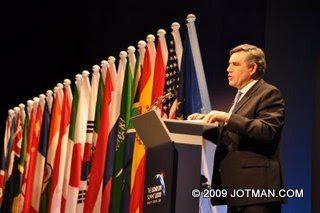
    At the G20 summit in London I watched Gordon Brown announce that “the Washington Consensus is over.” Indeed, the financial crisis had left the so-called Anglo-Saxon model of economic growth completely discredited -- a fact that even a British Prime Minister could no longer deny.

    So the old model was out. But what might serve as an alternative? Going into the summit France and Germany hardly inspired confidence. Neither did the safety-net deprived, export-driven model of growth adopted by Asian countries such as China, represented at the meeting seem to hold the answer.

    Largely absent from the G20 summit of April 2 were a group of countries that have been wildly successful by almost any measure -- countries that may well offer a model worth emulating. Now, as never before, the example of Sweden, Finland, Norway, Denmark (and to this list might be added the Netherlands) deserve a careful look.

    But is it possible for other countries to emulate the example of the Nordic democracies?

    At the IPI Congress in Helsinki, Monday, a panel of experts on Scandinavia addressed the question.

    I live-blogged their answers.

    At the IPI Congress in Helsinki, Monday, a panel of experts on Scandinavia addressed the question.

    The first panelist to speak, Andrew Brown, the author of Fishing in Utopia, was skeptical.

    “Democracy not one thing, not a set of constitutional arrangements, but almost religious faith in the people, and social attitudes” Brown said. “If you take these away, you are merely left with the constitutional arrangements.”

    Andrew saw much of what had made Nordic democracy viable absent in his native England. “Swedes will complain to radio call in shows about how the country is not doing enough to nurture badgers” Andrew observed. For Andrew, the essence of Nordic democracy is something cultural -- you simply can’t export an attitude of caring for badgers!

    Andrew’s critique stood in marked contrast to the optimism of the two panel economists concerning the transferability of Nordic model. Here’s a list of the panel members as presented in the agenda:


    “Nordic Democracy – A Lesson for the World?”


    The so-called Nordic Model, with its emphasis on consensual political institutions, social welfare, and the universal provision of basic human rights, has long been admired by other countries. But critics point at the increased state interference in all areas of public life. Has the right balance been achieved? Is the Nordic model of democracy exportable? What challenges does globalisation present to the model?

    • Andrew Brown, Writer and Journalist, The Guardian, London
    • Sixten Korkman, Managing Director of ETLA (The Research Institute of the Finnish Economy) and EVA (Finnish Business and Policy Forum)
    • Pär Nuder, former Minister of Finance, Stockholm
    • Egill Helgason, Moderator, Presenter, "Silfur Egils", Icelandic National Broadcasting Service (RUV), Reykjavik

    Drawing on a US political analogy, Sixten Korkman, Managing Director of ETLA, explained that that in the Nordic countries social welfare had not come at the expense of their ability to compete in the global marketplace. In other words, these countries showed that what’s good for society can be good for companies.

    Taking the current US debate over health care reform, Korkman said, “You can have collective solutions that are also good for business -- argument for publicly funded health care (as opposed to employer financed as in the US).”

    I thought this was a good example. One explanation for the bankruptcy of GM is that the company had been weighed down by having to foot the bill for employee healthcare -- money that could have been invested in making the cars of the future.

    Korkman listed three points that seem to characterize Nordic Democracy.

    • Spending more on education
    • Social security
    • Keeping people working

    He added, “You can typically find a Nordic ‘cluster’ (in statistical analysis). This suggests it’s real. You can talk about these countries as a distinct group.”

    The main point? “The Nordic countries,” Korkman said, “represent a more liberal economic systems than everyone in Europe except Anglo-Saxon countries.”

    “But is the model successful?” Korkman asked. “Yes, generally speaking, it is. Take one key variable: Social mobility. Inter-generational mobility higher than in France, UK, and the USA.”

    Pär Nuder, former Minister of Finance, Stockholm, supported much of what Korkman had said.

    “(Relative to most OECD countries) we have higher employment, lower inflation, stronger public finances.” And he asked “Why?”

    Answering his own question, Nuder said, "is it that Nordic countries have lowest taxes? No, they don't. A small public sector? No, they have a large public sector." So what explains it?

    Nuder told us he would explain it in several points:

    • Open economies. Free traders in his genes. Free trade key since “back when”. No other countries -- except perhaps Netherlands -- have so many well-known international brands. Part of Nordic culture to be free traders.
    • Social democratic system. I believe in strong public finances. Much fight deficits and high inflation.
    • Human capital investment. Invest in people through education and R&D. We know we have to compete with more R&D.
    • Inclusive workforce. Natural conclusion. If you want a sustainable society, must mobilize whole work force, including women. Highest female participation in the labor force. World’s most generous parental leave. One percent of GDP (spent on childcare) delivers highest female participation in labor.
    • Green ethic. Back in the early 90s we introduced a CO2 tax. We lowered tax on labor, raised it on emissions.
    • Cooperation. Eternal conflict between work and capital. We are too small, we concluded to have labor conflicts. Our countries are very vulnerable to lack of peace on labor market, so we need organized, responsible, labor unions. We have social bridges for people to walk on. These social bridges mean that more people willing to accept the often painful adjustments of global market capitalism. You can have world's highest taxes if they promote not only equality and safety, but high growth. These could be adopted by other countries.


    I had not known about point number five. To think these guys had a CO2 tax back in the early 90s! Brilliant.

    “Our model is to ‘Protect people not jobs.’ This way we can pursue free trade. The way of providing subsidies to companies is decidedly not part of the Nordic solution.”

    The panel took questions from the audience.

    Question: How Nordics got out of the financial crisis of the early 90s?

    Egill Helgason replied: “The early 90s were bad for the world, but not as bad as now. You could export your way out. We all expected the market economy and welfare state. Even though we cut down everything, we didn’t cut education or R&D. We increased human capital investment.”

    Question: Why did peasant societies transform? An ideology?
    Andrew Brown said “It seems to me Scandinavia is small community surrounded by hostile wilderness. So you have to have cooperation and doing the best for yourself (culture hostile to freeloaders).”

    Other speakers agree with Andrew, raising these additional points: Finland part of Swedish Kingdom. Lutheranism. Long roots of national democracy. But Finland took longer to realize that reforming capitalism, not overthrowing it, is the way to go.


    Question: If it’s so great living up there, why the high suicide rate? Or is that a myth?


    Panelists agreed that overall, it’s a myth that suicide rates are higher in Scandinavia. One noted that “in Finland, suicide rate high, but not linked to labor welfare.”

    There was a back and forth about immigration. One panelist noted that it “isn’t fair to compare Canada’s success with Scandinavia’s failure. Canada’s immigrants are economic migrants -- highly educated, etc. But Scandinavia has mainly accepted refugees.”

    Jotman live-blogged the following panel discussions at the IPI World Congress:

    Tuesday, April 7, 2009

    Seven bloggers

    I photographed the above-pictured bloggers at the G20 summit in London. Who are they? What did they have to say about the experience? 1) Vikki Chowney of Bitch Buzz: "it was the diversity of the group that made the few days and coverage of it so rich.";
    Rowan Davies of Mums Net: "Security clearance involved being bussed to a deserted industrial site in docklands. It felt very much as though we were all going to be shot"; Dave Walker of Church Times twittered: "G20voice bloggers driving around Docklands in coach entirely lost."
    2) Sam Graham-Felsen of Blue State Digital: "Many of the bloggers I’ve spoken to here say that media access for bloggers is unheard of in their countries"; Cheryl Conte of Jack and Jill Politics: "It was cool to be there and see the respect and admiration he commands. Def one of my proudest moments as an African-American and like Obama, one of very few in the room." 3) Daudi Were of Mental Acrobatics: "Coming from Kenya where our former president . . . looted Kenya for over 20 years stashing away billions in these tax havens, my position is not that surprising." 4) Todd Lucier of Canada's Climate Cafe: "We’re getting access to people that has traditional media’s mouth watering!"