
I recently had a chat on an airplane with a Thai horticulturalist who had started some guava plantations in Nigeria. He was a most impressive Thai entrepreneur. One thing he mentioned was that there were one million Chinese people living in Nigeria (a fact which I had not been aware).
This week The Economist has an article about the impact of Chinese businesspeople on Africa. I beleive this could be one of the most important -- and most under-reported -- developments in the recent history of the continent.
Tuesday, October 31, 2006

Beware of "Thai Style Democracy"
If you are a regular reader of the Thai newspapers, you cannot escape but noticing a continual slew of articles strung with such phrases as "Thai Style Democracy." This kind of writing makes me nautious -- for good reason. In the social sciences, such a discourse is refered to as "nativism." One need turn no further than to the roots of fascist ideology in Japan, Nazi Germany, the former Yugoslavia, or to the American government's invention of "Homeland Security" -- followed four years later by the recent decision of the US government to deny foreigners the right of habeus corpus -- to see where nativism leads.
In post-coup Thailand, nativist ideologues will claim that Thai-style democracy is not "only" about elections. New Mandala's Andrew Walker discusses a recent academic paper by Thai scholar Pattana Kitiarsa that attempts to explain the bloodless coup d'etat as an example of "Thai-style democracy." Here's a quote from the paper:
You can see this happening today in America vis a vis Christianity, where Republicans have hijacked Christianity in defense of torture and war. You can see this happening in Thailand now with regards to Buddhism. Walker quotes more such drivel from Sulak Sivaraksa*, who is quoted in Pattana Kitiarsa's academic paper:
* Posting amended on 11/30/06. Click here to view a reader's letter regarding this posting and Jotman's response.
In post-coup Thailand, nativist ideologues will claim that Thai-style democracy is not "only" about elections. New Mandala's Andrew Walker discusses a recent academic paper by Thai scholar Pattana Kitiarsa that attempts to explain the bloodless coup d'etat as an example of "Thai-style democracy." Here's a quote from the paper:
Thaksin’s deep crisis of legitimacy, despite having full control of power, reflects the fact that he had failed miserably to convert his power into the Buddhist ideal of moral and political authority.That's what nativism sounds like. Notice how it pulls local religious traditions into the political sphere. The stench of nativism pollutes both the political life of a nation and contributes to the rot and decay of the cultural and religious modes it hijacks.
You can see this happening today in America vis a vis Christianity, where Republicans have hijacked Christianity in defense of torture and war. You can see this happening in Thailand now with regards to Buddhism. Walker quotes more such drivel from Sulak Sivaraksa*, who is quoted in Pattana Kitiarsa's academic paper:
I hope I shall live that long to be able to witness the return of Thai democracy to its roots in the Buddha Dhamma—despite the destruction of Thai Democracy by Mara [the devil] who happens to be the chief executive of the Thai nation at present.As I mention, these days the Thai papers are full of articles spouting this sort of nonsense. But it's not so different from extreme right-wing American efforts to portray the United States as a "Christian nation." Walker quotes from philosopher Amarya Sen, who reminds us that "...the grand dichotomy between Asian values and European values adds little to our understanding, and much to the confounding of the normative basis of freedom and democracy."
* Posting amended on 11/30/06. Click here to view a reader's letter regarding this posting and Jotman's response.
Keep an Eye on that Pagoda in Burma
In a previous post today I mentioned the great pagoda of Rangoon (Yangon) in connection with the dedication of the world's largest dome which is under construction near Bombay (Mumbai). Nicholas Farrelly at New Mandala reports that the Yangon pagoda has become the site of a pro-democracy prayer vigil directed against the brutal Burmese junta:
In other Myanmar news, AFP reported recently on the plight of the Karen minority peoples of Myanmar:
As Yangon’s most famous landmark, and the nation’s best-known religious site, it has always been an obvious choice for important prayer vigils. During political turbulence in 1936, 1946 and 1988, it was also the site of landmark political protests.Speaking of Myanmar, I just came across a video I shot on my trip to the Thai-Burma border town of Mei Sai. The video clip illustrates the mode by which many Burmese men make the daily internatioal commute: two men are shown swimming home to Myanmar (This post provides more background on the Mei Sai border situation). The yellow building in the background (towards the end of the clip) is a casino built for Thai tourists -- an example of the kind of investment Thai businesses have made in Burma over the years that put wads of cash into the pockets of Burma's ruthless military junta.
There is now sporadic reporting that protests against the military regime - which, over the past three weeks, have developed in to a petition campaign - have moved forward. The International Herald Tribune and the Bangkok Post both provide more context on the small prayer vigil that has been held at the Shwedagon. A nation-wide week of prayer and reflection has been called by pro-democracy groups. It may soon spread beyond the capital.
In other Myanmar news, AFP reported recently on the plight of the Karen minority peoples of Myanmar:
Another 82,000 people were forced to flee their homes in eastern Myanmar this year amid fresh fighting between rebel forces and the military regime, according to a survey released yesterday.Jotman recently spoke with a freedom fighter who was well acquainted with thoe plight of the Karen people. Click here to view a June 2006 report by the BBC about Myanmar army atrocities and the Karen resistance. Watch that video, you will understand why Emma took up arms against the Burmese army.
The latest displacements mean a total of some 500,000 people have fled their homes and been unable to return as of November 2006, according to the Thai Burma Border Consortium, a non-government organisation. The most significant concentration of internally displaced people was in northern Karen state and eastern Pegu division, where people were fleeing military offensives, the annual survey said.
These conflicts were reported to have killed at least 39 civilians and displaced more than 27,000 others in these areas during the past year.
“What we are seeing is a continuation of this ongoing displacement of these ethnic people,” the survey said.
Happy Hallowe'en
If you haven't done so already, this is great time to read Jotman's ghost story -- it's from my account of a bus journey into Burma.
World's Largest Dome
The Asia Times reports:
The background to the structure's construction is is interesting. You can read the Asia Times story about it here. The organization that built it offers non-sectarian courses in meditation. That is, the practitioners practice Buddha's teachings on meditation and ethics but many -- if not most -- do not consider themselves "Buddhists" in a religious sense. Hence the meditation courses have become popular among persons of different religions, as they do not require persons to either become Buddhists or adhere to Buddhism.
The organization's vipassana meditation courses are offered at over one hundred centres throughout the world. There is no charge for the 10 day courses, and they are funded entirely by the voluntary donations of returning students. If you are looking for a way to develop a results-oriented meditation practice in your life (by "results-oriented" I mean a meditation practice that brings a noticeable increase in one's peace of mind, powers of concentration, and health condition) check out the vipassana organization's website where you can find out more about vipassana meditation and the 10 day course given by S.N. Goenka.
The 10 day meditation courses have also been given in prisons in both the US and India. The effect that the 10 day meditation course had on the inmates was the subject of an award winning documentary.
I have taken the 10 day course.
Air travelers over Mumbai will soon have something spectacular to goggle at: a cloud-high view of the golden Global Pagoda, the world's largest stone monument and the first dome in human history of this size without any supporting pillars.Outside Mumbai (Bombay) India, construction is nearing completion on what will be the largest self-supporting dome structure ever built. It is a stone pagoda designed to seat eight thousand meditators. The pagoda is dedicated to a Burmese meditation teacher, and it is modeled after the great pagoda in Rangoon (itself the focus of a developing news story).
The background to the structure's construction is is interesting. You can read the Asia Times story about it here. The organization that built it offers non-sectarian courses in meditation. That is, the practitioners practice Buddha's teachings on meditation and ethics but many -- if not most -- do not consider themselves "Buddhists" in a religious sense. Hence the meditation courses have become popular among persons of different religions, as they do not require persons to either become Buddhists or adhere to Buddhism.
The organization's vipassana meditation courses are offered at over one hundred centres throughout the world. There is no charge for the 10 day courses, and they are funded entirely by the voluntary donations of returning students. If you are looking for a way to develop a results-oriented meditation practice in your life (by "results-oriented" I mean a meditation practice that brings a noticeable increase in one's peace of mind, powers of concentration, and health condition) check out the vipassana organization's website where you can find out more about vipassana meditation and the 10 day course given by S.N. Goenka.
The 10 day meditation courses have also been given in prisons in both the US and India. The effect that the 10 day meditation course had on the inmates was the subject of an award winning documentary.
I have taken the 10 day course.
What a Nuclear North Korea Could Mean for SE Asia
If North Korea is allowed to continue producing nuclear weapons, it could be only a matter of time before SE Asia becomes the most nuclear-weapon infested region of the world. Here’s why.
Supposing that North Korea’s nuclear weapons program is allowed to stand, the Myanmar government will likely follow suit: perceiving the acquisition of WMD to be in the regime’s own self interest, it will attempt to acquire some nuclear weapons of its own. Nuclear weapons would give the Burmese military dictatorship a measure of security and international respect that it could not otherwise achieve, at a relatively low cost. Of all countries in the world, it may well be Myanmar that stands the most to gain and -- more importantly -- stands the least to lose by acquiring nuclear weapons.
We should expect that Myanmar junta will attempt to buy nuclear weapons -- or the technology necessary to assemble some -- from North Korea. If you consider that Myanmar and North Korea are natural allies and that both these “rouge states” have strong pre-existing commercial and military ties, this is not a possibility one can easily rule out. (In a world that had already allowed North Korea to get away with manufacturing nuclear weapons, what would the North Korean regime stand to lose by selling such weapons or their technology to Myanmar?) Given the very nature of power politics, attempts by Myanmar to buy North Korean nukes are not an unlikely development should the production of nuclear weapons by cash-strapped North Korea be permitted to continue. Now let us consider the consequences.
If Myanmar were to go nuclear, it is very likely that Thailand will feel it necessary to have a nuclear weapons program. Burma, after all, is the historic enemy of Thailand. Put quite simply, Thais might well decide it is a matter of national pride to acquire MWD of their own, apart from any legitimate security concerns.
And if Thailand went nuclear, Malaysia would feel justified in acquiring the bomb. If Malaysia develops a nuclear weapons program, Singapore would surely follow suit. And if Singapore and Malaysia go down that road, Indonesia would likely feel the need to acquire some as well. Muslim Indonesia and Malaysia would feel fully justified in acquiring nuclear weapons technology and materials from Pakistan (or in the not so distant future from Iran or Saudi Arabia). And of course, if Indonesia had nuclear weapons, neighboring Australia would not have any second thoughts about going nuclear.
A bleak scenario to be sure, but one that is not beyond the realm of possibility in a world that is prepared to live with a North Korean regime armed with nuclear weapons; especially in a world in which North Korea is permitted to engage in their continued production.
This dangerous chain reaction may hinge upon one other factor: Japan getting the bomb. If the Japanese decide to go nuclear, this could signal to governments throughout the Asia Pacific region a monumental shift in Japan's perception of US commitment to the region. Japan going nuclear is likely to be interpreted -- perhaps misinterpreted -- as Japan no longer feeling itself able to trust that the US will guarantee its security against attack from North Korea or China. The long term consequence of Japan getting its own nukes will be that Thailand, Singapore, Taiwan, Vietnam (with its historic animosity towards China), Australia, and South Korea will ask themselves: if the most important US ally in Asia – Japan – no longer puts its trusts in the US nuclear umbrella, why should we? And the provocation that is most likely to drive middling Southeast Asia powers into the nuclear camp would be the acquisition of a North Korea made nuclear weapon by Myanmar.
This depressing scenario shows why a strong US presence in Asia is absolutely necessary for the foreseeable future. And why the present-day contentment in the region at the sight of the relative decline in US power is gravely misplaced. The only powers that could conceivably fulfill the US role in the region – China, India, and Japan – are either too weak or far too distrusted by the other regional powers to serve as a guarantor of security. There is simply no good alternative in Asia to Pax Americana.
>I hope this discussion makes three things apparent: 1) American engagement in the region is necessary for the indefinite future; 2) Japan must be dissuaded from going nuclear; 3) North Korea’s nuclear weapons program absolutely cannot be allowed to continue. However, these three measures do not, in themselves, constitute a solution to the most pressing underling issue: nuclear proliferation. How to achieve a realistic resolution to this looming world crisis is to be the subject of a future posting.
Supposing that North Korea’s nuclear weapons program is allowed to stand, the Myanmar government will likely follow suit: perceiving the acquisition of WMD to be in the regime’s own self interest, it will attempt to acquire some nuclear weapons of its own. Nuclear weapons would give the Burmese military dictatorship a measure of security and international respect that it could not otherwise achieve, at a relatively low cost. Of all countries in the world, it may well be Myanmar that stands the most to gain and -- more importantly -- stands the least to lose by acquiring nuclear weapons.
We should expect that Myanmar junta will attempt to buy nuclear weapons -- or the technology necessary to assemble some -- from North Korea. If you consider that Myanmar and North Korea are natural allies and that both these “rouge states” have strong pre-existing commercial and military ties, this is not a possibility one can easily rule out. (In a world that had already allowed North Korea to get away with manufacturing nuclear weapons, what would the North Korean regime stand to lose by selling such weapons or their technology to Myanmar?) Given the very nature of power politics, attempts by Myanmar to buy North Korean nukes are not an unlikely development should the production of nuclear weapons by cash-strapped North Korea be permitted to continue. Now let us consider the consequences.
If Myanmar were to go nuclear, it is very likely that Thailand will feel it necessary to have a nuclear weapons program. Burma, after all, is the historic enemy of Thailand. Put quite simply, Thais might well decide it is a matter of national pride to acquire MWD of their own, apart from any legitimate security concerns.
And if Thailand went nuclear, Malaysia would feel justified in acquiring the bomb. If Malaysia develops a nuclear weapons program, Singapore would surely follow suit. And if Singapore and Malaysia go down that road, Indonesia would likely feel the need to acquire some as well. Muslim Indonesia and Malaysia would feel fully justified in acquiring nuclear weapons technology and materials from Pakistan (or in the not so distant future from Iran or Saudi Arabia). And of course, if Indonesia had nuclear weapons, neighboring Australia would not have any second thoughts about going nuclear.
A bleak scenario to be sure, but one that is not beyond the realm of possibility in a world that is prepared to live with a North Korean regime armed with nuclear weapons; especially in a world in which North Korea is permitted to engage in their continued production.
This dangerous chain reaction may hinge upon one other factor: Japan getting the bomb. If the Japanese decide to go nuclear, this could signal to governments throughout the Asia Pacific region a monumental shift in Japan's perception of US commitment to the region. Japan going nuclear is likely to be interpreted -- perhaps misinterpreted -- as Japan no longer feeling itself able to trust that the US will guarantee its security against attack from North Korea or China. The long term consequence of Japan getting its own nukes will be that Thailand, Singapore, Taiwan, Vietnam (with its historic animosity towards China), Australia, and South Korea will ask themselves: if the most important US ally in Asia – Japan – no longer puts its trusts in the US nuclear umbrella, why should we? And the provocation that is most likely to drive middling Southeast Asia powers into the nuclear camp would be the acquisition of a North Korea made nuclear weapon by Myanmar.
This depressing scenario shows why a strong US presence in Asia is absolutely necessary for the foreseeable future. And why the present-day contentment in the region at the sight of the relative decline in US power is gravely misplaced. The only powers that could conceivably fulfill the US role in the region – China, India, and Japan – are either too weak or far too distrusted by the other regional powers to serve as a guarantor of security. There is simply no good alternative in Asia to Pax Americana.
>I hope this discussion makes three things apparent: 1) American engagement in the region is necessary for the indefinite future; 2) Japan must be dissuaded from going nuclear; 3) North Korea’s nuclear weapons program absolutely cannot be allowed to continue. However, these three measures do not, in themselves, constitute a solution to the most pressing underling issue: nuclear proliferation. How to achieve a realistic resolution to this looming world crisis is to be the subject of a future posting.
Monday, October 30, 2006
Vice President for Torture
Last week, US VP Dick Cheney called the "dunking" of detainees a "no-brainer." The US media dutifully played up the White House spin that the VP had not been referring to "water-boading" -- a Khmer Rouge torture practice. Legal analyst Marty Lederman puts the spin in perspective:
...if, in the Administration's view, waterboarding were clearly unlawful, it would say so publicly. The fact that it is unwilling to do so means that it is leaving open the possibility that the CIA may legally employ waterboarding.You can read the rest of Marty Lederman's posting here.
How can that possibly be? I understand how the Vice President might think it is a "no brainer" that waterboarding can be used, because he and his staff do not think that the law binds the Executive branch at all. [It really says something about the state of our Nation, doesn't it, that the Administration's ludicrous defense of the Vice President's remarks is that he was referring not to waterboarding but instead to dunking detainees in water? As if that torture technique -- you know, the one used to test suspected witches -- is more acceptable conduct for the greatest democracy on Earth in the 21st Century? As I've said before, the term "shameless" doesn't even begin to describe . . . .]
Sunday, October 29, 2006
Bush Administration: Sheer Incompetence or Diverted Attention?
I have written a fair amount about Bush Administration "incompetence," but one way of looking at some of their supposedly "incompetent" actions is that the many important things which they have screw up have generally been things that simply haven't mattered to them. The Bush Administration's attention has been focused on achieving a different set of goals. One of the most shocking things about the US occupation of Iraq is the amount of attention that was devoted to making Iraq hospitable for US corporations. In the early days of the occupation certainly, this was a primary concern of the Bush Administration. But I had assumed that with the insurgency out of control, such concerns on the part of the Bush Administration would have gone by the wayside. But an article by Antonia Juhasz entitled Are US corporations going to win the war in Iraq? suggests otherwise.
First, Juhasz explains how the government's pandering to corporate interests came at the expense of local (more cost-effective) initiatives:
To what extent this is still happening, is rathter speculative, and I would attribute many current problems in Iraq to the sheer incompetence of the US Administration. But the mess in Iraq today is both so overwhelming and so much a product of the US decision-making process, that it is important to ask whether, even now, anyone in the administration really has their eyes are on the ball. That is, on the ball that matters to those of us who don't control multinational corporations.
First, Juhasz explains how the government's pandering to corporate interests came at the expense of local (more cost-effective) initiatives:
…U.S. Air Force Colonel Sam Gardiner, author of a U.S. government study on the likely effect that U.S. bombardment would have on Iraq’s power system, said, “frankly, if we had just given the Iraqis some baling wire and a little bit of space to keep things running, it would have been better. But instead we’ve let big U.S. companies go in with plans for major overhauls.”Do you know what a PSA is? I didn't know what a "PSA" was until I read this article. Antonia Juhasz explains why they matter so much to big oil companies. It seems PSAs might explain the nature of the Bush Administration's commitment to Iraq:
In his position as U.S. administrator of the occupation of Iraq, L. Paul Bremer fired all of the senior administrators in every Iraqi ministry and passed a law allowing for preference to be given to U.S. — rather than Iraqi — companies and workers in the reconstruction. What followed was a U.S. corporate invasion of Iraq. Many companies had their sights set on privatization in Iraq, also made possible by Bremer, which helps explain their interest in “major overhauls” rather than getting the systems up and running…
Meeting four times between December 2002 and April 20There are many unanswered questions about the US Administration's goals in Iraq. The excution of the post-invasion US occupation of Iraq is frequently described as "incompetent." Why for example, did they refuse to send sufficient troops to win? One explination might be that the whole occupation was intended not as a measure to build a strong Iraq, but as a way to secure an Iraq just weak enough to accept PSAs. So perhaps the administration was leery of helping Iraq recover fully, and hoped to keep its government "just weak enough' to accept the terms of US multinationals. In any number of recent books about about the US invasion and its aftermath, the authors make the case that the Bush Administration had this second set of goals so much in mind in the initial stages that their eyes were taken off the ball with regards to the insurgency.
03, members of the U.S. State Department’s Oil and Energy Working Group agreed that Iraq “should be opened to international oil companies as quickly as possible after the war” and that the best method for doing so was through Production Sharing Agreements (PSAs).
None of the top oil producers in the Middle East use PSAs because they favor private companies at the expense of the exporting governments. In fact, PSAs are only used in respect to about 12 percent of world oil reserves. PSAs are the favorite of international oil companies and the worst-case scenario for oil-rich states.
In August 2004, the U.S.-appointed interim Prime Minster of Iraq, Ayad Allawi (a former CIA operative), submitted guidelines for a new petroleum law recommending that the “Iraqi government disengage from running the oil sector” and that all undeveloped oil and gas fields in Iraq be turned over to private international oil companies using PSAs. Allawi’s proposal is the basis of the current proposed oil law and could potentially give foreign companies control over approximately 87 percent of Iraq’s oil.
…This past July, U.S. Energy Secretary Bodman announced in Baghdad that senior U.S. oil company executives told him they would not enter Iraq without passage of the new law.
This month, Petroleum Economist Magazine reported that U.S. oil companies put passage of the oil law before security concerns as the deciding factor over their entry into Iraq. Iraq has the second largest oil reserves in the world, reserves that are cheap to exploit and worth literally trillions of dollars. U.S. oil companies want in, but on their own terms. They are, quite simply, trying to get the best deal possible out of a war-ravaged and occupied nation. They are also holding U.S. troops hostage. Let’s face it, once they get their lucrative contracts, they will still demand protection to get to work. What better security force is there than 140,000 American troops?
To what extent this is still happening, is rathter speculative, and I would attribute many current problems in Iraq to the sheer incompetence of the US Administration. But the mess in Iraq today is both so overwhelming and so much a product of the US decision-making process, that it is important to ask whether, even now, anyone in the administration really has their eyes are on the ball. That is, on the ball that matters to those of us who don't control multinational corporations.
Saturday, October 28, 2006
Thought Police in the Classroom
Politicians fear that US students are so easily brainwashed that laws must be passed to prohibit the discussion of politics in college classrooms. This, from an op-ed in the Washington Post:
The College Access and Opportunity Act, passed by the House in March and under consideration in the Senate, aims to deny federal funding to institutions -- even private ones -- that refuse to comply with ABOR's limitations on speech.This story is evidence to me that most of the politicians who occupy the US Congress pander only to their right-wing base. It is my impression that this kind of law would be both unconstitutional, and nearly impossible to enforce. But if Americans re-elect this Republican-dominated Congress in 10 days, then I suppose anything is possible.
In truth, these efforts only hurt the students they purport to help. Horowitz and his backers aren't protecting our rights; they're impeding our educations. The Academic Bill of Rights would substitute political correctness for the free exchange of ideas on campus by preventing faculty and students from discussing fresh or controversial ideas in class. It would restrict what professors can teach and what students can learn.
Friday, October 27, 2006
Bangkok Crime Surge
I bumped into Carlos again today and I asked him something I had forgot to ask during our talk yesterday. Carlos had just been robbed, and had heard from a diplomatic source that crimes against Westerners were way up. What was thought to have accounted for the recent increase in crime?
"Drugs," said Carlos. "Mostly yaba-yaba. Thai kids as young as 17 or 18 are now taking the stuff. That's the big change."
"Drugs," said Carlos. "Mostly yaba-yaba. Thai kids as young as 17 or 18 are now taking the stuff. That's the big change."
Buy Some Masks
In a NY Times Op-Ed, a Stanford Business School Prof. Lawrence Wein discusses the single most important precaution you can take to prevent catching a deadly virus during a future influenza epidemic. "Our findings suggest that the dominant mode of transmission for influenza is aerosol — implying that hand washing will make little difference." And there is a way to protect yourself:
...the single most effective intervention is face protection. And because roughly one-third of influenza transmissions occur before an infected person exhibits symptoms, these precautions should be taken whenever people are in the same room throughout the pandemic period.Don't count on your government. Buy yourself some N95 face masks today. Keep in mind that lacking a competent executive branch, the US government is a rudderless entity. But nevertheless, many other countries still wait to follow what the US does in relation to major health issues. Remember Katrina, think for yourself, and be prepared. Wein confirms that the US goverment doesn't have a clue what it is doing in regards to this serious public health threat:
Remarkably, this issue has not been resolved: the Department of Health and Human Services’ Pandemic Influenza Plan states that “the relative clinical importance of each of these modes of transmission is not known.” As a result, the government enthusiastically endorses frequent hand washing — which would reduce contact transmission, and costs nothing — but remains noncommittal about face protection. While the government says that it might be beneficial, it doesn’t make respirators or masks available. Yet face protection would guard against aerosol and droplet transmission, and even reduce contact transmission by making it difficult to place fingers into one’s mouth or nose.Because I am based in a region where a bird flu pandemic could start at any time (see this Jotman posting), I pack a face mask -- just in case. The face mask also comes in handy when I am exposed to the filthy roadside air of an Asian metropolis. One thing I would add to what Wein wrote is that in the event of a pandemic, you would also want to wear wrap around glasses, because during SARS it was found that virus could enter the body through the eyes. Also, I advise buying your masks from 3M -- a company that seems to pay particular attention to design and quality.
It's Up Now
The extraordinary story which I had been holding back, "She fires machine guns," has now been posted. The delay in posting the story is explained here.
Thursday, October 26, 2006
World's Newest Airport
 Last night I arrived at Suvanabhumi Airport, the new international airport for Bangkok. It replaces the old international airport at Don Muang. The design most resembles Kuala Lumpur International. However, at night, the decoration of passageways leading to Baggage Claim at Suvanabhumi give the airport a sort neo-gothic feel. The light fixtures are funky -- like something out of The Munsters. Inside and outside the main building, blue spot lighting makes the building look most beautiful at night.
There has been a lot of controvery about the airport, from corruption relating to its construction, to recent accusations since opening on September 28th 2006 that it is not user-friendly.
This video clip was taken from the Departures Level at Level 4. It begins with a view of the unbelievably cramped International Arrivals reception area on Level 2 (actually there are two international arrivals areas, I believe this one is area "B"), and finishes with a panarama of the vast Departures area.
Indeed, of the airports various design problems, most glaring is the fact that the International Arrivals reception area is far too small to accomodate the crowd of people waiting for passengers, arriving passengers, and those trying to push carts from one end of the airport to the other. To give you an idea what it feels like to push a cart past this crazy bottleneck, I made the following video (the crash noise audible towards the end of the clip is someone's cell phone falling to the ground and breaking).
"The party’s over"
BANGKOK - Today I had lunch with Carlos (not his actual name). Carlos has a finger on the pulse of Bangkok clubs, businesses, and underworld.
Carlos was telling me about a conversation he had with a member of the foreign diplomatic corps in town. It seems that crime against Westerners is up 250 percent over last year (apparently several Western embassies jointly compile the statistics). The official told him that his country may be issuing a warning to tourists about Thailand.
Carlos had been robbed the other day not far from his Bangkok residence -- the occasion for a trip to his embassy.
“I was robbed by a person who standing on the corner opposite the police station. There is group of them over there. They pay off the cops, and they are allowed to stand there. The cops know what they were doing – they get their cut. The police get a cut of every dollar made by every shop on the street. There’s not a two foot mat by a sidewalk vendor that the police haven’t taxed.”
While waiting to see the consular affairs officer, he had a long talk with a Western heroin addict. In the case of this heroin addict, none of the Thais he was shooting up with got arrested. The story he pieced together was that Thai gangs working in cooperation with the police have been soliciting Westerns to take “drug holidays” in Thailand. Once they have been arrested in Bangkok – it’s all a set up, they are offered a chance to buy their freedom. Apparently the police are an integral part of this scam.
“If there is money to be made, the police are right there. The drug trade, the manufacture – of amphetamines… They are in the business.”
I hadn’t spoken to Carlos since shortly after the coup d’etat.
“Man, there’s massive uncertainty in the business community now. The coup has changed everything. Nobody knows anything anymore – like who is calling the shots. I don’t know where this country is headed.”
I told him that this seemed a 180 degree change from the mood when I had left town at the end of September.
“Well, yes, it’s different now. The party’s over now. It’s the morning after. And reality is staring them in the face.”
I mentioned the headline in yesterday’s Bangkok Post.
“Yeah, I knew right away that report of the army moving in had to be false -- being here in Bangkok – there was no way.” (see "Army denies troop movement report")
Carlos was telling me about a conversation he had with a member of the foreign diplomatic corps in town. It seems that crime against Westerners is up 250 percent over last year (apparently several Western embassies jointly compile the statistics). The official told him that his country may be issuing a warning to tourists about Thailand.
Carlos had been robbed the other day not far from his Bangkok residence -- the occasion for a trip to his embassy.
“I was robbed by a person who standing on the corner opposite the police station. There is group of them over there. They pay off the cops, and they are allowed to stand there. The cops know what they were doing – they get their cut. The police get a cut of every dollar made by every shop on the street. There’s not a two foot mat by a sidewalk vendor that the police haven’t taxed.”
While waiting to see the consular affairs officer, he had a long talk with a Western heroin addict. In the case of this heroin addict, none of the Thais he was shooting up with got arrested. The story he pieced together was that Thai gangs working in cooperation with the police have been soliciting Westerns to take “drug holidays” in Thailand. Once they have been arrested in Bangkok – it’s all a set up, they are offered a chance to buy their freedom. Apparently the police are an integral part of this scam.
“If there is money to be made, the police are right there. The drug trade, the manufacture – of amphetamines… They are in the business.”
I hadn’t spoken to Carlos since shortly after the coup d’etat.
“Man, there’s massive uncertainty in the business community now. The coup has changed everything. Nobody knows anything anymore – like who is calling the shots. I don’t know where this country is headed.”
I told him that this seemed a 180 degree change from the mood when I had left town at the end of September.
“Well, yes, it’s different now. The party’s over now. It’s the morning after. And reality is staring them in the face.”
I mentioned the headline in yesterday’s Bangkok Post.
“Yeah, I knew right away that report of the army moving in had to be false -- being here in Bangkok – there was no way.” (see "Army denies troop movement report")
Wednesday, October 25, 2006
Bangkok Goes on High Alert
I am in jotting in an airport lounge, about to board my first flight to the newly opened Bangkok International Airport.
Concerning what is surely the most ominous sounding development since the coup d'etat, the headline of this morning's Bangkok Post read: Third Army moves troops to capital. Here is the lead:
Concerning what is surely the most ominous sounding development since the coup d'etat, the headline of this morning's Bangkok Post read: Third Army moves troops to capital. Here is the lead:
The Third Army sent a battalion of troops to Bangkok last night following fears of the return of deposed prime minister Thaksin Shinawatra and protests against the election of Meechai Ruchupan as National Legislative Assembly (NLA) president.Apparently, the army fears that the man whom the new assembly elected its leader is loyal to deposed prime minister Thaksin. The article provides more background on the developments that have caused troops to be moved to Bangkok:
The military movements came to light after Mr Meechai was elected president of the NLA yesterday, in a move that sparked fierce criticism from anti-Thaksin groups who see him as being loyal to the deposed prime minister.The report says that checkpoints have been set up in the South of Thailand in anticipation that the deposed prime minister might try to sneak in Thailand by road. Also we read this, "Intelligence reports suggested that police and military officers loyal to Mr Thaksin were stirring up discontent with leaflets and rumours, the sources said."
The election came amid an upsurge of criticism against the Council for National Security (CNS) and the interim government of Prime Minister Surayud Chulanont.
The critics include academics and non-governmental organisations opposed to the coup, including the Campaign for Popular Democracy that was at the forefront in the People's Alliance for Democracy that protested against Mr Thaksin for several months earlier this year.
Several mobs could form at this juncture, the army sources said, quoting intelligence reports. They include those against Mr Meechai's election as NLA president, and those protesting the continued imposition of martial law.
''This is where the military fears that a third hand, or previously powerful elements loyal to Pol Lt-Col Thaksin may create a situation by infiltrating or organising mobs to stir up violence in order to lure soldiers into using force, or violent means because they are empowered to do so under martial law,'' a source said.
A Jotman Exclusive
NORTHERN THAILAND: In a short time, Jotman expects to post a most extraordinary story -- one that tops most "urban legends" I have heard. The story is not hearsay, but a first person account.
Last night I had a debate with the other person present at the telling of the story (whom I refer to as Dave). Our discussion concerned whether the story was true or a complete fabrication. The story is both so good and so implausible that Dave told me he was "80 percent convinced" the story was false. Dave said, "It hardly matters to me if the story is true or not, because it's a f-----g great story." This was also my initial reaction to the story.
But the truth does matter. It matters a lot to Jotman. Jotman is absolutely committed to reporting only "the best attainable version of the truth" (to quote Carl Bernstein). This means that Jotman will not run a story that he suspects may be a complete fiction (so as not to sink to the level of CNN or the New York Times).
So rather than running the story, I have been researching third party information sources, in attempt to collaborate key points. So far as these sources are concerned, the story checks out. That is, third party sources support rather than contradict, key points relating to the story.
But there are still a few points I want to investigate further. And I also need to edit and revise the draft, prior to posting. Unless there are any unexpected surprises, I expect to post the story before the end of the week.
UPDATE: The story is now up -- just scroll down to "She fires machine guns."
Last night I had a debate with the other person present at the telling of the story (whom I refer to as Dave). Our discussion concerned whether the story was true or a complete fabrication. The story is both so good and so implausible that Dave told me he was "80 percent convinced" the story was false. Dave said, "It hardly matters to me if the story is true or not, because it's a f-----g great story." This was also my initial reaction to the story.
But the truth does matter. It matters a lot to Jotman. Jotman is absolutely committed to reporting only "the best attainable version of the truth" (to quote Carl Bernstein). This means that Jotman will not run a story that he suspects may be a complete fiction (so as not to sink to the level of CNN or the New York Times).
So rather than running the story, I have been researching third party information sources, in attempt to collaborate key points. So far as these sources are concerned, the story checks out. That is, third party sources support rather than contradict, key points relating to the story.
But there are still a few points I want to investigate further. And I also need to edit and revise the draft, prior to posting. Unless there are any unexpected surprises, I expect to post the story before the end of the week.
UPDATE: The story is now up -- just scroll down to "She fires machine guns."
Tuesday, October 24, 2006
“She fires machine guns”
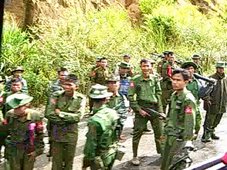 © Copyright 2006 by Blogger Jotman (story and photos). All Rights Reserved.
 Last night Dave, Emma, and I were having a drink (names have been changed) on the patio of bar by a quiet street of a town in northern Thailand. A few bugs hovered above our heads near a lamp.
I had met Dave the previous day at my guesthouse. Dave wore his hair long and had a Southern California manner about him. Spotting us from the street, Emma, whom Dave had only met that afternoon, sat down on the bench beside him. Emma wore a silver stud above her chin and large moon shaped earrings. As the evening light faded, her tanned face became more radiant.
We had just been chatting with the restaurant security guard. Smartly dressed in a blue cap and crisp white shirt, anyone would mistake the fifty year old guard for a police officer -- one of half his age. He told us he had been born to a Chinese mother and hill tribe father in Keng Tong, a town deep inside Myanmar’s Shan State which I had recently visited. Just as the guard left to check on something, I heard Emma say something to Dave about a “machine gun.” I glanced at the pair seated across the table from me.
Dave pointed at Emma. “She fires machine guns.”
“What?” I asked incredulously.
What Emma would say next, Dave had not heard before either. Indeed, we were about to hear this petite female tell us something about herself that was almost impossible to believe.
“I spent a year fighting for the Karen resistance army in Myanmar,” Emma said.
Dead silence. Needless to say Dave and I were almost speechless. “I think she’s joking” Dave muttered.
As for the background on her decision to join the army, here is what I was able to piece together from our conversation. Emma told us that at first she had worked with Karen refugees near a town on the Thai border -- a group who taught the Karen how to practice medicine in the jungle. But through a friend in the camp she had been introduced to a general in the Karen resistance army. Emma had the idea that by enlisting with the Karen resistance forces she could make a big difference to this suffering minority people. She told me that Myanmar's army had encroached on Karen villages, and the Karen had been fighting a defensive war to protect their home territory. After two months of boot camp, Emma was off fighting in the Burmese jungle.
“Did you shoot anybody?” I asked
“People always ask me that. And I don’t know,” Emma said. “In the confusion of a battle, you simply don’t know.”
It seems Emma had seen fighting quite frequently -- the longest stretch during which she saw no combat having lasted only a month and a half. In combat, she spoke of how the enemy line and her own side’s line would be mingled together. But she said she could always tell the two sides apart.
In the Burmese jungle the army subsisted mostly on a diet of rice and salt.
“Sometimes other soldiers caught rats, bugs, and whatever else they could catch in the jungle” she said. A vegan, Emma just ate the rice.
I asked her what kind of wild animals she had come across in the jungle.
“There were snakes -- really big snakes.”
“What about casualties?” I asked.
Emma said that although there were a couple fatalities, most of the casualties her platoon suffered had been leg injuries, related to land mines. She said the Myanmar army had planted mines that were of Chinese and Myanmar origin, and some others were hand made devices.
"The Myanmar army placed mines and left them. The Karen use mines too, but we always picked them up afterwards. Like when we camped in a village, we would put mines around the perimeter to protect the village. Then when we left, we picked up the mines we had placed,” she said.
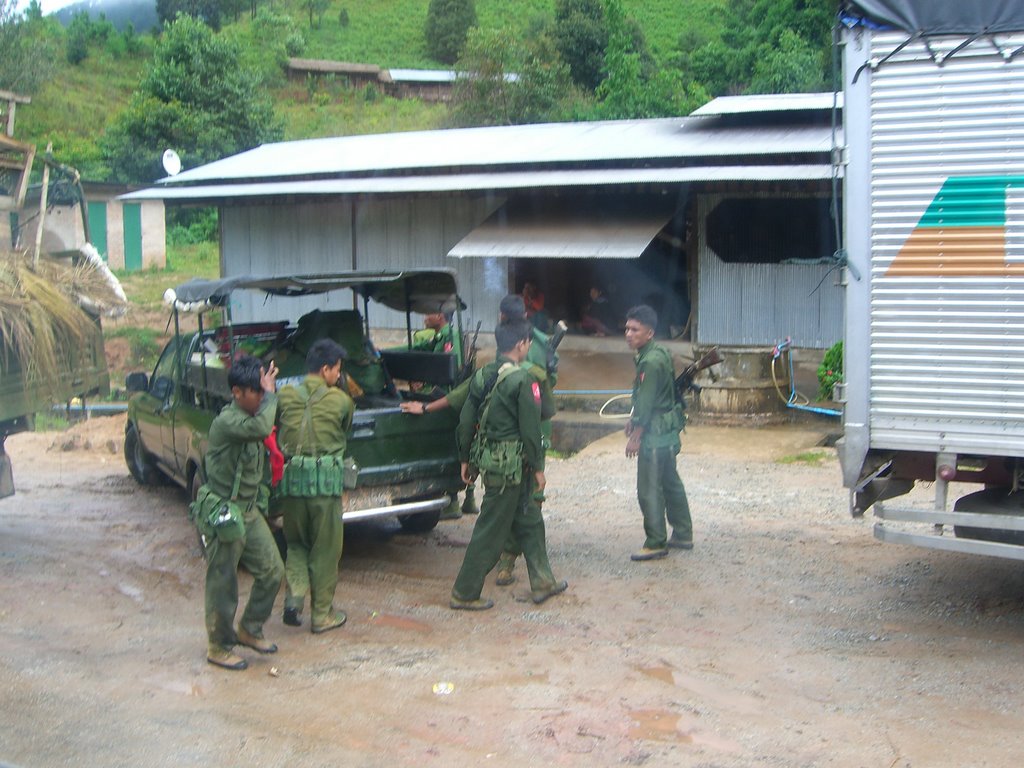 In a previous posting I related my own observations of a Myanmar army battalion on the move and referred to a recent report describing the state of the army. I asked her if the Myanmar troops were indeed badly equipped.
“Yes, compared to a Western army they certainly are. But not compared to the resistance fighters, who are worse equipped. The Myanmar army has tanks, but they can’t use them up in the that region -- there are no roads.” She said the resistance used mostly old American weapons.
When Emma smiled, rows of straight white teeth gleamed in the darkness.
Emma said that during one battle, “There was actually a guy on our side who was talking on the radio to his brother who fought for the other side.”
“Brother against brother,” Dave said. Dave’s ancestors had fought in the US Civil War.
That guy’s brother, she explained, wasn’t exactly a part of the Myanmar army. Rather, he was fighting for a different mountain tribe. The Myanmar troops were allied with an enemy of the Karen. And the soldiers from this other ethnic group had been promised a share of any land taken from the Karen. But Emma said that the price these people paid for cooperating with the Myanmar army was that they had to fight at the front of the Myanmar army line.
"What really moved me," Emma said, "was one day when we were preparing to launch an attack on an enemy camp I got up so close to the enemy. I saw the Myanmar troops sitting around talking. I could hear what they were saying: they were talking about girls. They were only boys. I realized something at that moment; how they were not so different from my side -- that it was not their choice to be fighting this war."
We decided to take a walk. Emma had not eaten dinner and she hoped to find some street food. We passed some stalls. “Only meats” Emma scowled. Finally, spotting a cart loaded with a steaming pile of corn-on-the-cob, Emma said, “I’m going to buy some corn.”
We walked further: Emma now wanted to buy some durian -- a large fruit resembling a bloated pineapple that has the taste, smell, and texture of brie cheese. The smell is considered so offensive that it’s forbidden even to carry the fruit on the subway in Singapore.
“Durian’s also banned on the Bangkok skytrain” said Dave.
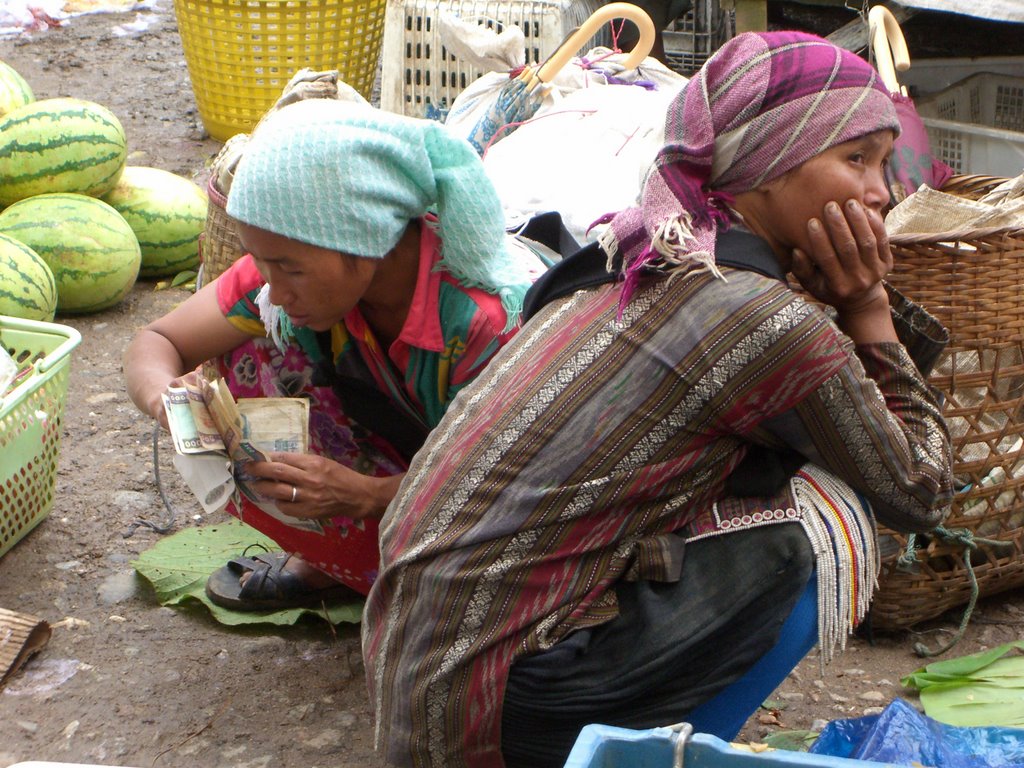 “Were there other women in the Karen army?” I asked.
“There were some nurses. But I was the only woman fighting.” She added, “The general who allowed me to enlist had the idea that by letting me join, I could be an example for Karen women. It might encourage them to sign up.”
But first some deep seated cultural issues would have to be resolved.
“The Burmese have these… well these cultural… oddities. In Burmese society, it is forbidden for a woman to be above a man, or for a woman to step over a man. Can you imagine? I’m not supposed to step over a man’s leg! So being in combat situations, obviously, this would not work. I told them I wouldn’t accept such restrictions. I said, ‘See that plane flying above you? There are women in that plane. You are already standing below some women.’ But my arguments did not convince them.
“So what happened?”
“Finally one of the army leaders came up with a solution to the problem,” she said. “It was decided that I was a man, and should be treated as a man.”
Dave and I looked at Emma. She was very much a woman.
“That must have got in the way of sex,” said Dave.
“Not at all,” she said with a wink.
Propaganda Headlines
The White House continues to act as if reality and facts can be transcended through denials and lies. Media corporations like CNN will repeat any strongly worded White House statement as a headline news item. So if the White House spin is fiction, the headline will be fiction. Because it's the headline that the public will remember,in this way a lie becomes an accepted "truthiness." Call this the "Propaganda Headline Syndrome"
Today the White House hauled out the US Ambassador to put a positive spin on the meltdown in Iraq. Guess the network where this ploy generated a Propaganda Headline: CNN or BBC?
CNN: U.S. envoy: 'Success in Iraq is possible'
BBC: Iraq success 'possible', says US
The most precise headline in a literal sense is CNN's, but BBC's headline is preferable because it's not a Propaganda Headline. The BBC editor refused to let the headline become a mechanism for the propagation of a White House distortion. Emphasizing "possible," its headline undercuts the propaganda ploy, subverting it. It attributes the statement to the "US," instead of the "US envoy." After all, the Ambassador, in this instance, is nothing other than a mouthpiece for the US government (i.e. the White House). For the BBC, getting the "spirit" of the story right mattered more than the "letter" of the news. Whereas CNN allowed itself to be used as means of conveying propaganda, BBC intelligently resisted this danger.
The other day, the White House forced a State Department official to contradict himself. With the US election two weeks away, the White House is now desperate, and will bully any US official into saying just about anything so as to generate more "Propaganda Headlines." CNN is standing by, ready to assist.
This should be journalism 101: Editors, avoid "Propaganda Headlines" wherever possible! A slavish literalism is the friend of the propagandist and the enemy of understanding.
Today the White House hauled out the US Ambassador to put a positive spin on the meltdown in Iraq. Guess the network where this ploy generated a Propaganda Headline: CNN or BBC?
CNN: U.S. envoy: 'Success in Iraq is possible'
BBC: Iraq success 'possible', says US
The most precise headline in a literal sense is CNN's, but BBC's headline is preferable because it's not a Propaganda Headline. The BBC editor refused to let the headline become a mechanism for the propagation of a White House distortion. Emphasizing "possible," its headline undercuts the propaganda ploy, subverting it. It attributes the statement to the "US," instead of the "US envoy." After all, the Ambassador, in this instance, is nothing other than a mouthpiece for the US government (i.e. the White House). For the BBC, getting the "spirit" of the story right mattered more than the "letter" of the news. Whereas CNN allowed itself to be used as means of conveying propaganda, BBC intelligently resisted this danger.
The other day, the White House forced a State Department official to contradict himself. With the US election two weeks away, the White House is now desperate, and will bully any US official into saying just about anything so as to generate more "Propaganda Headlines." CNN is standing by, ready to assist.
This should be journalism 101: Editors, avoid "Propaganda Headlines" wherever possible! A slavish literalism is the friend of the propagandist and the enemy of understanding.
Monday, October 23, 2006
CNN, Big Brother, and Truth
In at least one respect, the incident reported in my previous posting has unfolded like something straight out of George Orwell’s 1984. Orwell describes life in a dictatorship where “truth” is determined by the Party leadership, and actual news stories get endlessly rewritten in order to show Big Brother and the Party were in the first place, always correct. Now for a twist on 1984: imagine a world where critical news stories need never be completely rewritten, because news departments pre-empt anticipated government denials, rephrasing any harsh criticism of the government in softer terms.
In the previous posting, I questioned whether CNN had toned-down criticisms by a Bush administration official in its report. I contrasted CNN’s account with an account by the BBC. Answering some questions and raising new ones comes a second CNN article: State Department official: I misspoke on Iraq policy First, note that CNN has not altered its original phrasing of the official’s criticisms:
As to the content of the story: It’s evident that Bush Administration higher-ups pressured this official to renounce what he actually said and meant. The lesson is clear: if you work for the US government you must understand that truth is not based on fact, experience, or perception – that’s not how officials shall arrive at the truth. Truth is something that can only be determined and shaped by the Bush administration itself. Hence the absurdity of this second news story, wherein the official is shown disavowing his own words -- as if they had never been spoken.
In the previous posting, I questioned whether CNN had toned-down criticisms by a Bush administration official in its report. I contrasted CNN’s account with an account by the BBC. Answering some questions and raising new ones comes a second CNN article: State Department official: I misspoke on Iraq policy First, note that CNN has not altered its original phrasing of the official’s criticisms:
WASHINGTON (CNN) -- A senior State Department diplomat apologized Sunday for having told the Arab satellite network Al-Jazeera on Saturday that there is a strong possibility history will show the United States displayed "arrogance" and "stupidity" in its handling of the Iraq war.there is a strong possibility history will show… But that’s not what the official apologizes for having said, as the very next paragraph shows:
"Upon reading the transcript of my appearance on Al-Jazeera, I realized that I seriously misspoke by using the phrase 'there has been arrogance and stupidity' by the U.S. in Iraq," Alberto Fernandez said in an e-mail sent to reporters by the State Department and attributed to him.'there has been arrogance and stupidity' The official has quoted himself, and the quote attests to the blatant inaccuracy of the first paragraph of this CNN report. Further down the article, we see that CNN has misreported the wording of CNN’s own translation:
His apology Sunday differed from a defense of his comments that he made to CNN during an interview Saturday night.…because undoubtedly there was arrogance and stupidity from the United States in Iraq. This also happens be a near perfect match with the BBC account. Here we have concrete evidence (provided by CNN itself) that CNN's distortion of the official's actual remark did not stem from a translation issue. CNN reconstructed the official’s harsh language into phrasing that made the official sound far less critical of the administration than he actually was. Of course, we have no proof that CNN softened the tone of the official’s criticisms intentionally.
"History will decide what role the United States played," he told Al-Jazeera in Arabic, based on CNN translations. "And God willing, we tried to do our best in Iraq.
"But I think there is a big possibility (inaudible) for extreme criticism and because undoubtedly there was arrogance and stupidity from the United States in Iraq."
As to the content of the story: It’s evident that Bush Administration higher-ups pressured this official to renounce what he actually said and meant. The lesson is clear: if you work for the US government you must understand that truth is not based on fact, experience, or perception – that’s not how officials shall arrive at the truth. Truth is something that can only be determined and shaped by the Bush administration itself. Hence the absurdity of this second news story, wherein the official is shown disavowing his own words -- as if they had never been spoken.
Sunday, October 22, 2006
One US official, two networks
BBC headline: US 'arrogant and stupid' in Iraq BBC quote:
Mr Fernandez, an Arabic speaker who is director of public diplomacy in the state department's Bureau of Near Eastern Affairs, told Qatar-based al-Jazeera that the world was "witnessing failure in Iraq"... "I think there is great room for strong criticism, because without doubt, there was arrogance and stupidity by the United States in Iraq."CNN headline: U.S. official: History may show U.S. 'stupidity' on Iraq CNN quote:
A senior State Department official told Arab satellite station Al Jazeera on Saturday that there is a strong possibility history will show the United States displayed "arrogance" and "stupidity" in its handling of the Iraq war."...without a doubt..." (BBC) Vs "History may show..." (CNN's headline) The question is, what will CNN show? I'm wondering if we're not beginning to see a pattern here with CNN. Recently I posted on CNN's propensity to sensationalize trivia, and how CNN never saw a terror threat it couldn't hype. Over the years, I've watched CNN couch, nuance, and counter criticisms of the Bush administration. But would CNN deliberately distort what someone has actually said? Of course one can't be sure that it wasn't BBC that got the quote wrong. Or perhaps it was just a mistake on CNN's part. But its interesting to see CNN presenting a major news story in such low-key tones -- so often does CNN choose to sensationalize these days.
Scapegoating Reality
Today, some US journalists describe the symptoms of a disease, but few dare penetrate its cause. Case in point is an otherwise insightful article by Sally Quinn of the Washington Post that examines Rumsfeld’s role as “scapegoat.” It explains how by continuing to serve as Defense Secretary, Rumsfeld deflects blame from others in the administration, namely Cheney and Bush. Quinn may well have hit the nail on the head. This may explain why Rumsfeld has not yet been fired. But in the article observe how – ever so subtly -- the context for the scapegoating becomes its justification:
The real story is not the scapegoating, it's that a number of the most intractable problems facing Americans today began at the top. The big things Rumsfeld is accused of having screwed up – troop levels in Iraq, refusal to take the insurgency seriously, and the absence of post war planning -- are things that any competent chief executive would have prevented. Scapegoating – particularly as the practice pertains to the George W. Bush presidency -- amounts to denial of reality. The reality is that America has a president who is not up to the job. And the news media refuses to give this issue the attention it deserves.
The prospect of a move to impeach George W. Bush is not said to be “popular” at this time. But it ought to top of the nation’s agenda. (Along with this related constitutional question: how to also remove Vice President Cheney from office at the same time?)
Because the past six years provide sufficient evidence that President Bush is not up to handling another crisis. Take the situation in regards to Iran’s nuclear program. Some say Iran must be prevented from pursuing its nuclear program, even by military means. Personally, I’m not convinced. But let’s, for the sake of argument, assume that an invasion of Iran would be prudent. Next, consider the identity of the Commander in Chief charged with executing the invasion. Ponder that for a moment. See my point? Nobody in his right mind would argue that President George W. Bush has the wherewithal to lead the nation into another war. This holds true regardless of whether Rumsfeld stays or goes.
 And I maintain it is reckless for anyone – be they Republican or Democrat – to assume that there will not be some major national or world crisis within the next two years. One simply can’t rule that out. And if impeaching Bush is not worth the effort, why not cut the defense budget in half for the next two years? This idea makes about as much sense as this reluctance to at least make an honest effort to impeach President Bush. Because with an incompetent at the helm, what use is the world's finest military machinary? Of what use are the dedicated personnel of the US Armed Forces who put their lives on the line for their “more comfortable” and "hardness-averse" compatriots? Led by this chief, the finest warriors armed with the best guns are likely to prove ineffective. I'm using a military example, but Huricane Katrina proved that presidential incompetence knows no boundaries, a perception which grounds my belief that to scapegoat Rumsfeld is to deny the scope of the problem.
However, the real problem facing the United States is neither Rumsfeld, nor, ultimately, is it George W. Bush. The deeper, more fundamental problem is an American news media which refuses to take facts and reality as its starting point, choosing only to take present-day mainstream public perception as a valid foundation from which to describe current affairs.
It is hard for the American people to turn completely against the president. It seems tantamount to patricide. We're much more comfortable being able to blame someone else for the president's mistakes. Laura Bush will never be the scapegoat. For now, it's Rumsfeld. (my italics)The American People this, the American People that. The blather goes on and on. These days, it is “hard” for Americans to do a lot of things; and it seems as if keeping Americans “more comfortable” is now tantamount to “life, liberty, and the pursuit of happiness.” Let there be no mistake: the steadfast pursuit of “the more comfortable” and “the least hard” is no virtue. Never was. Never will be.
The real story is not the scapegoating, it's that a number of the most intractable problems facing Americans today began at the top. The big things Rumsfeld is accused of having screwed up – troop levels in Iraq, refusal to take the insurgency seriously, and the absence of post war planning -- are things that any competent chief executive would have prevented. Scapegoating – particularly as the practice pertains to the George W. Bush presidency -- amounts to denial of reality. The reality is that America has a president who is not up to the job. And the news media refuses to give this issue the attention it deserves.
The prospect of a move to impeach George W. Bush is not said to be “popular” at this time. But it ought to top of the nation’s agenda. (Along with this related constitutional question: how to also remove Vice President Cheney from office at the same time?)
Because the past six years provide sufficient evidence that President Bush is not up to handling another crisis. Take the situation in regards to Iran’s nuclear program. Some say Iran must be prevented from pursuing its nuclear program, even by military means. Personally, I’m not convinced. But let’s, for the sake of argument, assume that an invasion of Iran would be prudent. Next, consider the identity of the Commander in Chief charged with executing the invasion. Ponder that for a moment. See my point? Nobody in his right mind would argue that President George W. Bush has the wherewithal to lead the nation into another war. This holds true regardless of whether Rumsfeld stays or goes.
 And I maintain it is reckless for anyone – be they Republican or Democrat – to assume that there will not be some major national or world crisis within the next two years. One simply can’t rule that out. And if impeaching Bush is not worth the effort, why not cut the defense budget in half for the next two years? This idea makes about as much sense as this reluctance to at least make an honest effort to impeach President Bush. Because with an incompetent at the helm, what use is the world's finest military machinary? Of what use are the dedicated personnel of the US Armed Forces who put their lives on the line for their “more comfortable” and "hardness-averse" compatriots? Led by this chief, the finest warriors armed with the best guns are likely to prove ineffective. I'm using a military example, but Huricane Katrina proved that presidential incompetence knows no boundaries, a perception which grounds my belief that to scapegoat Rumsfeld is to deny the scope of the problem.
 However, the real problem facing the United States is neither Rumsfeld, nor, ultimately, is it George W. Bush. The deeper, more fundamental problem is an American news media which refuses to take facts and reality as its starting point, choosing only to take present-day mainstream public perception as a valid foundation from which to describe current affairs.
Saturday, October 21, 2006
"a nation of ninnies"
The other day, the US media hyperventilated over a supposed terrorist threat -- an alleged plot to simultaneously blow up several US football stadiums. The story had absolutely no credibility. James Fallows gets right to the point:
When did we become a nation of ninnies? Yes, there are dangers in modern life. But to put it mildly, this is not the first generation to be imperiled. (By starving, being eaten by a bear, being scalped if you were a white settler, being killed by small pox if you were an Indian, being lynched if you were black, being dismembered in a factory, being shot as you stormed Normandy Beach, and so on.) We don’t look back on those hardships as having created a culture of fraidy cats. The British like to think that they endure hardship with the spirit of Winston Churchill, not Mr. Bean. We’d be better off acting like Gary Cooper, not PeeWee Herman.Fallows also points out that the term "Homeland Security" has fascistic undertones. And what is fascism anyway, but a system designed for people willing to trade away real freedom for the perception of security?
Friday, October 20, 2006
A Clinton Classic
In case you missed it, here is a video of a Fox News interview with President Clinton about Bin Laden. Hat tip David Metz.
C No News
This morning I went to CNN's website to check out the headlines, but seeing nothing even remotely newsworthy on its USA homepage, I instinctively clicked its "World News" link. At about the same time on another continent, the same sight must have confronted a blogger at Daily Kos, but instead of clicking away, she took the time to dissect CNN's homepage. What an eye-opener.
Wednesday, October 18, 2006
The War of Ideas: America's Capitulation
Although I was critical here of Arirang, South Korea’s overseas television service, it also happens to provide cultural programming that is second to none. Japan’s NHK, meanwhile, offers superb science and technology programming. Unfortunately, America’s overseas broadcast service lacks any redeeming virtue.
The White House would like to give Americans the impression that it views terrorist propaganda as a serious threat -- hence the treason indictment (discussed here and here). But surely a far better way of countering hostile propaganda is to advance ideals that are intrinsically more appealing and attainable than the slippery promises of jihadist fanatics.
 This should not be difficult for the United States. As a child of the European Enlightenment, the ideal of open society is something America has long represented to the world. Throughout the cold war, effective means of promoting such a vision were the overseas broadcast services of Voice of America. Today, former dissidents from across Eastern Europe talk of having been heartened by VOA broadcasts during that dark epoch. And in the end, it wasn't the US military, but the people of Eastern Europe who brought down the Soviet Empire. Ideals proved more powerful than guns.
Naturally, one would assume that in the worldwide struggle against murderous Islamicists, the VOA would again play an indispensable role, providing a coherent and constructive antidote to terrorist propaganda and religious extremism. Last night, I happened to tune into VOA television. I'll tell you what I saw.
First of all, VOA has the production values of your local community TV station. It looks produced on a shoestring budget. But that’s the very least of its problems. When I happened to tune-in, the program being aired was “Think Tank.” The show is hosted by someone from the American Enterprise Institute -– one of various right-wing groups (think tanks) based in Washington DC that churn out studies, WSJ op-eds, and propoganda for the Republican Party. The format of the show is to have a guest from one think tank or another discuss a topic dear to the right wing agenda. The show I caught featured a discussion about “Intelligent Design” -- a pseudo-scientific alternative to evolution dished up by fundamentalist Christians.
 I am reminded of when on a trip to the Middle East, I asked some residents of Amman Jordan if they knew that humans are descended from primates. “What? You must be joking! No, we never heard that before,” came the reply. Evidently, evolution was not a theory they had been taught in school. So it seems to me that one of the more obvious ways VOA could counter religious extremism would be to promote science and the scientific way of thinking. But when VOA treats religious pseudoscience as a topic worthy of serious consideration, what has it accomplished?
Of course, Think Tank is but one show...
But when the VOA programming schedule was flashed on the screen – music, sports, ESL, McLaughlin Group -- it became clear to me that Think Tank was about the most intellectually substantive program that VOA offered. So much for winning the war of ideas.
 But wait -- there is more to VOA. The other day I posted on how Business Week magazine had recently deteriorated into a shadow of its former self – vapid articles on business lifestyle, how to spend your fortune, and the like. Can you guess the program that follows Think Tank on VOA? A show called Business Week. True to the magazine's crapy new format, the feature story concerned "how to dress for success." (In my travels I have observed that beyond the borders of the United States, people generally know how to dress. I honestly don’t think the world needs America’s advice in that department.)
So VOA appears to be something of joke. But mostly, I find it rather sad. You see, I’m thinking about my visit to Myanmar, and I’m recalling my conversations (here and here) with Khin: Khin who desperately wanted to visit the local library, but lacked “the right papers” to get through the door; Khin whose prized possession was a book given him by a Western traveler -- a copy of an Aung San Suu Kyi biography; Khin, who excitedly accepted several chapters from a book on Athenian democracy I had photocopied for him. Around the world, there are thousands of Khins: people who live under dreadful regimes where they are deprived of access to information that is neither commercialized pulp, political propaganda, or religious dogma; minds hungry for big ideas; human beings desperate to learn more about the foundations of democracy, liberty, and justice.
Too bad all America has on offer these days is “Intelligent Design” and “dress for success.”
The White House would like to give Americans the impression that it views terrorist propaganda as a serious threat -- hence the treason indictment (discussed here and here). But surely a far better way of countering hostile propaganda is to advance ideals that are intrinsically more appealing and attainable than the slippery promises of jihadist fanatics.
 This should not be difficult for the United States. As a child of the European Enlightenment, the ideal of open society is something America has long represented to the world. Throughout the cold war, effective means of promoting such a vision were the overseas broadcast services of Voice of America. Today, former dissidents from across Eastern Europe talk of having been heartened by VOA broadcasts during that dark epoch. And in the end, it wasn't the US military, but the people of Eastern Europe who brought down the Soviet Empire. Ideals proved more powerful than guns.
Naturally, one would assume that in the worldwide struggle against murderous Islamicists, the VOA would again play an indispensable role, providing a coherent and constructive antidote to terrorist propaganda and religious extremism. Last night, I happened to tune into VOA television. I'll tell you what I saw.
First of all, VOA has the production values of your local community TV station. It looks produced on a shoestring budget. But that’s the very least of its problems. When I happened to tune-in, the program being aired was “Think Tank.” The show is hosted by someone from the American Enterprise Institute -– one of various right-wing groups (think tanks) based in Washington DC that churn out studies, WSJ op-eds, and propoganda for the Republican Party. The format of the show is to have a guest from one think tank or another discuss a topic dear to the right wing agenda. The show I caught featured a discussion about “Intelligent Design” -- a pseudo-scientific alternative to evolution dished up by fundamentalist Christians.
 I am reminded of when on a trip to the Middle East, I asked some residents of Amman Jordan if they knew that humans are descended from primates. “What? You must be joking! No, we never heard that before,” came the reply. Evidently, evolution was not a theory they had been taught in school. So it seems to me that one of the more obvious ways VOA could counter religious extremism would be to promote science and the scientific way of thinking. But when VOA treats religious pseudoscience as a topic worthy of serious consideration, what has it accomplished?
Of course, Think Tank is but one show...
But when the VOA programming schedule was flashed on the screen – music, sports, ESL, McLaughlin Group -- it became clear to me that Think Tank was about the most intellectually substantive program that VOA offered. So much for winning the war of ideas.
 But wait -- there is more to VOA. The other day I posted on how Business Week magazine had recently deteriorated into a shadow of its former self – vapid articles on business lifestyle, how to spend your fortune, and the like. Can you guess the program that follows Think Tank on VOA? A show called Business Week. True to the magazine's crapy new format, the feature story concerned "how to dress for success." (In my travels I have observed that beyond the borders of the United States, people generally know how to dress. I honestly don’t think the world needs America’s advice in that department.)
So VOA appears to be something of joke. But mostly, I find it rather sad. You see, I’m thinking about my visit to Myanmar, and I’m recalling my conversations (here and here) with Khin: Khin who desperately wanted to visit the local library, but lacked “the right papers” to get through the door; Khin whose prized possession was a book given him by a Western traveler -- a copy of an Aung San Suu Kyi biography; Khin, who excitedly accepted several chapters from a book on Athenian democracy I had photocopied for him. Around the world, there are thousands of Khins: people who live under dreadful regimes where they are deprived of access to information that is neither commercialized pulp, political propaganda, or religious dogma; minds hungry for big ideas; human beings desperate to learn more about the foundations of democracy, liberty, and justice.
Too bad all America has on offer these days is “Intelligent Design” and “dress for success.”
Monday, October 16, 2006
Treason, Part II
Does the treason indictment point to a larger issue of fundamental importance to the United States? That's the question this post seeks to answer. First, I should note that since jotting my response to the recent decision by the US Justice Department to charge an Orange County Islamicist with treason, it's come to my attention that several legal experts have also seen through this charade:
Americans ought to be asking themselves whether this ongoing state of war is in the country's best interests. Does continuing the "war on terror" make the US any safer? Does the "war" metaphor continue to serve a useful strategic purpose? Asking these kinds of questions, we discern that a far larger issue looms behind the treason indictment.
When James Fallows spoke with sixty experts on terrorism for an article entitled "Declaring Victory" published in the September issue of the Atlantic Monthly (summary here), he discovered a general consensus among terrorism authorities that Al Quaeda had been severely disabled; most believed that the greatest future danger posed by the terrorists to the United States lay in the damage that the US might bring upon itself should it over-react to a future attack. Fallows wrote, "the greatest threat posed by these (terror) groups is not the damage they can do directly, but rather the self-defeating, irrational, or excessive responses they can goad a target country into making."
Fallows argued that an open-ended state of war increases the likelihood of over-reaction, and imparts credibility to the terrorist agenda. These are not its only serious drawbacks; other disadvantages of "war" include its pernicious effect upon civil liberties, its tendency to elevate individual terrorists to positions of prominence on the world stage, its tendency to cheapen the notion of war through over-familiarity (now we see that a related concept -- treason -- is likewise at risk of devaluation), and its capacity to erode the quality of life for Americans by making them fearful.
The chain of events that culminated in World War I, an expert interviewed for Fallows' article pointed out, was triggered when an anarchist shot Austrian Archduke Franz Ferdinand. At the time, there were only two thousand anarchists in Europe; anarchists posed no existential threat to European civilization. However, because of the way European powers reacted to the assassination of the Austrian archduke, an otherwise insignificant anarchist could set off a chain reaction which eventually destroyed great empires.
Fallows came to the conclusion that the time has come to end the war on terror by declaring victory. I find it hard to fault the logic.
On the other hand, when the US government charges a propagandist with treason, the country takes another step down a road called "war on terror" -- a dark and lonely path fraught with perils of America's own making.
"There's a real effort in the (Bush) administration to keep fear alive in the country," said Jonathan Turley, a George Washington University Law School professor.Legal opinions on the case prompt new questions: Does this charge relate to a kind of "marketing plan" for the war on terror? The US President seems to be promoting a war-without-end, and the treason charge affirms that America is a nation at war:
"The timing of this case and the use of this charge seems to be a bit too coincidental with the election cycle," Turley said.
Turley said prosecutors could have charged Gadahn with providing material support to terrorists.
The treason charge, he said, "is for public consumption."
Bruce Fein, a constitutional law expert who served in president
Ronald Reagan's administration, said the charge was used to "up the ante as November approaches to say, 'geez, this is really, really, terrible, terrible, terrible stuff'" going on with Al-Qaeda.
Law experts noted the treason charge puts the "war on terror" on par with a conventional war, justifying the administration's description of the conflict.As treason is defined in the US Constitution, it clearly seems to require that the country be at war for the section to apply. The US Constitution defines treason this way:
"It is a way of hammering home the administrations's point that the war on terror is real war in a technical sense," said Eugene Fidell, president of the National Institute of Military Justice.
Treason against the United States, shall consist only in levying War against them, or in adhering to their Enemies, giving them Aid and Comfort. No Person shall be convicted of Treason unless on the Testimony of two Witnesses to the same overt Act, or on Confession in open Court.But what of a war against non-state actors? Eugene Volokh discusses the litmus test for a treason conviction here.
Americans ought to be asking themselves whether this ongoing state of war is in the country's best interests. Does continuing the "war on terror" make the US any safer? Does the "war" metaphor continue to serve a useful strategic purpose? Asking these kinds of questions, we discern that a far larger issue looms behind the treason indictment.
When James Fallows spoke with sixty experts on terrorism for an article entitled "Declaring Victory" published in the September issue of the Atlantic Monthly (summary here), he discovered a general consensus among terrorism authorities that Al Quaeda had been severely disabled; most believed that the greatest future danger posed by the terrorists to the United States lay in the damage that the US might bring upon itself should it over-react to a future attack. Fallows wrote, "the greatest threat posed by these (terror) groups is not the damage they can do directly, but rather the self-defeating, irrational, or excessive responses they can goad a target country into making."
Fallows argued that an open-ended state of war increases the likelihood of over-reaction, and imparts credibility to the terrorist agenda. These are not its only serious drawbacks; other disadvantages of "war" include its pernicious effect upon civil liberties, its tendency to elevate individual terrorists to positions of prominence on the world stage, its tendency to cheapen the notion of war through over-familiarity (now we see that a related concept -- treason -- is likewise at risk of devaluation), and its capacity to erode the quality of life for Americans by making them fearful.
The chain of events that culminated in World War I, an expert interviewed for Fallows' article pointed out, was triggered when an anarchist shot Austrian Archduke Franz Ferdinand. At the time, there were only two thousand anarchists in Europe; anarchists posed no existential threat to European civilization. However, because of the way European powers reacted to the assassination of the Austrian archduke, an otherwise insignificant anarchist could set off a chain reaction which eventually destroyed great empires.
Fallows came to the conclusion that the time has come to end the war on terror by declaring victory. I find it hard to fault the logic.
On the other hand, when the US government charges a propagandist with treason, the country takes another step down a road called "war on terror" -- a dark and lonely path fraught with perils of America's own making.
The Moral Equivalent of Treason
The Justice Department recently indicted one Mr. Adam Gadahn, a Californian hiding in Pakistan, on the charge of “treason.” Now treason is a high crime -- such a high crime that no American has been charged with treason since World War II. According to the OED, the definition of treason is “attempting to kill or overthrow the sovereign or government.” Treason carries the maximum penalty of death. So what is this Orange County character accused of having done to merit being charged with this rare and most grave of crimes against the state -- that of treason?
Apparently the accused has produced some videos in which he praises the 9-11 attacks, prays that America gets what he malevolently considers its just deserts -- "Allah willing, the streets of America will run red with blood, matching drop for drop the blood of America's victims," and urges American soldiers to come over to the “winning” side. Menacing-sounding stuff alright. But why charge him with treason?
The US Deputy Attorney General Mr. Paul McNulty justifies the treason charge this way:
Who do you suppose is really scaring Americans, "facilitating the propaganda" of the terrorists? A Californian hiding in Pakistan, or a US Justice Department that publicizes his activities; having brought the rare and extreme charge of treason against him? Mr. McNulty, why are you giving an obscure American hiding in Pakistan armed with video camera the free publicity?
He’s not been captured yet, but the unearned infamy bestowed upon him by the Justice Department risks turning him into a jihadist celebrity – someone truly influential and dangerous.
Don’t you suppose Mr. McNulty, that your chances of convicting this man – assuming our guys can find him – on such a serious charge are likely going to be slim, perhaps a lot slimmer than had you charged him with something less onerous than treason? Sorry, I almost forgot: convicting terrorists is not a priority of the Bush administration; otherwise your branch of government would not have authorized the torture of so many terror suspects in US custody, thereby irreparably compromising the use of their confessions in US courts.
Of course it was the Justice Department – your office, Mr. McNulty -- that signed-off on policies condoning the torture of prisoners in US custody. By the way, don’t you suppose that by having sanctioned the cruel and abusive treatment of many innocent Muslim detainees – 112 of whom have died in US custody (43 of which were homicides) – the US Justice Department has done far more to serve the propaganda interests of the terrorists than this (formerly) obscure video producer from Orange County hiding in Pakistan?
Treason is a serious charge. Do you seriously think the Republic is safer when the US Justice Department must now devote precious time and resources to indicting propagandists on extreme charges? And if terrorism-supporting propaganda is now treason, where do you draw the line between treasonous propaganda and propaganda that is merely critical of the US government? It seems to me Americans have yet another reason to be frightened of the Justice Department, and relatively little cause to be scared by Mr. Gadahn’s videos -- despite the unearned infamy your office has bestowed upon him.
I asked you whether you thought you could ever get a conviction on the rare treason charge. But the trial doesn’t matter, does it? I bet the indictment was orchestrated to remind Americans that Bush is really tough on fighting terrorism before the November elections. Let’s face it, charging an Islamicist with “treason” sounds tough.
This story has one thing in common with a string of recent statements relating to terror threats that have emanated from the White House: each of the stories appears to be disconnected from any discernable new threat, but coincides with the run-up to the November elections. “Terrorists… want Americans to live and walk in fear” you say. It seems to me if you replace the word “terrorists” with “The Bush White House” the sentence also makes sense.
Which brings me to ask you, not as an attorney, but as an American: At what point does the relentless pursuit of partisan political advantage in the guise of national security become the moral equivalent of treason?
Apparently the accused has produced some videos in which he praises the 9-11 attacks, prays that America gets what he malevolently considers its just deserts -- "Allah willing, the streets of America will run red with blood, matching drop for drop the blood of America's victims," and urges American soldiers to come over to the “winning” side. Menacing-sounding stuff alright. But why charge him with treason?
The US Deputy Attorney General Mr. Paul McNulty justifies the treason charge this way:
Terrorists… want Americans to live and walk in fear. They want to demoralize us. That’s why propaganda is so important to them, and why facilitating that propaganda is such an egregious crime. (my italics)I don’t know about you, but I had never heard of Mr. Adam Gadahn and his videos before -- before, that is -- I read that the Justice Department had charged him with treason. So I have some questions for the Deputy US Attorney-General Mr. Paul McNulty and the US Justice Department:
Who do you suppose is really scaring Americans, "facilitating the propaganda" of the terrorists? A Californian hiding in Pakistan, or a US Justice Department that publicizes his activities; having brought the rare and extreme charge of treason against him? Mr. McNulty, why are you giving an obscure American hiding in Pakistan armed with video camera the free publicity?
He’s not been captured yet, but the unearned infamy bestowed upon him by the Justice Department risks turning him into a jihadist celebrity – someone truly influential and dangerous.
Don’t you suppose Mr. McNulty, that your chances of convicting this man – assuming our guys can find him – on such a serious charge are likely going to be slim, perhaps a lot slimmer than had you charged him with something less onerous than treason? Sorry, I almost forgot: convicting terrorists is not a priority of the Bush administration; otherwise your branch of government would not have authorized the torture of so many terror suspects in US custody, thereby irreparably compromising the use of their confessions in US courts.
Of course it was the Justice Department – your office, Mr. McNulty -- that signed-off on policies condoning the torture of prisoners in US custody. By the way, don’t you suppose that by having sanctioned the cruel and abusive treatment of many innocent Muslim detainees – 112 of whom have died in US custody (43 of which were homicides) – the US Justice Department has done far more to serve the propaganda interests of the terrorists than this (formerly) obscure video producer from Orange County hiding in Pakistan?
Treason is a serious charge. Do you seriously think the Republic is safer when the US Justice Department must now devote precious time and resources to indicting propagandists on extreme charges? And if terrorism-supporting propaganda is now treason, where do you draw the line between treasonous propaganda and propaganda that is merely critical of the US government? It seems to me Americans have yet another reason to be frightened of the Justice Department, and relatively little cause to be scared by Mr. Gadahn’s videos -- despite the unearned infamy your office has bestowed upon him.
I asked you whether you thought you could ever get a conviction on the rare treason charge. But the trial doesn’t matter, does it? I bet the indictment was orchestrated to remind Americans that Bush is really tough on fighting terrorism before the November elections. Let’s face it, charging an Islamicist with “treason” sounds tough.
This story has one thing in common with a string of recent statements relating to terror threats that have emanated from the White House: each of the stories appears to be disconnected from any discernable new threat, but coincides with the run-up to the November elections. “Terrorists… want Americans to live and walk in fear” you say. It seems to me if you replace the word “terrorists” with “The Bush White House” the sentence also makes sense.
Which brings me to ask you, not as an attorney, but as an American: At what point does the relentless pursuit of partisan political advantage in the guise of national security become the moral equivalent of treason?
Business Week RIP
I picked up a copy of Business Week a couple months back, assuming I would be getting the quality I had come to expect from the most intelligently written and socially-conscious of business journals. I was shocked: only inane, cheesy articles devoid of interesting content and pages of pointless graphics. This article explains its sad demise; hat-tip Sullivan.
Sunday, October 15, 2006
Effects of China's "Radical Marketization"
Recently the Chinese government purged a large number of corrupt officials. Former Tainanmen Square demonstration leader Wang Hui shares his view of the larger situation facing China with Pankaj Mishra of the New York Times Magazine:
The future danger for China, in Wang’s opinion, is that a lack progress on issues facing the majority of Chinese will lead to pressure for more authoritarianism: “We have already seen in Russia how people prefer a strong ruler like Putin because they are fed up with corruption, political chaos and economic stagnation.” He says “When radical marketization makes people lose their sense of security, the demand for order and intervention from above is inevitable.”
Although I am not sold on Wang’s prognosis, I found his diagnosis of the problem facing China compelling.
… local officials, he said, used their arbitrary power to become successful entrepreneurs and the expense of the rural populations they were meant to serve, and had joined up with real estate speculators to seize collectively owned land form peasants (According to Chinese officials, 60 percent of land acquisitions are illegal.) The result has been an alliance of elite political and commercial interests, Wang said, that recalls similar alliances in the United States and many East Asian countries.Wang strongly commends the Chinese government for having admitted its failure at providing adequate health care and education. But he says that due to extensive decentralization, “it is not easy to translate central government policy into action.”
The future danger for China, in Wang’s opinion, is that a lack progress on issues facing the majority of Chinese will lead to pressure for more authoritarianism: “We have already seen in Russia how people prefer a strong ruler like Putin because they are fed up with corruption, political chaos and economic stagnation.” He says “When radical marketization makes people lose their sense of security, the demand for order and intervention from above is inevitable.”
Although I am not sold on Wang’s prognosis, I found his diagnosis of the problem facing China compelling.
Who is 25 times more important to Bush than the American People?
In case you had any doubt about who the Bush admistration works for, this editorial suggests that saving the US coal industry $2 billion is a higher priority than saving US citizens $50 billion.
Radioactive Sunshine
Eventually, the light of reality exposes distortion. This now appears to be happening in South Korea. Dangerously, the light is not the "sunshine" South Koreans had been promised, but emanates from a source more radioactive.
The lead news story on Thai television last night was a report that 2,000 people demonstrated on the streets of the South Korean capital against their government's “Sunshine Policy” which, say protestors, has amounted to appeasement of the North Korean dictatorship. They burned North Korean flags.
Curious about this development, I switched the channel to Arirang, the overseas broadcast service of South Korea (available on Thai cable). But on the South Korean news, not a word was spoken about the protests in Seoul, nor – more strikingly -- was there any mention of the fact that North Korea’s nuclear testing has caused turmoil in domestic South Korea politics (news that made the front page of the International Herald Tribune).
From what one long-time foreign resident of South Korea told me, the “mute approach” to the North Korea problem extends to local news coverage. In her opinion, the South Korean population had not been getting the straight facts about the North.
Integral to South Korea’s “Sunshine Policy” appears to have been an “Ostrich Policy.”
Some South Koreans with whom I have spoken are of the opinion that the North is their “friend” and the real "enemy" is the US (and Japan). This fantasy is analogous to the untenable belief held by so many Americans that “WMD were found in Iraq,” or the conviction of many Japanese that Japan's high school curriculum teaches “the facts” about Japanese imperialism in Asia.
In each of these instances, the truth lies elsewhere; and a complicit mainstream media has proven itself unwilling to challenge conventional wisdom that serves the country's leaders, supports current state policy, and appeals to influential special interest groups.
The lead news story on Thai television last night was a report that 2,000 people demonstrated on the streets of the South Korean capital against their government's “Sunshine Policy” which, say protestors, has amounted to appeasement of the North Korean dictatorship. They burned North Korean flags.
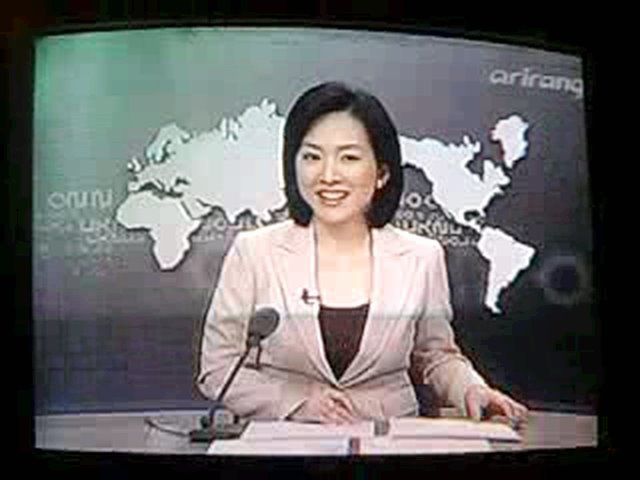
Curious about this development, I switched the channel to Arirang, the overseas broadcast service of South Korea (available on Thai cable). But on the South Korean news, not a word was spoken about the protests in Seoul, nor – more strikingly -- was there any mention of the fact that North Korea’s nuclear testing has caused turmoil in domestic South Korea politics (news that made the front page of the International Herald Tribune).
From what one long-time foreign resident of South Korea told me, the “mute approach” to the North Korea problem extends to local news coverage. In her opinion, the South Korean population had not been getting the straight facts about the North.
Integral to South Korea’s “Sunshine Policy” appears to have been an “Ostrich Policy.”
Some South Koreans with whom I have spoken are of the opinion that the North is their “friend” and the real "enemy" is the US (and Japan). This fantasy is analogous to the untenable belief held by so many Americans that “WMD were found in Iraq,” or the conviction of many Japanese that Japan's high school curriculum teaches “the facts” about Japanese imperialism in Asia.
In each of these instances, the truth lies elsewhere; and a complicit mainstream media has proven itself unwilling to challenge conventional wisdom that serves the country's leaders, supports current state policy, and appeals to influential special interest groups.
Thursday, October 12, 2006
Giant Rodent
A giant rodent looked down at our bus -- it must have been twelve-feet tall. As we approached the figure, female dancers fanned out in front of our vehicle. The bus came to a stop as the performance commenced. When our bus was allowed to move forward again, I looked out my open side-window (this was an Air Con Bus after all). That was when some villagers caught sight of the foreigner on board. I smiled and waved. The revelers responded with a tremendous cheer. If only for an instant, it felt great to be the guest of honor at such a happy celebration.
Encounter with an Infantry Battalion
 I have already described the first leg of my return bus trip from Keng Tong to Tachileik where we passed the wrecked Air Con bus. But this journey had other notable encounters in store for us – apart from the rendezvous with the ghost.
 Our bus crossed a terrain of valleys, streams, ravines, jungle-covered hills, banana groves; we passed straw huts, small black pigs, and terraced rice fields. Rounding one corner, I looked up the road ahead of our bus and far in the distance I made out a group of people walking down the road towards us. I suspected they might be soldiers – something about the way they walked; also that they carried long objects. Indeed, we were about to pass an infantry battalion of the Myanmar army – presumably it was on the move against the insurgency which is known to be active in Shan State. Our bus passed several hundred soldiers in all: many carried heavy machine guns, others mortars or grenade launchers on their shoulders. On foot, apart from the big machine guns or mortars they slogged, the soldiers traveled light -- no heavy packs, just ammo belts around the waist.
Then our bus came to a stop for a few minutes. Military trucks blocked the road opposite some roadside stores – presumably the commanders were loading up on supplies (see top photo). Later we passed more trucks carrying soldiers, tents, poles, other camping equipment, but little else. No tanks, helicopters, jeeps, or other modern vehicles of war -- just old trucks.
What I saw on the road that day corresponded with a recent assessment of the state of preparedness of the Burmese army, in terms of its ongoing war against the insurgency. The analysis happened to have been published that same day in the the Asia Times. The writer, Clifford McCoy, noted that although the Burmese Army (the Tatmadaw) had purchased some newer tanks and guns, there was no evidence that any this modern equipment had been put to use in the field. Moreover, although much of it was useless for insurgent warfare, some of this new hardware seemed better suited for battling democracy protestors in urban settings. His main point was that today the Burmese government wages war against the insurgents almost exactly the same way it has for the last forty years: same tools, same ineffectual tactics. And with egregious human rights violations:
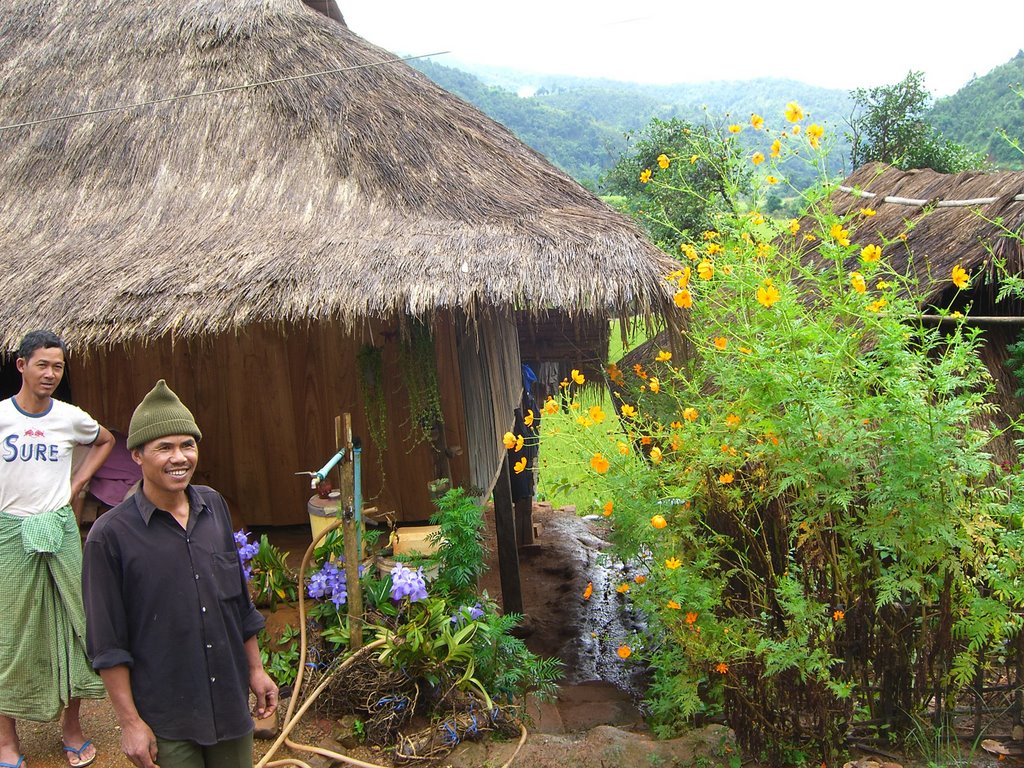
Strategy and tactics likewise remain relatively unchanged from decades ago. The guiding strategy is still the so-called "four cuts", which seeks to deprive armed resistance of food, funds, intelligence and recruits by separating them from civilian support. The army implements this strategy by targeting villagers, razing their jungle communities and forcing them out of the hills and mountains. The SPDC has notably shown very little inclination to dedicate resources toward winning the "hearts and minds" of ethnic civilians.
Recent reports from the Free Burma Rangers and the Karen Human Rights Group indicate that army columns have been conducting sweeps of KNU-controlled territory, shooting villagers on sight and destroying their food supplies and crops. True to form, the great majority of casualties inflicted by the army's current year-long operations have been Karen civilians, providing yet further fuel to the fire of Myanmar's long war.
Keng Tong: A Warning and a Celebration
 Finally, I arrived in the northern Burmese town of Keng Tong. Khin had warned me about this place:
When you go there, be sure not to eat the chicken. They had bird flu recently -- three months ago ten people died there. A tour-guide friend in Keng Tong told me about it. He says a doctor lost his job for trying to report it.My final night in Keng Tong, I attended the night festival for Buddhist Lent. I have never heard so many firecrackers. And kids liked to throw them at people – especially at me -- so getting around the town meant playing dodge-the-fire-cracker. That night, I shot this video clip depicting what struck me as an unusual procession: it consisted of perhaps fifty men in total...
Wednesday, October 11, 2006
Speaking Out Against Myanmar's Regime
TACHILEIK, MYANMAR: Khin told me his prized possession was a book by Aung San Suu Kyi, the imprisoned leader of the National League for Democracy who won the Nobel Peace Prize in 1991. His admiration of her was unshakable and his loyalty fervent. I asked him what had sustained the military dictatorship. Khin replied:
I mentioned to Khin that the UN Security Council was presently meeting to discuss the situation in Burma – also a US initiative. He was excited to hear such news. (International news was not quick to reach those living in this town. There was no Internet access. My Thai mobile phone still worked; but beyond this border town overseas calls were prohibitively expensive at $5 a minute). I advised Khin not to get his hopes up -- China would likely veto any sanctions against the regime -- and would sanctions do any good?
Perhaps such pessimism was not warranted. The UN Security Council talks seems to have galvanized the government to reconvene its never-ending constitutional conference -- a measure which prompted a boycott of those talks by opposition groups. Following from this, judging by some recent news reports (here and here) there seems to be increased resolve on the part of protestors in the capital city of Rangoon (Yangon) -- which won't remain the capital for much longer as last year the government inexplicably decided to move it. Other reports (here and here) are more gloomy.
My country has many poor people with no education. Many of them think they are poor because they are lazy. They don’t see what the army has done to their country.Another woman who Khin held in high esteem was US Secretary of State Condi Rice. He was well aware of her efforts to entice the Thailand and other ASEAN member states to get tough with the Burmese regime.
I mentioned to Khin that the UN Security Council was presently meeting to discuss the situation in Burma – also a US initiative. He was excited to hear such news. (International news was not quick to reach those living in this town. There was no Internet access. My Thai mobile phone still worked; but beyond this border town overseas calls were prohibitively expensive at $5 a minute). I advised Khin not to get his hopes up -- China would likely veto any sanctions against the regime -- and would sanctions do any good?
Perhaps such pessimism was not warranted. The UN Security Council talks seems to have galvanized the government to reconvene its never-ending constitutional conference -- a measure which prompted a boycott of those talks by opposition groups. Following from this, judging by some recent news reports (here and here) there seems to be increased resolve on the part of protestors in the capital city of Rangoon (Yangon) -- which won't remain the capital for much longer as last year the government inexplicably decided to move it. Other reports (here and here) are more gloomy.
Jotman Focus of Wikipedia Debate
 Today, if you read the Wikipedia article on the Thailand Coup D'etat, under the heading "Siam Center, 22 September" you will see it written: "Nobody was arrested...." This highly controversial assertion -- presented as fact by Wikipedia -- flies in the face of a report by Jotman.
 Early efforts are now being made to document the Thai coup d'etat. Writers are confronted with an unprecidented, new choice: do they go with traditional media sources, despite the overwhelming evidence such reports are subject to censorship, self-censorship, and manipulation by government propogandists? Or do they give consideration to the documentation -- including photographs and videos -- provided by blog-reporters like Knarly Kitty or Jotman? Some authors of Wikipedia appear seriously divided on this question. This from Wikipedia Talk:
Here are some pictures of the protest gnarlykitty/mob-at-paragon and jotman/we-love-democracy As PROVEN by the pictures, soldiers were present at the protest. This is contradictory to what the Bangkok Post claims. Bangkok Post claims no police or soldiers were present except for security guards that work for Siam Center. You still think Bangkok Post is a trustworthy source of information??? Humanoid 14:37, 24 September 2006 (UTC)
Under the heading "People arrested during first protest" at Wikipediat Talk this disussion ensues:
According to a guy who has talked directly with one of the protesters. 7 people were arrested during the protest. jotman/saturday Since this information is probably not going to be reported by the thai media until the end of the junta, and wikipedia rules mean that we cannot provide this information on the main page, I'm posting it here until somebody finds a source that is accepted by wikipedia rules. Humanoid 14:54, 24 September 2006 (UTC)Another Wikipedia writer responds:
There is no indication who this prostester is, who are the person arrested ("not from his group" he says) or who the reporter is. In another video http://jotman.blogspot.com/2006/09/this-way-is-even-worse-than-thaksin-way.html the protester wearing black does not report any arrest and even wonder why they have not been arrested! The problem with this kind of info is that you can make what you want of it.Here is a transcript of the Jotman video clip in which protestor arrests are discussed:
Journalist: How many people were arrested, about?
Protestor: Seven.
Journalist: Seven. Seven were arrested. And that was just the beginning.
And these were part of your group?
Protestor: No, they’re not part of it but we were moving toward the same goal.
Journalist: So why did you come out here today?
Protestor: Today we came here to denounce the military and to state that we will not tolerate their presence in the city. Sorry I have to go, very sorry.
The Ghost on the Bus
MYANMAR (BURMA): Consumer complacency appalls me. Because it is commonplace in Southeast Asia, I was surprised and thankful to discover on my bus journey to Keng Tong that among my fellow passengers was a most assertive – not to mention outspoken -- Burmese woman.
Our driver served as mechanic for the forward bus in our little two-bus convoy. My bus didn’t break down, but the one ahead of ours did – over and over again. The first time he got off the bus to make repairs, our driver abandoned us to the thickening heat (because docile passengers occupied seats situated in the isle, nobody could not get off). Had we not sat there sweating for an hour? Suddenly, a woman seated in the back row started hollering something; next other passengers giggled and began to cheer her on. Before too long the driver -- in apparent compliance with the lady’s request – was telling us to get off the bus.
A few minutes later, near to where I stood, the assertive woman walked off the road and picked a giant round leaf. Folding the leaf into a cup-shape, she pointed at my water bottle, which I gave to her. She poured some water into the leaf-cup and gave this to her friend, who, sipping from the leaf-cup, popped some pills.
Now I should point out that -- officially -- I was on the “Air Con Bus.” The name was deceptive. Previously, the ticket agent had explained: “Actually there isn’t any air con on the air con bus because the passengers keep the windows open.” I had to restrain myself from laughing: Actually there isn’t any air con on the air con bus… I mention this because our driver exhibited an annoying tendency which was to tailgate the first bus, exposing his passengers to its smelly black diesel exhaust. Just as the air was getting unbearably noxious, familiar shouting came from the back of our bus; cries of support from other passengers followed. At this, the driver put some distance between the buses. Thanks to the outspoken woman we could breathe.
Before we had boarded the bus, local passengers had submitted state-issued identity cards; station clerks then hand-printed passenger information onto a roster that got faxed somewhere. (In my case, before boarding, a messenger actually had to be dispatched to immigration to get travel documents copied and my passbook stamped). Before arriving in Keng Tong, the bus attendant handed the ID cards back to passengers. As he called out names, he made up jokes – taking care to mock especially funny-sounding names. Most passengers thought his routine hilarious, though a few victims did not look amused.
Nine hours after our departure (the journey that was supposed to take 3 hours) we arrived at Keng Tong, but not before passing the wreck of a bus that had crashed the day before. Passengers leaned out the window and gasped at the sight of an Air Con Bus sticking out of a ditch.
A couple days later, on my return journey, when my bus again passed this wreck -- in daylight this time – like many other passengers I leaned to my window to take another look. I should mention that it felt like we were in the middle of nowhere; we were transiting through jungle; perhaps thirty kilometers out of town. Examining the bus-wreck, I spotted a man seated by an open window towards the elevated back-end of the bus. At first glace I thought I might be looking at a corpse – for he did not turn his head. But upon closer inspection, the man appeared very much alive; he had thick black hair; he was seated upright. Might he be the driver who had returned to meditate on his recklessness? Perhaps he was a friend or relative of a victim? In any case, I would hardly have faulted anyone on my bus for claiming to have just seen a ghost.
Our driver served as mechanic for the forward bus in our little two-bus convoy. My bus didn’t break down, but the one ahead of ours did – over and over again. The first time he got off the bus to make repairs, our driver abandoned us to the thickening heat (because docile passengers occupied seats situated in the isle, nobody could not get off). Had we not sat there sweating for an hour? Suddenly, a woman seated in the back row started hollering something; next other passengers giggled and began to cheer her on. Before too long the driver -- in apparent compliance with the lady’s request – was telling us to get off the bus.

A few minutes later, near to where I stood, the assertive woman walked off the road and picked a giant round leaf. Folding the leaf into a cup-shape, she pointed at my water bottle, which I gave to her. She poured some water into the leaf-cup and gave this to her friend, who, sipping from the leaf-cup, popped some pills.
Now I should point out that -- officially -- I was on the “Air Con Bus.” The name was deceptive. Previously, the ticket agent had explained: “Actually there isn’t any air con on the air con bus because the passengers keep the windows open.” I had to restrain myself from laughing: Actually there isn’t any air con on the air con bus… I mention this because our driver exhibited an annoying tendency which was to tailgate the first bus, exposing his passengers to its smelly black diesel exhaust. Just as the air was getting unbearably noxious, familiar shouting came from the back of our bus; cries of support from other passengers followed. At this, the driver put some distance between the buses. Thanks to the outspoken woman we could breathe.
Before we had boarded the bus, local passengers had submitted state-issued identity cards; station clerks then hand-printed passenger information onto a roster that got faxed somewhere. (In my case, before boarding, a messenger actually had to be dispatched to immigration to get travel documents copied and my passbook stamped). Before arriving in Keng Tong, the bus attendant handed the ID cards back to passengers. As he called out names, he made up jokes – taking care to mock especially funny-sounding names. Most passengers thought his routine hilarious, though a few victims did not look amused.
Nine hours after our departure (the journey that was supposed to take 3 hours) we arrived at Keng Tong, but not before passing the wreck of a bus that had crashed the day before. Passengers leaned out the window and gasped at the sight of an Air Con Bus sticking out of a ditch.
A couple days later, on my return journey, when my bus again passed this wreck -- in daylight this time – like many other passengers I leaned to my window to take another look. I should mention that it felt like we were in the middle of nowhere; we were transiting through jungle; perhaps thirty kilometers out of town. Examining the bus-wreck, I spotted a man seated by an open window towards the elevated back-end of the bus. At first glace I thought I might be looking at a corpse – for he did not turn his head. But upon closer inspection, the man appeared very much alive; he had thick black hair; he was seated upright. Might he be the driver who had returned to meditate on his recklessness? Perhaps he was a friend or relative of a victim? In any case, I would hardly have faulted anyone on my bus for claiming to have just seen a ghost.
How many FBI counter-terrorism agents speak Arabic?
Apparently none. Probing the staggering depths of Bush administration incompetence, comes this report in today's Washington Post:
Five years after (9-11)... only 33 FBI agents have even a limited proficiency in Arabic, and none of them work in the sections of the bureau that coordinate investigations of international terrorism, according to new FBI statistics.Unbelievable.
...officials said several factors limit the number of foreign speakers who can become agents at the FBI. Special agents... must undergo background checks that are much more difficult to pass if the candidate has relatives or friends overseas.
Subscribe to:
Posts (Atom)